China's World Heritage Sites: 61 Properties and How to Choose Between Them
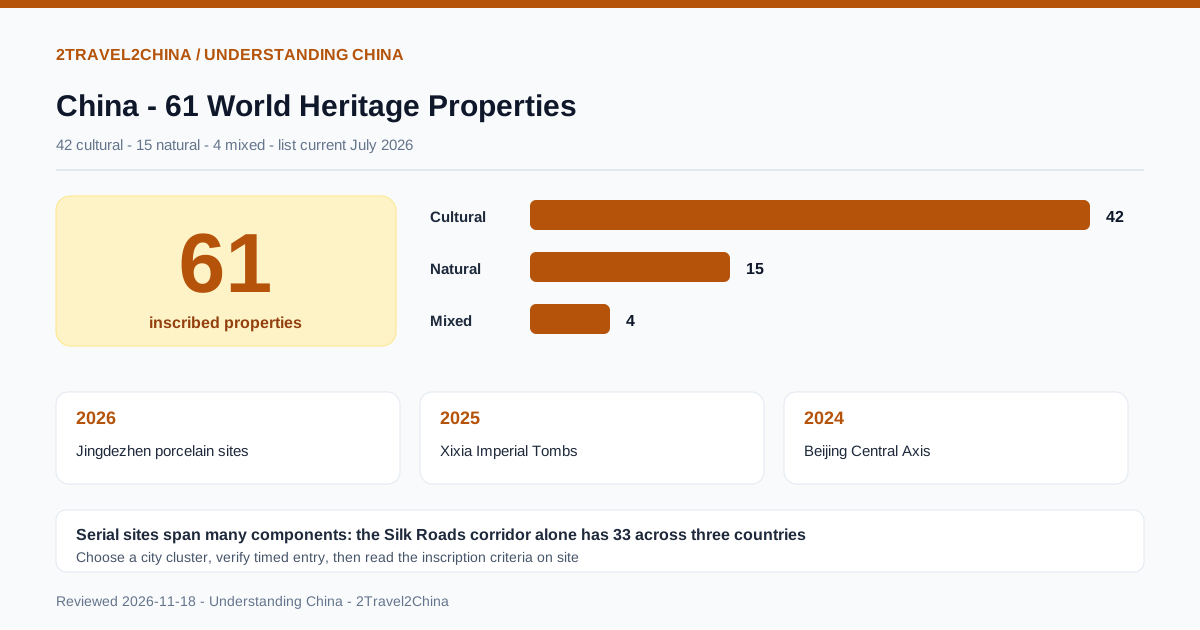
China has 61 properties on the UNESCO World Heritage List as of July 2026: 42 cultural, 15 natural and 4 mixed. The number is useful, but the list is a planning problem rather than a ranking. Some entries are single walled palaces with timed tickets; others are serial properties scattered across provinces or even three countries. This guide explains what inscription actually certifies, groups the sites by what a visitor can do with them, and gives a defensible shortlist for a first trip.
The short answer: 61 properties, four categories
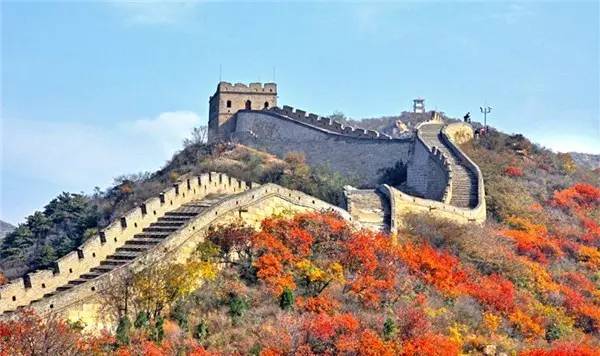
China's official UNESCO State Party page lists 61 properties inscribed on the World Heritage List. They divide into 42 cultural, 15 natural and 4 mixed sites. China ratified the World Heritage Convention on 12 December 1985 and received six inscriptions in 1987, including the Great Wall, the Imperial Palaces of the Ming and Qing Dynasties in Beijing, the Mogao Caves, the Mausoleum of the First Qin Emperor, the Peking Man Site at Zhoukoudian and Mount Taishan.
The most recent additions show how active the list remains: Beijing Central Axis was inscribed in 2024, the Xixia Imperial Tombs in 2025, and the Jingdezhen Handicraft Porcelain Industry Sites in 2026. UNESCO also records 60 properties on China's Tentative List, which is an inventory of possible future nominations, not a promise of inscription. Numbers change at each World Heritage Committee session, so the live State Party page is the source of truth.
A World Heritage label certifies Outstanding Universal Value under the Convention. It is not a star rating, a guarantee of good facilities, or a statement that a site is the oldest or largest of its kind.
What the label means for a traveller
UNESCO inscribes properties that meet at least one of ten criteria and pass tests of integrity, authenticity and protection. The criteria explain why a place matters: a site may bear a unique testimony to a cultural tradition, represent a significant stage in human history, or contain superlative natural phenomena. Reading the criterion attached to a property is the fastest way to know what to look for when you arrive.
The practical consequence is that different properties demand different visit styles. A palace inscribed for its urban plan is best understood on foot along an axis. A cave complex inscribed for rock art needs a guided interpretation and strict photography compliance. A natural site inscribed for geology or biodiversity needs time for weather and transport. The same label covers all three, and treating them alike is the most common itinerary mistake.
- Cultural properties: 42, including archaeological sites, architecture and cultural landscapes.
- Natural properties: 15, including karst, deserts, wetlands and mountain systems.
- Mixed properties: 4, namely Mount Taishan, Mount Huangshan, Mount Emei with Leshan Giant Buddha, and Mount Wuyi.
- Transnational properties: shared with other states, most notably the Silk Roads corridor.
The newest inscriptions, and why they matter
The 2026 inscription of the Jingdezhen Handicraft Porcelain Industry Sites brings the national total to 61. Jingdezhen represents a production landscape rather than a single monument: kiln sites, raw material sources, transport remains and workshops together document centuries of porcelain manufacture. For visitors, this is a useful reminder that some of the most revealing heritage sites in China are industrial and urban, not royal or religious.
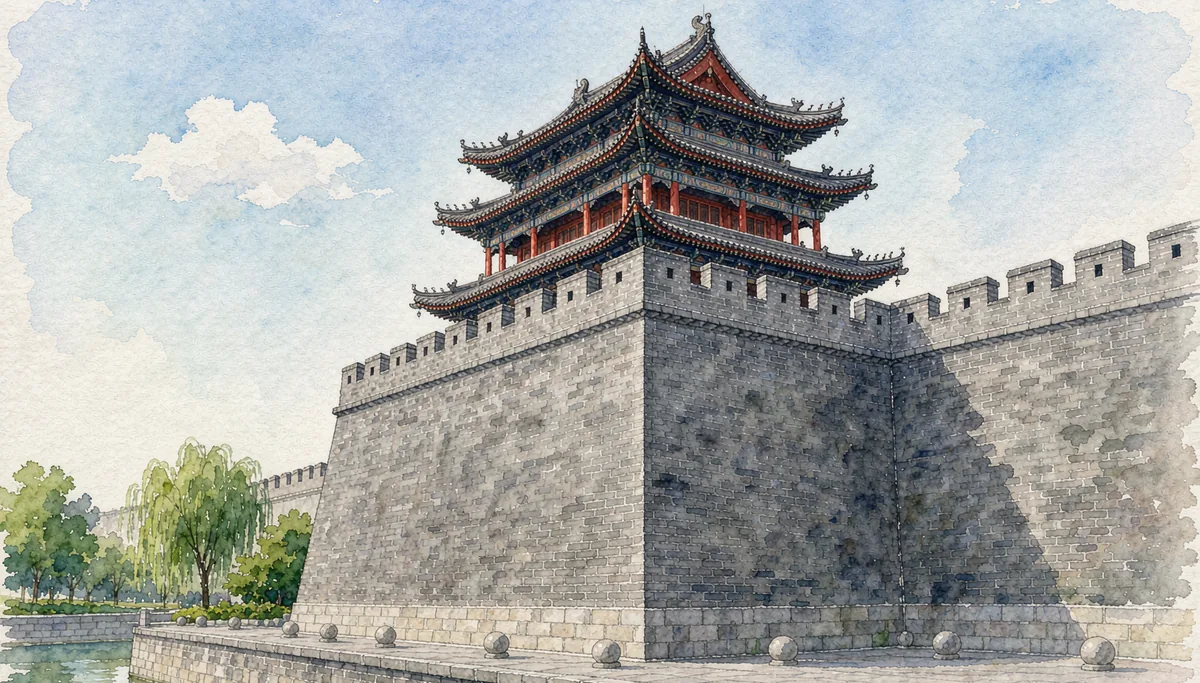
The 2025 Xixia Imperial Tombs and the 2024 Beijing Central Axis extend the same pattern. Xixia documents a dynasty often omitted from short histories of China, while the Central Axis was inscribed specifically for an urban planning tradition: UNESCO says its layout follows the ideal capital described in the Kaogongji and originated under the Yuan before being developed in the Ming and Qing. Both can be added to itineraries that already include Xi'an or Beijing.
| Property | Inscribed | Category | Easy to combine with |
|---|---|---|---|
| Jingdezhen Handicraft Porcelain Industry Sites | 2026 | Cultural | Hangzhou and the Yangtze delta |
| Xixia Imperial Tombs | 2025 | Cultural | Yinchuan and the western route |
| Beijing Central Axis | 2024 | Cultural | Forbidden City and Temple of Heaven |
| Badain Jaran Desert | 2024 | Natural | Inner Mongolia extended trips |
Six properties that reward a first trip
With 61 properties to choose from, a first itinerary should favour sites that combine strong interpretation with reachable transport. The six below are not the only worthwhile entries; they are the ones that most visitors can fit into a standard Beijing-Xi'an-Shanghai or Beijing-Xi'an-Chengdu route without a dedicated expedition. Each also anchors a clear historical or natural story that other sites can echo.
| Property | Year | Type | Why it earns a place |
|---|---|---|---|
| The Great Wall | 1987 | Cultural | Defensive systems across dynasties; several sections near Beijing |
| Imperial Palaces, Beijing and Shenyang | 1987, 2004 | Cultural | Ming and Qing court architecture at imperial scale |
| Mausoleum of the First Qin Emperor | 1987 | Cultural | Terracotta army and the first unified empire |
| Mogao Caves | 1987 | Cultural | Buddhist cave art on the desert route |
| Jiuzhaigou Valley | 1992 | Natural | High-altitude lakes, waterfalls and protected forest |
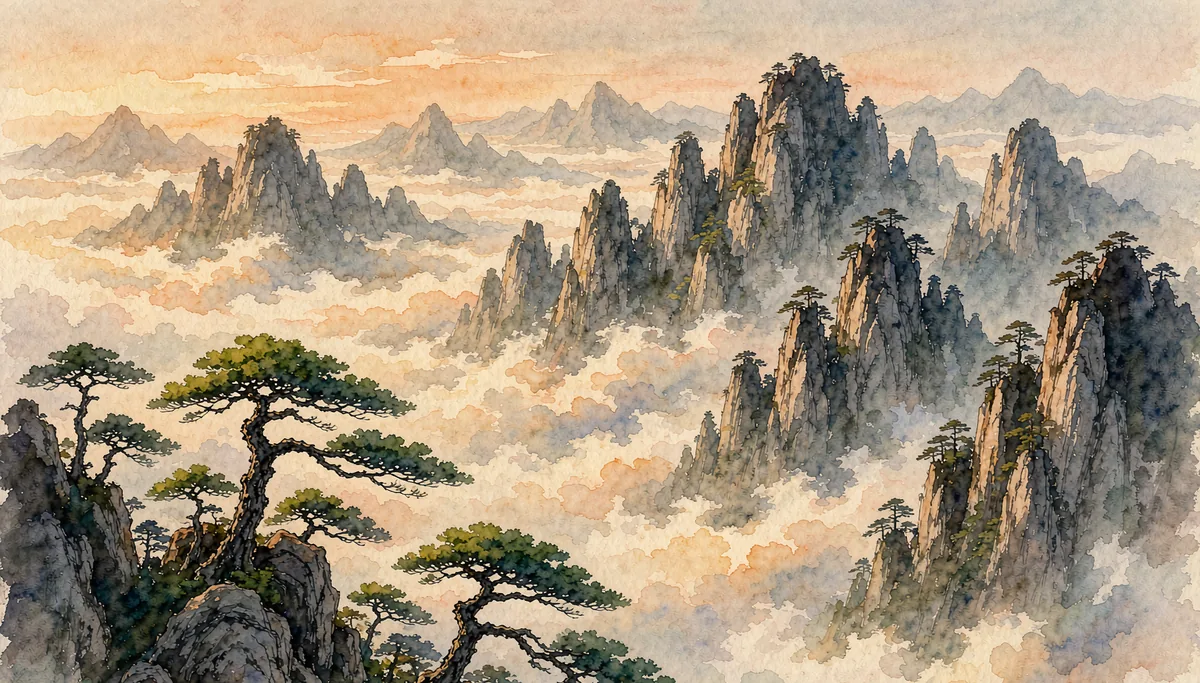
| Mount Huangshan | 1990 | Mixed | Granite landscape and a long artistic tradition |
Serial and transnational properties are a planning trap
A serial property is one inscription made up of many separate components. The Silk Roads Chang'an-Tianshan corridor has thirty-three components across China, Kazakhstan and Kyrgyzstan; the Grand Canal is another sprawling example. There is no single entrance, no shared ticket and no realistic way to visit every component in one trip. Treat the inscription as a thematic framework and choose one cluster.
This also changes how to read site signage. A component can be a palace foundation, a beacon tower, a cave temple or a tomb, and all are equally part of the property. If you arrive expecting a complete ancient city, an open field with a stone marker will feel like a failure. Check the component type on the UNESCO map before you allocate time, and pair the field visit with a museum that displays related objects.
Identify the property on the UNESCO list
Use the official State Party page or property record rather than a travel blog's ranking.
Check whether it is serial
Look at the component map; if it spans provinces or borders, choose one city cluster.
Read the inscription criteria
The criteria tell you whether to look for architecture, geology, ritual or trade infrastructure.
Verify access and booking
Cave sites and palace museums use timed reservations; open landscapes rarely do.
Crowds, closures and the day-of reality
Inscription raises visitor demand, and several Chinese properties now cap daily numbers or require timed entry. The Palace Museum sells timed tickets only through its own channels; Mogao Caves uses a reservation system and limits the number of caves shown; natural sites such as Jiuzhaigou rely on shuttle buses and daily caps. A World Heritage label should therefore trigger a booking check, not just a map pin.
Monday closures are common at museums, while natural sites usually open daily but close trails in bad weather or winter. Public holidays such as National Day turn popular properties into crowd-management exercises. Check the official site notice within forty-eight hours of the visit, and keep one non-heritage alternative in each city in case a timed ticket or trail permit is unavailable.
Some properties lie in regions outside the 240-hour transit visa-free scheme's eligible areas. Verify the current eligible province list before building a western China itinerary around a single heritage site.
A simple way to plan a heritage route
The most reliable route is built around cities with more than one property, then extended by high-speed rail. Beijing offers the Central Axis, the Forbidden City, the Great Wall, the Temple of Heaven and the Summer Palace within one metropolitan region. Xi'an offers the Qin mausoleum and Silk Roads components; Hangzhou and Suzhou add cultural landscapes and gardens. A route built this way survives ticket failures because each city has several options.
Keep the list honest about travel time. Jiuzhaigou, Huangshan and the western Silk Roads oases are not day trips from the eastern capitals; they require dedicated legs and seasonal planning. If your trip is under ten days, choose one natural property and no more than two clusters of cultural properties. Depth produces a better understanding of Outstanding Universal Value than a checklist of six scattered sites.
Frequently asked questions
How many UNESCO World Heritage sites does China have in 2026?
China has 61 properties on the World Heritage List as of July 2026: 42 cultural, 15 natural and 4 mixed. The latest addition, the Jingdezhen Handicraft Porcelain Industry Sites, was inscribed in July 2026. UNESCO also lists 60 properties on China's Tentative List.
What were the first Chinese sites on the World Heritage List?
Six properties were inscribed in 1987: the Great Wall, the Imperial Palaces of the Ming and Qing Dynasties in Beijing, the Mogao Caves, the Mausoleum of the First Qin Emperor, the Peking Man Site at Zhoukoudian and Mount Taishan. China had ratified the World Heritage Convention in December 1985.
Which of China's World Heritage sites are mixed cultural and natural?
There are four mixed properties: Mount Taishan, Mount Huangshan, Mount Emei including the Leshan Giant Buddha, and Mount Wuyi. Each is inscribed for both natural value and a long record of human engagement, including pilgrimage, scholarship, religious practice and landscape art.
Do I need to visit every component of a serial site?
No. The Silk Roads Chang'an-Tianshan corridor has 33 components across three countries, and the Grand Canal spans multiple provinces. UNESCO treats them as one property, but visitors normally choose one city cluster. Read the component map first so you know whether a marked site is a palace, a pass, a tomb or a beacon tower.
Does World Heritage status guarantee entry?
No. Many properties use timed tickets or daily caps. The Palace Museum sells timed tickets only through official channels, and the Mogao Caves require advance reservations. Monday closures and holiday crowding are common. Check the property's official visitor page shortly before your visit and keep a backup plan.