Chinese Dynasties at a Glance: A Traveller's Timeline of What You Can Still See
Chinese dynasty dates are not trivia. They tell you why a city has a Tang pagoda beside a Ming wall, why a museum label says Ming rather than Yuan, and why Beijing's central axis reads as a layer cake of three empires. This guide gives you a compact chronology and attaches each period to a place you can actually stand in. It uses UNESCO inscriptions and museum records for the dates that matter most, and flags the early traditional chronology as tradition rather than verified record.
The short answer: how the dynasties fit together
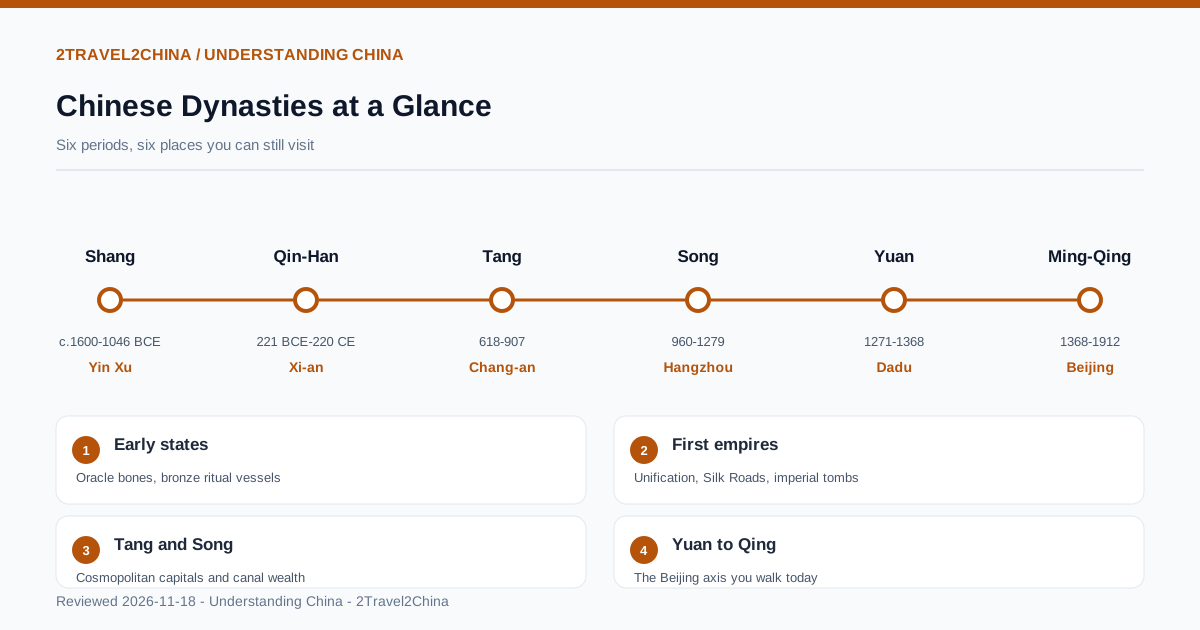
Chinese history is conventionally grouped into dynasties, ruling families that held the throne in sequence, with long unifications separated by periods of division. For a traveller, the useful cut is much simpler: early Bronze Age states before 221 BCE, the first empires of Qin and Han, the cosmopolitan Tang and commercially wealthy Song, and the last three imperial dynasties that built the historic cores of Beijing. You do not need every ruler; you need the order and the landmarks.
The dates below follow the standard chronology used by UNESCO when it describes inscribed properties. The Qin empire begins in 221 BCE with the first unification of China under a centralised state. The Yuan dynasty runs from 1271 to 1368, the Ming from 1368 to 1644, and the Qing from 1636 to 1912. Earlier dates are traditional estimates, so treat them as a framework rather than exact years.
A dynasty is a ruling house, not a country or a continuous state. China was divided into competing states for long stretches, and the capitals listed here moved. When a label says Tang, it dates an object or building style, not a modern border.
A dynasty table you can use in a museum
This table reduces the sequence to the periods that leave visible evidence on a standard first trip. Dates for the Yuan, Ming and Qing come from UNESCO's Beijing Central Axis description; Qin and Han dates match UNESCO's records for the first emperor's mausoleum and the Silk Roads nomination. Use it to work out what century a hall or tomb belongs to before you read the detailed label.
| Period | Approximate dates | Main capital or capitals | What you can see today |
|---|---|---|---|
| Shang | c. 1600-1046 BCE | Yin, near Anyang | Yin Xu oracle bones and royal tombs |
| Zhou | c. 1046-256 BCE | Chang'an and Luoyang | Bronze vessels, early city walls |
| Qin | 221-206 BCE | Xianyang | Terracotta Army near Xi'an |
| Han | 206 BCE-220 CE | Chang'an, later Luoyang | Han tombs, Silk Roads origins, Zhang Qian's tomb |
| Tang | 618-907 | Chang'an and Luoyang | Daming Palace, Giant Wild Goose Pagoda, Luoyang gate sites |
| Song | 960-1279 | Kaifeng, then Lin'an | Grand Canal towns, Hangzhou city layer |
| Yuan | 1271-1368 | Dadu, today's Beijing | Beijing Central Axis origins, city grid |
| Ming | 1368-1644 | Nanjing, then Beijing | Forbidden City, city walls, Nanjing gates |
| Qing | 1636-1912 | Beijing | Imperial gardens, Chengde Mountain Resort, Lhasa Potala |
Early dynasties: bronze, oracle bones and written record
The Shang and Zhou periods are the foundation layer of Chinese material culture, though their exact years are less certain. What makes them real for a visitor is the archaeology: Yin Xu, the late Shang capital near Anyang, was inscribed on the World Heritage List in 2006 and is famous for oracle-bone inscriptions, the earliest substantial corpus of Chinese writing. Bronze ritual vessels from these periods are the objects that museum galleries place at the start of the story.
The Zhou house presided over a long period of political fragmentation, and the states that emerged within it fought each other for centuries. This matters for interpretation. A bronze vessel from the Warring States period is not a national artefact in the modern sense; it belongs to one of several competing courts. When you read a label that gives a state name rather than a dynasty, you are usually seeing that fragmented late Zhou world.
- Yin Xu: late Shang capital, oracle-bone writing, royal burials.
- Zhou: long dynasty conventionally split into Western and Eastern phases.
- Warring States: 475-221 BCE, the period that ends with Qin unification.
- Practical reading: early galleries are arranged by object type and ritual function, not by named emperors.
Qin and Han: unification and the routes west
Qin is the short dynasty with the longest shadow. In 221 BCE the first emperor unified China and imposed a single system of writing, money, weights and measures, UNESCO records. Construction of the tomb began in 246 BCE; the mound still rises 51.3 metres, and its pits hold thousands of terracotta figures. The site was discovered in 1974, 35 kilometres northeast of Xi'an.
The Han dynasties that followed turned the unified state into a long-lived empire and opened the land routes that later generations called the Silk Road. UNESCO dates the formation of the Chang'an-Tianshan corridor to between the second century BCE and the first century CE, and directly links the route to Zhang Qian's diplomatic mission to the Western Regions. Tomb of Zhang Qian is one of the corridor's 33 component sites.
For itinerary building, this period is concentrated around Xi'an and Luoyang. Xi'an gives you the terracotta army, Han and Tang palace remains, and the pagodas that UNESCO lists as Silk Roads components. Luoyang supplies the eastern end of the corridor, with Han and Northern Wei city sites and the Sui-Tang Dingding Gate. Two days in each city are enough to see the physical transition from empire to trade network.
Do not assume a monument was built by the dynasty that made it famous. The Great Wall was begun before Qin, rebuilt for centuries, and most of the masonry visible near Beijing is Ming. Always check the build date on the site sign.
Tang and Song: cosmopolitan capitals and a commercial age
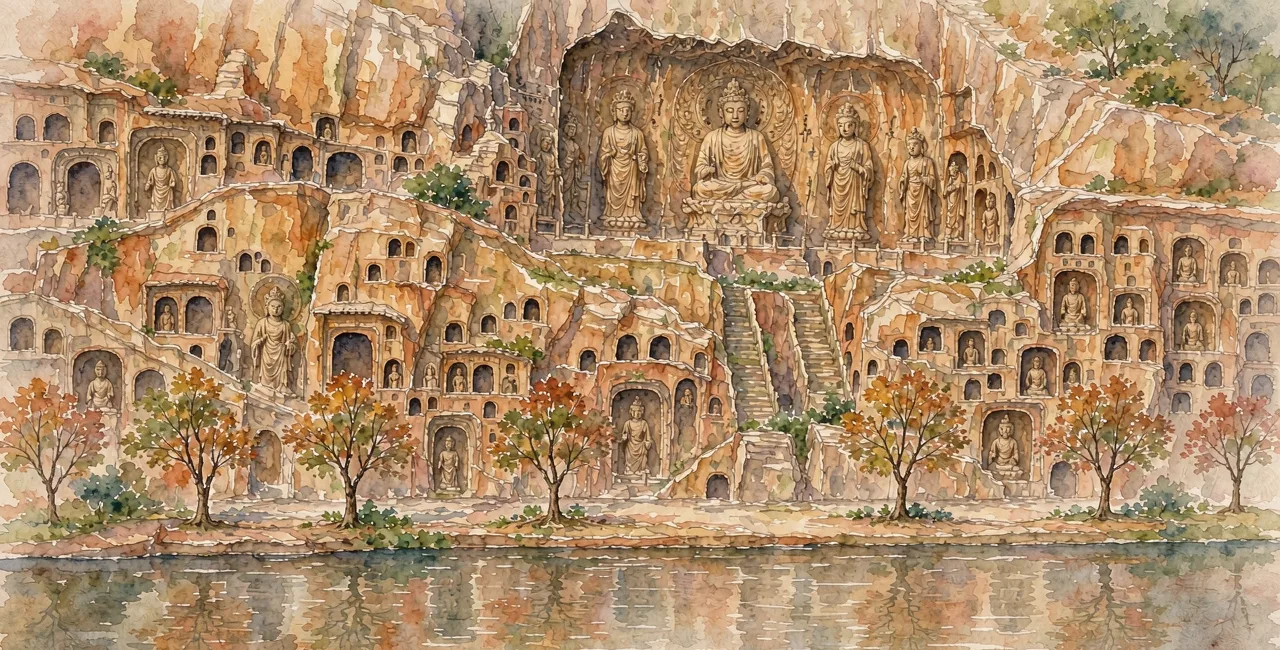
Tang Chang'an was among the largest, most cosmopolitan cities of its era, the eastern anchor of a trade system that moved goods, religions and techniques across Asia. Surviving components in Xi'an include the Daming Palace site, the Great Wild Goose Pagoda and the Small Wild Goose Pagoda. Luoyang's Dingding Gate and Hangu Pass form the corridor's eastern extension. These are often open-air archaeological sites rather than complete buildings, so a good site map matters more than a long visit.
The Song period shifts the centre of gravity east and south. Kaifeng served as the Northern Song capital, and after 1127 the court moved to Lin'an, today's Hangzhou. The Grand Canal, inscribed in 2014, is the infrastructure that explains the wealth of this era and the later rise of canal towns such as Suzhou. In Hangzhou, most Song layers are beneath the modern street grid, so the West Lake landscape and canal museums do more work than standing ruins.
| Dynasty | City to visit | Best single stop | Why it matters |
|---|---|---|---|
| Tang | Xi'an | Daming Palace National Heritage Park | Palace scale of the Silk Roads eastern capital |
| Tang | Luoyang | Dingding Gate site | Sui-Tang city gate on the UNESCO corridor |
| Song | Hangzhou | West Lake cultural landscape | Southern Song capital and garden aesthetics |
| Song | Suzhou | Classical gardens | Scholar-garden tradition, canal wealth |
Yuan, Ming and Qing: the capitals you can still walk
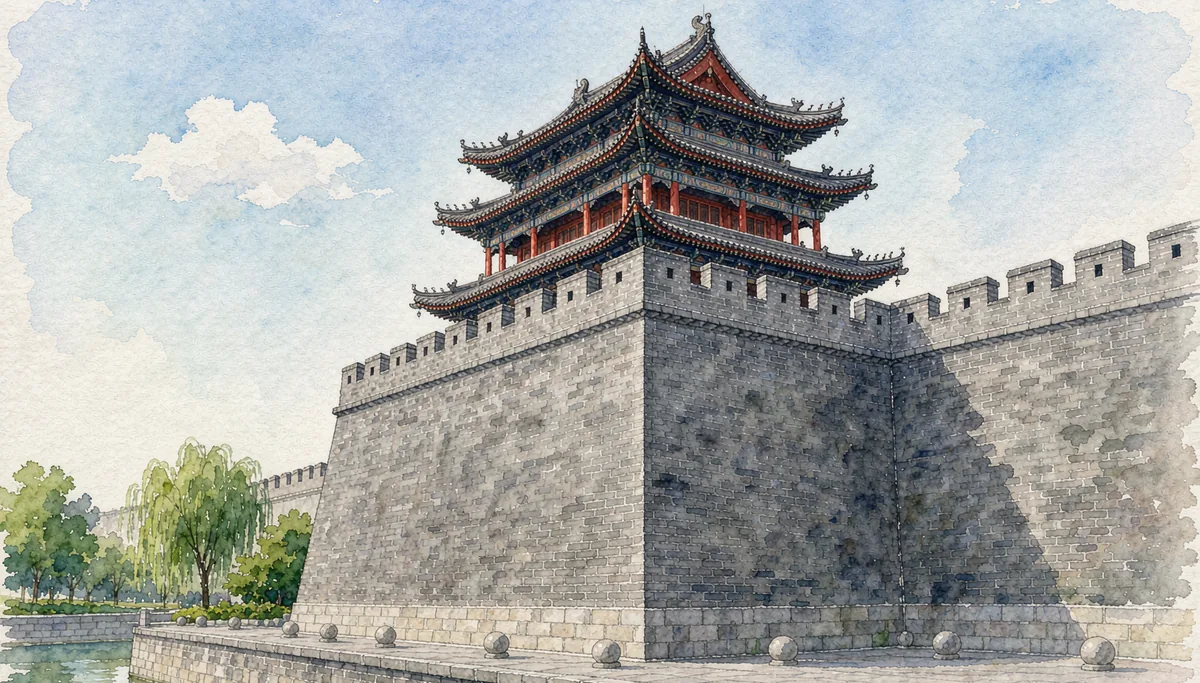
Beijing is the easiest city in China for reading dynasty layers because the sequence is written into one urban spine. UNESCO states that the Central Axis originated under the Yuan, which founded its capital Dadu in the northern part of the present axis, and that later structures were built under the Ming and improved under the Qing. The inscribed property contains fifteen heritage components in five categories, from imperial palaces and sacrificial buildings to city management facilities and road remains.
The Forbidden City is the Ming foundation of that spine. UNESCO records that it was constructed between 1406 and 1420 by the Ming emperor Zhu Di and witnessed the enthronement of fourteen Ming and ten Qing emperors. It was inscribed in 1987, with the Shenyang imperial palace added as an extension in 2004. The Temple of Heaven, the Imperial Ancestral Temple and the Altar of Land and Grain show how ritual buildings were placed symmetrically around the axis.
Qing additions reach beyond the capital. The Mountain Resort at Chengde and the Potala Palace in Lhasa both belong to this period and are inscribed in their own right. If your time is limited, one full day on the Beijing axis plus a half day at the Temple of Heaven gives a clearer sense of imperial planning than trying to cover every dynasty site in the country.
How to use the chronology in a gallery
Museum labels in China often lead with a dynasty and a reign title rather than a century. Once you know the order, those labels become a navigation tool instead of noise. A small routine is enough: locate the dynasty on the table, note whether the object comes from a unified empire or a divided period, then look at the material and function. The steps below work in a national museum, a provincial collection or a site museum.
Read the dynasty first
Find the period name on the label and place it on your six-point timeline before reading the object description.
Convert reign years to a century
A reign title such as Qianlong is a Qing emperor's era name; the label usually adds the calendar years.
Check whether the state was unified
Warring States objects belong to competing states, while Tang or Ming objects belong to a unified imperial court.
Match the object to a place
Link the period to a city on your itinerary so the gallery and the monuments reinforce each other.
Photograph the site map
Open-air ruins are hard to read without the plan; the map often labels dynastic phases more clearly than the plaques.
Common mistakes when reading Chinese chronology
Most confusion comes from treating dynasty names as simple labels for a whole country. The map changed size, capitals moved, and several dynasties overlapped with rival states. A second source of error is assuming that a modern city carries the same name as its ancient counterpart: Chang'an is Xi'an, Dadu is Beijing, and Lin'an is Hangzhou. Learning these equivalences removes most of the friction from signage and guidebooks.
- Do not read the Forbidden City as a single-dynasty building; it is Ming in conception and Qing in use.
- Do not treat the Great Wall as one construction campaign; successive dynasties built different walls.
- Do not assume the oldest-looking temple is the oldest building; timber structures were frequently rebuilt.
- Do not use Peking or Canton on current maps; official romanisation is Beijing and Guangzhou.
Frequently asked questions
How many dynasties are there in Chinese history?
There is no single agreed count because scholars differ on which short or regional regimes qualify as dynasties. A practical traveller's sequence has nine major periods from Shang through Qing, with long intervals of division in between. UNESCO records give firm dates for the later dynasties: Yuan 1271-1368, Ming 1368-1644 and Qing 1636-1912.
Which dynasty built the Forbidden City?
The Ming dynasty built it. UNESCO records that the palace complex was constructed between 1406 and 1420 under the Ming emperor Zhu Di, and that it later served ten Qing emperors alongside fourteen Ming ones. The Beijing palace was inscribed on the World Heritage List in 1987, and the Shenyang palace was added as an extension in 2004.
Which dynasty built the Great Wall?
No single dynasty built it. Defensive walls predate the Qin empire, and the first emperor connected and extended earlier sections after unification in 221 BCE. The Ming built most of the masonry walls visitors see near Beijing today. When choosing a section, check the construction date rather than assuming every stretch is Qin or Ming.
What is the difference between a dynasty and a reign title?
A dynasty is a ruling family, while a reign title is the era name used by one emperor within it. Qianlong, for example, is a Qing reign title, and museum labels often print both. Once you know which dynasty a reign belongs to, the label's century becomes easy to place on a timeline and much faster to read.
Where can I see more than one dynasty in a single day?
Beijing is the clearest option: the Central Axis holds Yuan-era planning, Ming palace buildings and Qing additions within one walkable corridor. Xi'an is the best alternative, with Qin and Han imperial sites, Tang palace remains and Silk Roads pagodas spread across the city and its outskirts. Allow a full day for either.