Terracotta Army Tickets and Visitor Guide 2026: Xi'an Warrior Pits
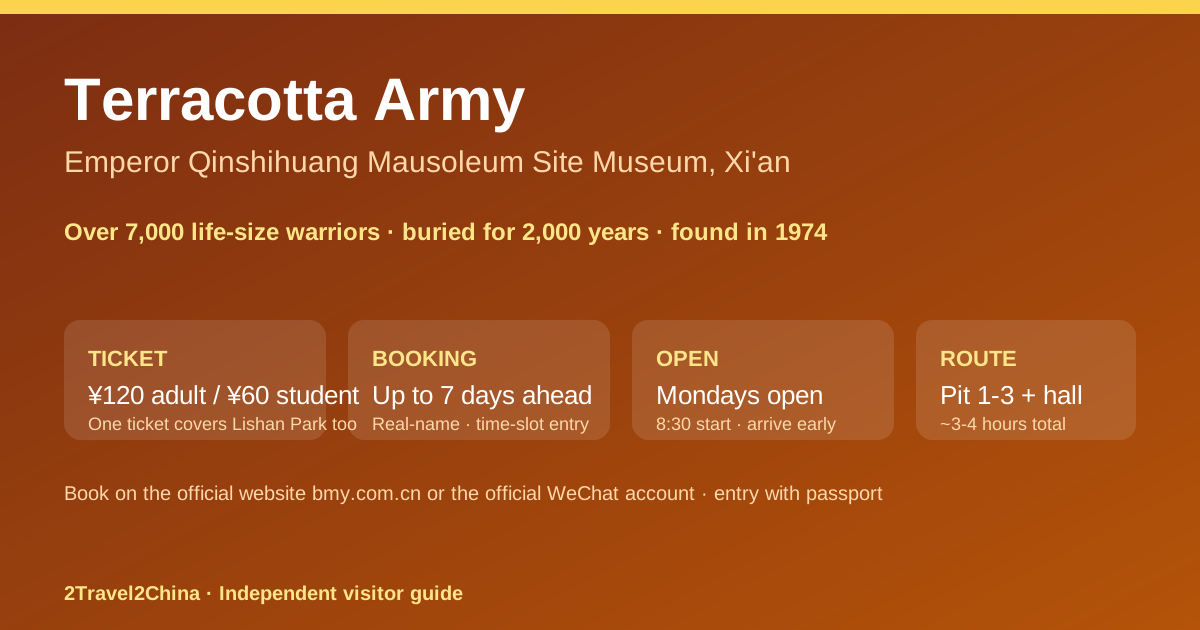
The Terracotta Army, formally the Emperor Qinshihuang Mausoleum Site Museum, is the reason most visitors put Xi'an on their China itinerary. More than 7,000 life-size warriors were buried here for over 2,000 years and found by farmers in 1974. In 2026 the site runs a single real-name ticket of RMB 120 that also covers the nearby Lishan Park, with online booking up to seven days ahead. This guide covers the 2026 price, the booking rule, the opening hours, the pit-by-pit route and how to get there from Xi'an.
How much is the Terracotta Army, and what does the ticket include?
The museum uses one ticket price for everyone, with no separate peak and off-peak tier. An adult ticket is RMB 120 and a student ticket is RMB 60, and the same ticket covers two sites: the Terracotta Army Museum itself and the Lishan Park, which is the mausoleum site a few kilometres away, with a free shuttle bus running between them. Children under 16, visitors over 65, military personnel and people with disabilities enter free, but even the free categories must reserve a time slot online, so no one arrives without a booking.
| Visitor type | Price | Covers |
|---|---|---|
| Adult | RMB 120 | Pits 1-3, hall and Lishan Park |
| Student (undergraduate) | RMB 60 | Pits 1-3, hall and Lishan Park |
| Under 16 / over 65 | Free | Reservation still required |
| Military / disabled | Free | Reservation still required |
How do you book, and can you use a passport?
Booking is fully online and real-name. You reserve on the official website bmy.com.cn or the museum's official WeChat accounts up to seven days before your visit, choose a date and time slot, and pay online. Foreign visitors use a passport as the identity document, just as domestic visitors use an ID card, and entry is by the original document at the gate. There is no need to buy from a tour agent to get in, although audio guides and group tours are available once inside if you want commentary.
Open the official channel
Use the museum website bmy.com.cn or its official WeChat accounts up to seven days ahead.
Enter passport details
Add each visitor with the exact name and passport number; mismatches block entry.
Choose date and time slot
Pick a visit date and the earliest slot, then pay before the quota sells out in holidays.
Bring the passport
Scan the original passport at the north gate; students also show a valid student ID.
When is it open, and why Mondays are fine here?
Unlike the Forbidden City in Beijing, the Terracotta Army is open on Mondays, which makes it a good fallback if a Monday lands in your itinerary. In peak season, from 16 March to 15 November, the site runs 08:30 to 17:00 with last entry at 17:00; in off-peak, from 16 November to 15 March, it closes at 16:30 with last entry at 16:30. The single most useful planning tip is to arrive before 08:00 and head straight to Pit 1, because tour groups flood in later and the viewing platforms get crowded.
Because the museum opens on Mondays, pair it with a Beijing-style Monday closure elsewhere only if your route crosses cities. Within Xi'an, Monday is a normal operating day here, so it is a smart day to visit while indoor sites that close on Monday are off the table.
What is the best route through the pits?
The museum is built around three excavation pits plus an exhibition hall, and the order you see them in matters. Pit 1 is the headline: a 14,260-square-metre hall holding more than 6,000 figures in battle formation, and it sets the tone for the whole visit. Pit 3 is small but shows the command post, Pit 2 holds the mixed chariots, cavalry and the famous kneeling archers, and the exhibition hall displays the bronze chariots and horses. The validated route is Pit 1, then Pit 3, then Pit 2, then the hall, which spreads the crowds and ends on the finest objects.
- Pit 1: the main army, over 6,000 figures, the defining view.
- Pit 3: the small command headquarters of the whole army.
- Pit 2: chariots, cavalry and the kneeling archer detail.
- Exhibition hall: the two bronze chariots and horses, the museum's crown jewels.
After the pits, take the free shuttle to Lishan Park, the actual tomb mound of the first emperor, which most visitors skip but which gives the wider context of why the army was buried here. Budget about two to three hours for the pits and hall and another 1.5 hours for Lishan, so a relaxed visit is three to four hours in total.
How do you get from Xi'an to the warriors?
The site is in Lintong district, about 40 kilometres east of central Xi'an. The most reliable public route is Metro Line 9 to Huaqing Pool station, then the local bus 613 to the museum gate, which avoids road traffic and surge pricing. Tourist shuttle buses also run from the city, and Didi or a taxi works if you share the cost, but the approach road congests on holidays. Leave the city early: with travel, queues and the visit itself, plan a half day rather than squeezing it between other sights.
Do not confuse the Terracotta Army with the smaller, separate Wax Museum or folklore parks near the gate that sell similar names. The real site is the Emperor Qinshihuang Mausoleum Site Museum, and its only official tickets are sold through bmy.com.cn and the museum's own WeChat accounts.
Why the Terracotta Army matters and how it was discovered
The army was discovered in March 1974 by local farmers digging a well during a drought, and the find is considered one of the greatest archaeological discoveries of the twentieth century because of its scale, its age and the individual realism of every figure. Over 7,000 life-size soldiers, horses and chariots were buried in battle formation around the tomb of Qin Shi Huang, China's first emperor, to guard him in the afterlife more than two thousand years ago.
What makes the figures remarkable is that no two faces are identical. Each warrior was built from mass-produced body parts and then finished by hand with individual features, hairstyles, armour and facial expressions, which is why the pits feel like a real army rather than a row of clones. The paint that originally covered them faded within minutes of exposure to air, so what visitors see today is the terracotta underneath, and conservation work continues to slow that loss.
The site is still being excavated, and the figures on display are only a fraction of what lies beneath; new pits and restored warriors are added as work proceeds, which is one reason to check the official notice before a visit. Understanding that the army is a single piece of a much larger tomb complex, centred on the unexcavated mound at Lishan Park, changes how you read the pits and makes the free shuttle there worth the extra hour.
- Discovered in 1974 by farmers digging a well near Xi'an.
- Over 7,000 figures buried for Qin Shi Huang, China's first emperor.
- Each face is individually modelled, not repeated.
- Still being excavated; Lishan Park holds the unopened tomb mound.
What should you know before you go?
The biggest mistake is underestimating the distance from Xi'an and the time inside, then rushing the pits. The second is arriving late and fighting the mid-morning groups for a place at the Pit 1 railing. Go early, book a week ahead in peak season, carry your passport, and treat the visit as a half-day commitment. If you want commentary, rent the official audio guide or join a group at the site rather than buying an inflated package that still delivers the same entry.
Frequently asked questions
How much is the Terracotta Army in 2026?
An adult ticket is RMB 120 and a student ticket is RMB 60. Children under 16, visitors over 65, military personnel and people with disabilities enter free but must still reserve a time slot online. One ticket covers both the Terracotta Army Museum and Lishan Park, with a free shuttle bus between them.
Do I need to book the Terracotta Army in advance?
Yes. The museum uses a real-name online system on the official website bmy.com.cn and its official WeChat accounts, with booking open up to seven days ahead and time-slot entry. Foreign visitors book with a passport and enter by scanning the original document at the gate. There is no reliable walk-up.
Is the Terracotta Army open on Mondays?
Yes, unlike the Forbidden City it opens every Monday, which makes it a good Monday plan within an Xi'an itinerary. Peak-season hours are 08:30 to 17:00 with last entry at 17:00; off-peak closes at 16:30. Arrive before 08:00 and go to Pit 1 first to beat the tour groups.
How long should I spend at the Terracotta Army?
Allow three to four hours in total: about two to three hours for Pits 1 to 3 and the exhibition hall, plus another 1.5 hours for Lishan Park if you take the free shuttle. A rushed under-two-hour visit covers Pit 1 but misses the detail in Pit 2 and the bronze chariots.
How do I get from Xi'an to the Terracotta Army?
Take Metro Line 9 to Huaqing Pool station, then local bus 613 to the museum gate, which avoids road traffic. Tourist shuttles and taxis also run the 40-kilometre trip east to Lintong, but the approach road congests on holidays, so leave the city early and treat it as a half-day outing.