Spring Festival Explained: Dates, Customs and Why China Celebrates It (2026)
Spring Festival is the Chinese New Year, the most important annual celebration in China and the largest human migration on earth. It begins on the first day of the first lunar month, which in 2026 falls on 17 February and opens the Year of the Horse. The public holiday runs 15 to 23 February, but the festival is really a fifteen-day season built around family reunion, food and visits. This guide explains the calendar, the customs and the official recognition behind it.
What Spring Festival is, in one paragraph
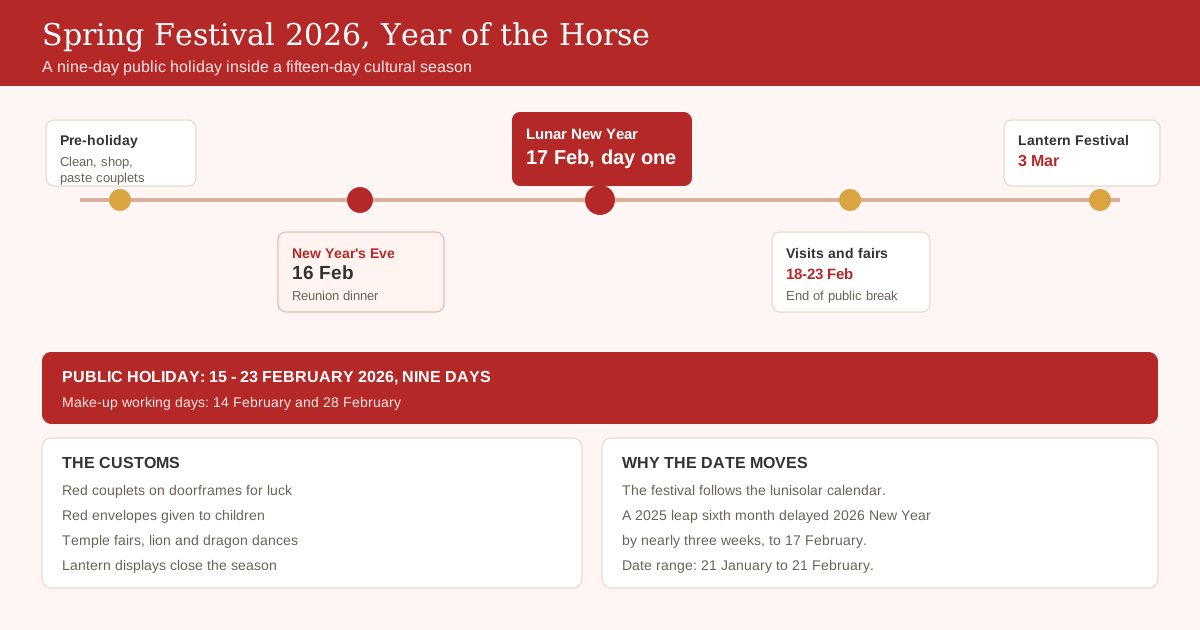
Spring Festival marks the start of a new year on the traditional Chinese lunisolar calendar. It is a family reunion festival centred on a New Year's Eve meal, red envelopes and visits to relatives, with customs that unfold over fifteen days. In 2026 the lunar year begins on 17 February, opening the Year of the Horse. It is a statutory holiday in China and joined UNESCO's Representative List of the Intangible Cultural Heritage of Humanity in December 2024.
| Fact | 2026 detail |
|---|---|
| First day of lunar year | 17 February 2026, Tuesday |
| Zodiac year | Bingwu, the Year of the Horse |
| Public holiday | 15 to 23 February, nine days |
| Make-up working days | 14 February and 28 February |
| New Year's Eve | 16 February 2026 |
| Lantern Festival | 3 March 2026 |
| UNESCO inscription | 4 December 2024, nineteenth session |
Why the date changes every year
Chinese New Year is tied to the lunar calendar rather than the Gregorian one, so its date moves between 21 January and 21 February. A standard lunar year is about eleven days shorter than a solar year. To keep the seasons aligned, an extra leap month is added in some years. That is why the festival landed on 29 January in 2025 but shifts to 17 February in 2026, nearly twenty days later.
The detail comes from the Purple Mountain Observatory, which computes the Chinese calendar. The 2025 lunar year contained a leap sixth month, making it 384 days long. That pushed the start of the following lunar year later, and it also moved the Lantern Festival to 3 March and the rural festival known as Dragon Heads Raising to 20 March. The observatory notes that this century the latest possible Spring Festival date, 19 February, occurs in 2015, 2034, 2053 and 2072.
Never quote a Chinese New Year date without its year. Unlike National Day on 1 October, the Spring Festival date can differ by almost a full month between neighbouring years.
The nine-day holiday inside a fifteen-day season
The State Council General Office set the 2026 Spring Festival holiday at 15 to 23 February, nine days, with 14 and 28 February designated as make-up working days. That is a long break by international standards, but it sits inside a wider season. The pre-holiday weeks are for shopping and travel, New Year's Eve is for the family meal, and the days after the break taper into the Lantern Festival on 3 March.
- Two weeks before: homes are cleaned, decorations are bought and travel is booked.
- 16 February, New Year's Eve: the reunion dinner, then late-night fireworks where permitted.
- 17 February, day one: the first visits within the immediate family.
- 18 to 19 February: visits to relatives and the main temple fair days.
- 20 to 23 February: friends, outings and the tail of the public break.
- 3 March: the Lantern Festival closes the season with lantern displays.
For the traveller, the practical point is that intensity falls unevenly across these days. The first three days are the quietest on city streets in one sense, because many shops close, but the busiest at temples and family attractions. After the third day, normal services resume gradually and the experience becomes closer to ordinary travel.
The reunion dinner and the food of the festival
The New Year's Eve reunion dinner is the central event of Spring Festival. Families travel home from across the country to eat together, and restaurant demand for private rooms spikes. Meituan platform data reported in 2026 showed New Year's Eve dinner reservations up 122 percent year on year, with overall Spring Festival dining bookings up 105 percent. The dishes are regional, but fish and dumplings appear widely because their names sound like abundance and wealth.
Visitors rarely join a private family meal, but the same foods are sold in restaurants and street stalls throughout the season. Dumplings dominate the north, while the south favours rice cakes and braised dishes. Ordering a festival meal in a restaurant is a realistic way to see the food culture without an invitation, though booking ahead matters during the first three days.
Red envelopes, couplets and the language of luck
The visible symbols of Spring Festival are mostly about luck and renewal. Red paper couplets are pasted around doorways, red envelopes containing money are given to children and sometimes to employees, and the colour red is treated as auspicious throughout the season. Firecrackers were traditionally used to drive away bad fortune, though many cities now restrict or ban them for safety and air quality reasons.
| Custom | What it means | Can a visitor see it |
|---|---|---|
| Red couplets on doors | Wishes for the coming year | Yes, on streets and hotel entrances |
| Red envelopes | Money given as a blessing | Rarely, unless you are a guest in a home |
| Temple fairs | Stalls, performances and food | Yes, in most major cities |
| Lion and dragon dances | Traditionally to ward off evil | Yes, at fairs and commercial venues |
| Firecrackers | Traditionally to scare away misfortune | Restricted in many cities |
Official recognition: UNESCO and the United Nations
On 4 December 2024, at the nineteenth session of the UNESCO Intergovernmental Committee for the Safeguarding of the Intangible Cultural Heritage in Asuncion, Paraguay, Spring Festival was inscribed on the Representative List of the Intangible Cultural Heritage of Humanity. The formal title refers to the social practices of the Chinese people in celebrating the traditional new year. With that inscription China had 44 elements on UNESCO's intangible heritage lists, the most of any country.
Recognition came a year earlier at the United Nations itself. In December 2023 the seventy-eighth session of the UN General Assembly designated the Lunar New Year as a UN holiday. Chinese official reporting also notes that nearly twenty countries treat the festival as a statutory holiday and that celebrations take place in about two hundred countries and regions. For visitors this means that the festival is increasingly marked in their own cities as well as in China.
How Spring Festival differs from an ordinary Chinese holiday
The scale is what separates Spring Festival from National Day or Labour Day. Domestic tourism data for the eight-day 2025 holiday recorded roughly 501 million trips and about 677 billion yuan in tourism revenue, according to figures compiled from Ministry of Culture and Tourism data. National Day in 2025 drew 888 million trips over eight days, but Spring Festival is distinct because it is tied to family return travel rather than leisure travel.
That difference changes what a visitor experiences. During National Day, attractions are full of tourists. During Spring Festival, the transport hubs are at their peak in the days before the holiday and the cities can feel unusually empty for the first two or three days, because residents are at home with family. Museums and restaurants may keep limited hours. By the fourth day the rhythm begins to return to normal.
The transport figure behind this is enormous. Official estimates put the 2025 Spring Festival migration at roughly 501 million domestic trips over eight days, with about 677 billion yuan in tourism spending. Rail, road and air capacity all run near their limits in the days before the holiday, so anyone moving between cities needs a confirmed ticket well in advance. Inside the cities, the paradox is that the festival is both the busiest travel period and the quietest street period of the year.
For a visitor the practical answer is to treat the calendar in two halves. Use the days before the break to arrive and settle, expect reduced services for the first three festival days, and plan the more demanding sightseeing for the second half of the holiday and the days after it. Temples, fairs and lantern displays are the exceptions that stay busy throughout, precisely because they are the public face of the celebration.
Frequently asked questions
What date is Chinese New Year in 2026?
Chinese New Year falls on 17 February 2026, the first day of the lunar year and the start of the Year of the Horse. The official public holiday runs 15 to 23 February, with 14 and 28 February as make-up working days. New Year's Eve is 16 February and the Lantern Festival is 3 March.
Why does Chinese New Year fall on a different date each year?
The festival follows the lunisolar calendar, not the Gregorian calendar. A lunar year is about eleven days shorter than a solar year, so a leap month is added in some years to keep them aligned. The result is that Chinese New Year can fall anywhere from 21 January to 21 February, moving nearly twenty days between 2025 and 2026.
Is Spring Festival a UNESCO heritage event?
Yes. On 4 December 2024 UNESCO inscribed Spring Festival, the social practices of celebrating the traditional new year, on its Representative List of the Intangible Cultural Heritage of Humanity. The decision was taken at the nineteenth committee session in Asuncion, Paraguay, and it was China's forty-fourth element on the lists.
How long does the Spring Festival holiday last?
The statutory break in 2026 is nine days, from 15 to 23 February, created by combining statutory days, weekends and two make-up working days. The wider cultural season lasts about fifteen days, from the pre-holiday preparations through New Year's Eve to the Lantern Festival on 3 March.
Is Spring Festival a good time for a tourist to visit China?
It depends on your goal. The first three days are culturally rich but many shops and restaurants close, and transport is at its busiest before the holiday. Later in the break and after it, services resume and crowds ease. Visitors interested in temple fairs and lantern displays will find the season rewarding with careful planning.