Chinese Festivals Calendar 2026: Dates, Customs and What Visitors Can See
China's festival year runs on two clocks. Three of the seven public holidays follow the lunar calendar and move by about a month each year; four sit on fixed Gregorian dates. In 2026 the sequence runs from New Year's Day on 1 January to National Day on 1 October, with Spring Festival on 17 February, Dragon Boat on 19 June and Mid-Autumn on 25 September. This guide gives every date, explains which ones move, and says what a visitor can actually see.
The short answer: which festival dates are fixed and which move
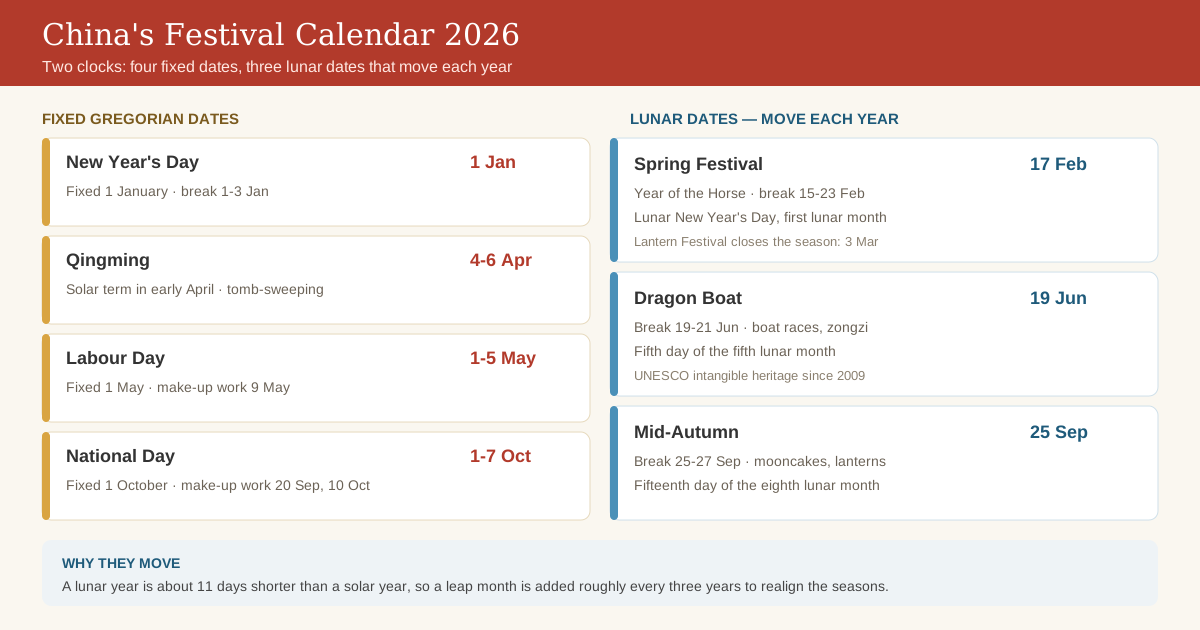
Four of China's seven public holidays sit on fixed Gregorian dates: New Year's Day on 1 January, Labour Day on 1 May, National Day on 1 October and Qingming in early April. Three follow the lunar calendar and shift each year: Spring Festival, Dragon Boat and Mid-Autumn. In 2026 those three fall on 17 February, 19 June and 25 September respectively. Knowing which clock a festival uses is the single most useful thing when planning a trip around it.
| Festival | Date basis | 2026 public break | What it marks |
|---|---|---|---|
| New Year's Day | Fixed, 1 January | 1-3 January | Start of the Gregorian year |
| Spring Festival | Lunar, first day of first month | 15-23 February | Chinese New Year, Year of the Horse |
| Qingming | Solar term, early April | 4-6 April | Tomb-sweeping and spring outings |
| Labour Day | Fixed, 1 May | 1-5 May | International Workers Day |
| Dragon Boat | Lunar, fifth day of fifth month | 19-21 June | Boat races and sticky rice parcels |
| Mid-Autumn | Lunar, fifteenth day of eighth month | 25-27 September | Moon viewing and family reunion |
| National Day | Fixed, 1 October | 1-7 October | Founding of the People's Republic |
Why the lunar festivals move, and why Spring Festival is late in 2026
China's traditional festivals follow a lunisolar calendar, so their Gregorian dates change every year. A lunar month is about 29.5 days and twelve of them make roughly 354 days, so an extra leap month is inserted about every three years to keep the calendar aligned with the seasons. Spring Festival can fall anywhere between 21 January and 21 February. Because 2025 contained a leap sixth month, the 2026 Chinese New Year arrived on 17 February, almost three weeks later.
The mechanism is computed by the Purple Mountain Observatory, the mainland authority responsible for the calendar. A lunar year with a leap month runs about 384 days instead of roughly 354. The extra month in 2025 pushed Spring Festival, the Lantern Festival and the later rural festivals into the second half of February and early March in 2026. If an old festival date and a new one disagree, check the leap-month rule before assuming either guide is wrong.
A festival date quoted without a year is meaningless for the three lunar holidays. Always attach the year: Mid-Autumn is 25 September in 2026 but is projected for 15 September in 2027.
Spring Festival 2026: a fifteen-day arc, not a single day
Spring Festival is a season rather than a single date. The official 2026 break runs 15 to 23 February, nine days, with 17 February as the first lunar day and the start of the Year of the Horse. The build-up begins with pre-New-Year market weeks, peaks at the reunion dinner on New Year's Eve, and continues through the visiting days that follow. The season ends with the Lantern Festival on 3 March 2026, about two weeks later.
- Pre-New-Year, roughly two weeks before: homes are cleaned and red couplets are pasted on doorframes.
- New Year's Eve on 16 February 2026: the reunion dinner is the year's central family meal.
- Days one to three, 17 to 19 February: visits to close family, red envelopes and temple fairs.
- Days four to seven, 20 to 23 February: visits to friends, outings and the end of the public break.
- Lantern Festival on 3 March 2026: lantern displays and sweet rice balls close the season.
For a visitor the useful distinction is between the public break and the wider festival season. Shops and restaurants that close do so mainly in the first two or three days, and many reopen before the break ends. Temple fairs and lantern displays are the most visible public events, and they are scheduled for particular dates rather than running throughout the holiday.
Dragon Boat and Mid-Autumn: the other two moving festivals
Dragon Boat falls on the fifth day of the fifth lunar month, which in 2026 is 19 June with a public break of 19 to 21 June. Mid-Autumn falls on the fifteenth day of the eighth lunar month, 25 September in 2026, with a break of 25 to 27 September. Both are family-centred festivals, but Dragon Boat is the one with a public spectacle, the boat races, that a visitor can reliably turn up and watch without a private invitation.
| Feature | Dragon Boat, 19 June 2026 | Mid-Autumn, 25 September 2026 |
|---|---|---|
| Lunar date | Fifth day, fifth month | Fifteenth day, eighth month |
| Signature food | Sticky rice parcels called zongzi | Filled round pastries called mooncakes |
| Public activity | Dragon boat races on rivers | Lantern parks and evening viewing |
| UNESCO status | Inscribed 2009, first Chinese festival listed | Not separately inscribed as a festival |
| Best place to see it | Southern river cities and Hong Kong, China | A city park with a lantern display |
Mid-Autumn has an extra planning wrinkle. When its lunar date falls close to 1 October, the two breaks merge into an eight-day period often called a super golden week, as happened in 2025. In 2026 they do not merge: Mid-Autumn ends on 27 September and National Day starts on 1 October, leaving a three-day gap. That gap is a useful window for a quieter visit to a major city or a heritage site.
Fixed-date holidays: Qingming, Labour Day and National Day
The fixed holidays anchor the year and are far easier to plan around. The State Council General Office sets the exact arrangement each November. For 2026 it published Qingming as 4 to 6 April, Labour Day as 1 to 5 May with a make-up working day on 9 May, and National Day as 1 to 7 October with make-up working days on 20 September and 10 October. These dates do not drift between years.
Qingming is the quietest of the three long breaks and is tied to tomb-sweeping, so demand concentrates into short outings rather than a national migration. Labour Day and National Day are the two classic sightseeing peaks. National Day is the single most crowded week in the Chinese travel calendar, and in 2026 it follows the Mid-Autumn break closely, which concentrates domestic demand into late September and early October.
What visitors can actually see, festival by festival
Not every festival is equally visible to a short-term visitor. The rule of thumb is that public spectacles such as lantern displays, boat races, temple fairs and parades are events you can plan around, while family rituals happen in private homes. The list below maps each festival to the public event most worth seeking out and the practical catch that comes with it.
- Spring Festival: temple fairs in Beijing and other big cities; expect dense crowds in the first three days.
- Lantern Festival: evening lantern displays in city parks; check each park for its own ticket and entry rules.
- Qingming: spring outings to parks and gardens; a good week for garden walks in the Yangtze delta.
- Dragon Boat: river races in southern cities; race times are set locally and are usually held in the morning.
- Mid-Autumn: evening lantern parks and moon-viewing spots; restaurants may require advance booking.
Planning around the 2027 festival dates
The State Council publishes the following year's holiday notice in early November, so 2027 dates were still provisional when this guide was written. Calendar publishers project Spring Festival on 6 February 2027, Dragon Boat on 7 June, Mid-Autumn on 15 September and National Day on 1 October. Treat these as planning estimates only and recheck the official notice before buying non-refundable tickets.
A practical approach is to fix the fixed-date holidays first, since National Day and Labour Day never move, and then slot the lunar festivals around them once the notice is out. If your dates are flexible, the three-day gap between Mid-Autumn and National Day in 2026, or the quieter days immediately after a break, will change your experience more than swapping one city for another will.
Frequently asked questions
Which Chinese festivals move each year?
Three of China's seven public holidays follow the lunar calendar: Spring Festival, Dragon Boat and Mid-Autumn. Their Gregorian dates shift by about a month each year because a lunar year is shorter than a solar year and periodically gains a leap month. The other four are fixed dates or tied to a solar term.
When is Spring Festival in 2026?
Chinese New Year falls on 17 February 2026, the first day of the Year of the Horse. The official public break runs 15 to 23 February, nine days, with 14 and 28 February as make-up working days. The wider festival season continues until the Lantern Festival on 3 March.
Is Mid-Autumn a public holiday in China?
Yes. Mid-Autumn is one of the seven statutory public holidays. In 2026 the break runs 25 to 27 September, three days, with no make-up working day. Because it is a lunar festival the date changes each year, and in some years it merges with the National Day holiday into a single eight-day break.
What is the difference between a statutory holiday and a festival?
A statutory holiday is a legally designated day off, set for the whole country by the annual State Council notice. A festival is the cultural event, which may or may not receive a day off. Several festivals, including the Lantern Festival and Qixi, are widely celebrated but have no statutory holiday attached.
When are the 2027 China holiday dates announced?
The State Council General Office normally publishes the next year's arrangement in early November. Calendar publishers project 2027 dates in advance, with Spring Festival on 6 February and Mid-Autumn on 15 September, but these are estimates until the official notice appears. Recheck before committing to non-refundable travel.