Travelling in China During Chinese New Year: What Actually Changes (2026)
Chinese New Year, or Spring Festival, is the country’s largest annual movement of people and its most important family holiday. For a visitor it is culturally remarkable and logistically demanding: transport is at its busiest, many independent businesses close, and prices rise. This guide sets out what changes, what stays open and how to build an itinerary that works with the holiday rather than against it.
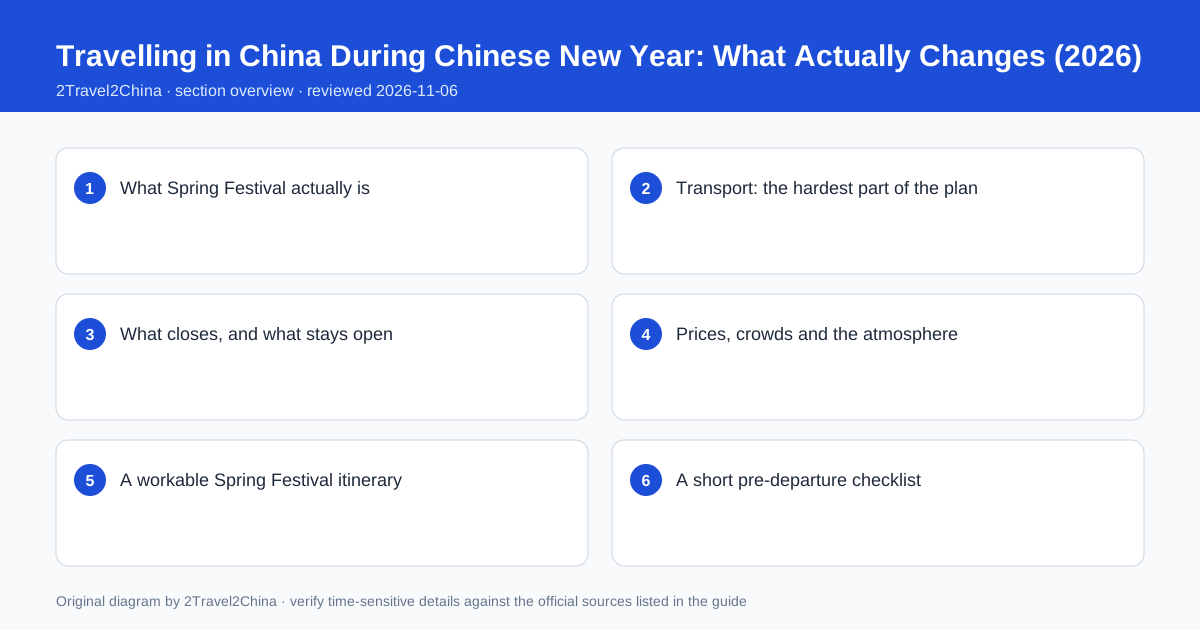
What Spring Festival actually is
Spring Festival follows the lunar calendar, so it falls in January or February rather than on a fixed date. The State Council publishes the official holiday arrangement each year, typically creating a block of consecutive days off with designated make-up working days. The travel period around it, often called chunyun, extends well beyond the official break as people travel to family homes and return afterwards. The holiday itself is centred on family, food and visiting rather than on sightseeing.
| Aspect | What happens | Visitor implication |
|---|---|---|
| Dates | Lunar calendar, Jan or Feb, set annually | Read the current year notice |
| Travel | Largest annual movement of people | Rail and flights sell out early |
| Business | Family-run shops and restaurants close | Plan meals and services in advance |
| Attractions | Major sites often open with special hours | Check venue-specific schedules |
| Atmosphere | Decorations, temple fairs, family gatherings | Culturally rich but not a normal week |
The single most important planning step is to read the current year’s official notice and mark the exact days off. The peak travel days fall on either side of the break, not only within it. A trip that lands three days before the holiday can be as affected by transport demand as one that lands in the middle of it.
Transport: the hardest part of the plan
Spring Festival travel is the most competitive ticket environment of the year. High-speed rail seats on popular routes sell out within minutes of release, and standby lists are long. Domestic flights are expensive and also fill. The practical response is to fix the route early, keep the number of intercity legs low, and be ready at the moment tickets are released with a 12306 account whose passenger details exactly match the passport.
Fix the dates from the official notice
Mark the break and the peak travel days before and after it.
Choose one or two bases
Avoid a multi-city loop during the busiest travel days.
Prepare 12306 in advance
Exact passport name, saved passenger details, verified payment method.
Be ready at ticket release
Consider earlier or later departures and connecting routes.
Leave a wide buffer before flying home
Return travel peaks sharply at the end of the break.
Do not plan an intercity move on the first or last day of the holiday, and do not schedule an international flight immediately after a domestic leg. If a route is sold out, an extra night in the same city is a better solution than a complicated connection. Inside a city, the metro keeps running and is often the fastest way across town while roads are congested.
What closes, and what stays open
The closure pattern is uneven. Independent restaurants, small shops, markets and many family-run businesses close for at least part of the holiday, sometimes for a week or longer. Large hotels, international chains, major shopping centres, supermarkets, metro systems, airports and railway stations continue operating, often with adjusted hours. Major museums and heritage sites usually publish a specific holiday schedule, which may include extended opening, timed entry and a daily visitor cap.
| Usually open | Often closed or reduced | Check individually |
|---|---|---|
| International hotels | Family-run restaurants | Museums and heritage sites |
| Major shopping centres | Small neighbourhood shops | Temple fairs and events |
| Metro, rail and airports | Independent cafés | Bank branches |
| Supermarket chains | Some local markets | Pharmacies and clinics |
| Large chain restaurants | Small tour operators | Attraction opening hours |
For meals, the reliable options are hotel restaurants, restaurants inside large shopping centres and international chains. Book a table where possible, because the open restaurants are busy. For a visitor who wants a specific small restaurant or a particular neighbourhood experience, the honest answer is that the week around the holiday is the wrong time to build an itinerary around them.
Prices, crowds and the atmosphere
Accommodation and airfares rise with demand, and cancellation terms tighten. Attraction tickets themselves usually do not move much, but timed-entry slots become scarce. Crowds concentrate at temples, festival events, lantern displays and the most famous heritage sites, often in the evening. At the same time, city centres can be unusually quiet on the first days of the holiday itself, because residents are with family rather than out shopping.
- Expect higher hotel rates and tighter cancellation windows
- Book timed-entry slots for major sites as soon as they open
- Use hotel and shopping-centre restaurants for reliable meals
- Plan evening events around crowd peaks and transport back to the hotel
- Keep a flexible afternoon for a site that is unexpectedly closed
The atmosphere is the reason to come. Decorations, lantern displays, temple fairs and regional New Year food are genuinely distinctive, and a city can feel transformed. That is a real trade, not a compromise: accept higher prices and fewer independent restaurants in exchange for an experience that is unavailable on any other week of the year. What does not work is pretending it is a normal sightseeing week.
A workable Spring Festival itinerary
A good holiday-week plan has one base, one fixed activity per day and a lot of slack. Choose a city with strong internal transport and a hotel whose restaurant you can use. Book one timed-entry site in the morning, use a park, temple fair or neighbourhood walk in the afternoon, and treat the evening as optional. Keep the first and last days free of intercity travel.
- One base city, not a multi-city loop
- A hotel with an operating restaurant and a metro station nearby
- One booked morning activity per day, with a flexible afternoon
- No intercity transfer on the first or last day of the break
- A confirmed plan for the return to the airport with extra time
Beijing, Shanghai, Xi’an and Chengdu all have enough large-scale infrastructure to make this work, though each has its own holiday schedule. A smaller town or a rural homestay is a much riskier choice for a first trip during this week, because the closure pattern is harder to predict and there are fewer fallback options. Save the small-town route for a quieter month.
A short pre-departure checklist
Everything that matters can be checked before the flight. Confirm the holiday notice, the venue schedules, the restaurant options, the rail or flight bookings and the airport transfer. Save all confirmations offline, because a crowded entrance with poor connectivity is a bad place to discover that a timed-entry QR code has not loaded.
Read the official notice
Fix the exact break dates and the peak travel days around them.
Confirm venue schedules
Museums and heritage sites publish holiday-specific hours and caps.
Book meals and entries
Reserve tables where possible and secure timed-entry slots.
Save everything offline
Tickets, slot codes, hotel address in Chinese and the return transfer.
Pack for the season
Spring Festival is winter in most of China, often damp in the east.
The last item is easy to forget because the holiday is associated with lanterns and red decorations rather than cold. In Beijing it is winter; in Shanghai it is damp and chilly; only the far south is mild. Pack for the region, keep the itinerary slower than usual, and let the festival set the pace.
Spring Festival dates, official holiday arrangements, venue schedules and transport timetables are published annually and change. Verify the current year State Council notice and each venue or operator’s holiday announcement before booking non-refundable travel.
Frequently asked questions
When is Chinese New Year in China?
It follows the lunar calendar and falls in January or February. The exact holiday arrangement is published annually by the State Council, so read the current year notice rather than assuming a fixed date.
Is everything closed during Spring Festival?
No. Hotels, major shopping centres, supermarkets, metro systems, airports and railways keep operating. Family-run restaurants, small shops and local markets often close for part or all of the holiday.
How hard is it to get train tickets during Spring Festival?
It is the most competitive ticket period of the year. Popular high-speed rail routes can sell out within minutes of release. Fix the route early, keep intercity legs few, and be ready at ticket release.
Is Chinese New Year a good time for a first trip to China?
It is culturally remarkable but logistically demanding. One base city, booked timed entries, reliable hotel restaurants and a slower pace make it work; a fast multi-city route usually does not.
Are attractions more expensive during the holiday?
Ticket prices usually change little. The real constraints are scarce timed-entry slots, daily visitor caps and higher hotel and airfare costs.