China Weather by Month: What to Pack and When to Go (2026)
China is too large for a single monthly weather answer. A January that is pleasant on Hainan is severe in Harbin, and a July that is humid in Shanghai is mild on the Yunnan plateau. This guide reads the calendar by travel region rather than by national average, and translates each season into what to pack and what can disrupt an itinerary.
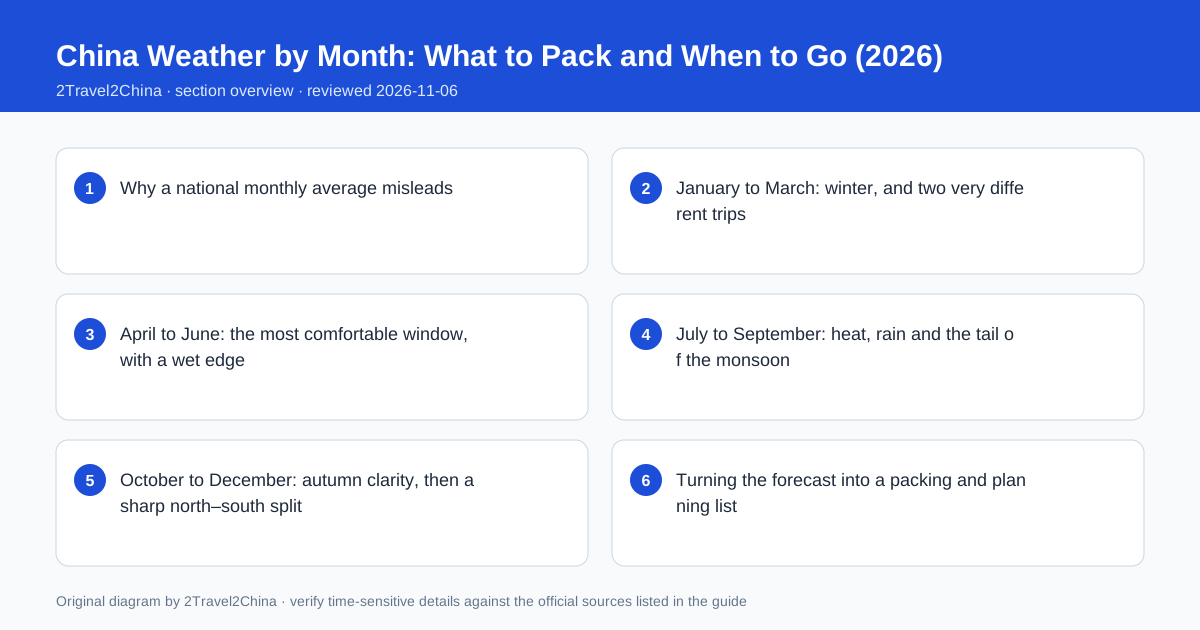
Why a national monthly average misleads
The country spans tropical islands, a humid eastern seaboard, a dry continental north, high plateaus and subarctic north-east. Latitude, altitude and the monsoon all matter more than the month alone. Beijing in April can be dry, windy and warm by day; Shanghai in the same week can be damp and cool; Harbin can still be near freezing. A single "April in China" line hides the differences that actually determine what you pack and how you plan a day.
| Region | Typical cities | Climate character |
|---|---|---|
| North China | Beijing, Tianjin, Pingyao | Dry continental, cold winter, hot summer |
| Yangtze Delta | Shanghai, Hangzhou, Suzhou, Huangshan | Humid subtropical, wet early summer, mild winter |
| South | Guangzhou, Guilin, Zhangjiajie, Xiamen | Subtropical to tropical, long humid summer |
| South-west plateau | Chengdu, Lijiang, Kunming | Milder summers, altitude effects, basin cloud in Chengdu |
| Far north-east | Harbin | Long severe winter, short intense summer |
Altitude changes the answer again within a single trip. Lijiang and the Yunnan plateau can be cool in the evening even when a lowland city is warm, and Huangshan’s summit is substantially colder and wetter than the town at its foot. For a mountain day, check the summit forecast rather than the city forecast. The China Meteorological Administration publishes regional forecasts and warnings that are more useful than a generic travel climate chart.
January to March: winter, and two very different trips
Winter splits the country. In the north and north-east it is genuinely cold, with dry air, freezing nights and the possibility of snow; Harbin builds an entire visitor season around ice and snow. In the Yangtze Delta it is damp and chilly rather than severely cold, and humidity makes a modest temperature feel sharper. In the far south it is mild, and Hainan is a winter escape. Spring arrives in the south well before it reaches Beijing.
- North and north-east: insulated layer, windproof outer, warm footwear, lip balm
- Yangtze Delta: a damp-proof layer and shoes that tolerate wet pavements
- South: a light jacket for evenings rather than winter clothing
- Harbin ice season: insulated boots, thermal layers, hand and foot warmers, a phone battery kept warm
- Across all regions: expect shorter daylight and earlier site closing times
Late January or February also brings Spring Festival in most years, which is a much bigger logistical variable than the weather. Transport volumes, closures and pricing move sharply around it, and many independent restaurants shut for the holiday. A winter trip that avoids the festival window is straightforward; one that overlaps it needs the holiday plan as much as the cold-weather plan.
April to June: the most comfortable window, with a wet edge
For much of the classic Beijing–Xi’an–Shanghai route, April to May is the most comfortable period: warm days, cooler evenings and lower humidity than summer. Gardens, the Great Wall and city walking are at their best. By June the Yangtze Delta moves into its rainy season, with persistent drizzle and high humidity, while the north is turning hot and dry. The south is already warm and wet.
| Month | North | Yangtze Delta and south |
|---|---|---|
| April | Mild, dry, occasional wind and dust | Mild and increasingly humid |
| May | Warm, generally dry, good for walking | Warm, early rains, lush gardens |
| June | Hot and dry beginning | Rainy season, humid, frequent showers |
| Late June | Summer heat establishing | Sustained rain can affect river and mountain plans |
Pack for rain if the itinerary crosses June in the Yangtze Delta or the south: a compact waterproof shell, quick-drying trousers and shoes that are not ruined by a wet day. For a mountain or river itinerary — Huangshan, Guilin, Zhangjiajie — build a spare day, because heavy rain can close a cableway or change a boat schedule. A weather-disrupted day is much easier to absorb when the following day is not a reserved intercity train.
July to September: heat, rain and the tail of the monsoon
Summer is hot and humid across much of eastern and southern China, with the north also hot and with heavy rainfall events that can affect rail and flights. Chengdu’s basin holds cloud and humidity; the Yunnan plateau is comparatively mild. This is also the peak domestic school-holiday period, so attraction queues and family travel rise independently of the weather. September is often the turning point: heat eases in the north, humidity drops, and the autumn travel season begins.
- Light, breathable clothing and a hat for strong sun
- A compact umbrella or shell that works for both sun and sudden rain
- Electrolytes and a refillable bottle; dehydration is the common summer problem
- Indoor or early-morning planning for the hottest part of the day
- A flexible afternoon on days with a thunderstorm warning
Plan the day around heat rather than against it. An early start at an outdoor site, a long indoor museum or a rest in the early afternoon, and a return outdoors in the evening is more comfortable than a continuous 10:00–16:00 walking schedule. Check official weather warnings during a period of heavy rain, because a warning can change transport availability — and leave a buffer before an international departure in the autumn storm season.
October to December: autumn clarity, then a sharp north–south split
October is often the best all-round month for a classic multi-city route: clear dry air in the north, comfortable temperatures in the Yangtze Delta and pleasant conditions in the south. It also contains the National Day Golden Week, so the first week is a crowd and pricing event rather than a weather one. November brings autumn colour in the north and cooler, damper conditions in the east. December sets up the winter split again: cold and dry in the north, mild in the far south, and the start of Harbin’s ice season.
| Month | What works well | What to watch |
|---|---|---|
| October | Clear northern autumn, comfortable cities | National Day Golden Week crowds |
| November | Autumn foliage, fewer crowds after the holiday | Shorter days, cooler evenings |
| December | Harbin winter season, mild Hainan | Northern cold, early darkness |
| Any autumn month | Multi-city rail itineraries | Check the current holiday notice |
For a first trip, the April–May and late September–October windows suit the widest range of regions, with the important caveat that early October is dominated by the holiday. If those windows are unavailable, choose the itinerary around the climate: a winter trip to Harbin and the north, a shoulder-season trip to the Yangtze Delta, or a mild-winter trip to the far south rather than forcing a single route into the wrong season.
Turning the forecast into a packing and planning list
The useful output of a climate read is not a temperature table but three decisions: what to pack, which days need a spare, and where the itinerary should be flexible. Pack layers rather than one heavy garment, because a plateau evening and a lowland afternoon on the same trip can differ by ten degrees. Give mountain and river days a spare. Keep the first day after an international arrival light so a storm-driven delay does not cascade.
List the regions on the route
North, Yangtze Delta, south, plateau or far north-east.
Check summit and plateau forecasts
Do not use the nearest lowland city forecast for a mountain day.
Pack layers and a waterproof shell
Covers altitude, humidity and sudden rain in one small bag.
Give outdoor days a spare
Cableways, boats and long walks are the weather-sensitive legs.
Check official warnings during the trip
Change the order of the day rather than cancelling it.
Re-check the forecast three days out rather than two weeks out, and use the China Meteorological Administration or a local official source for warnings. Long-range charts are useful for choosing a season; they are not useful for deciding whether to visit a mountain on Thursday. The month sets the plan, the short-range forecast sets the order of the days.
Seasonal patterns are stable but specific forecasts, warnings and transport impacts change daily. Check the China Meteorological Administration and local operator announcements during the trip, and read the current year holiday notice before fixing dates.
Frequently asked questions
What is the best month to visit China?
For a classic Beijing–Xi’an–Shanghai route, April to May and late September to October are the most comfortable. Avoid treating early October as a quiet week, because it contains the National Day Golden Week.
Is July a bad time to visit China?
It is hot, humid and busy with domestic school holidays, but manageable with early starts, indoor afternoons and a flexible schedule. Heavy rain can affect mountain, river and flight plans, so keep a spare day.
How cold is Harbin in winter?
Severely cold, with freezing nights and a long winter season. The ice and snow attractions exist because of it. Insulated boots, thermal layers and protection for a phone battery are more useful than a fashionable coat.
Do I need different clothes for different Chinese cities on one trip?
Often yes. A plateau evening can be much cooler than a lowland afternoon, and the north is dry while the Yangtze Delta is damp. Layers plus a compact waterproof shell cover most combinations.
Where should I check weather warnings during the trip?
Use the China Meteorological Administration or a local official source, and check summit forecasts separately for mountain days. Long-range charts help choose a season; short-range warnings set the order of the days.