Peak vs Low Season in China: How Prices and Crowds Actually Move (2026)
Peak season in China does not raise every cost equally. Accommodation moves the most, rail fares and attraction tickets move very little, and the largest low-season gain is often availability rather than price. Understanding which line items are fixed and which are flexible makes shoulder-season planning much more concrete than a vague promise of cheaper travel.
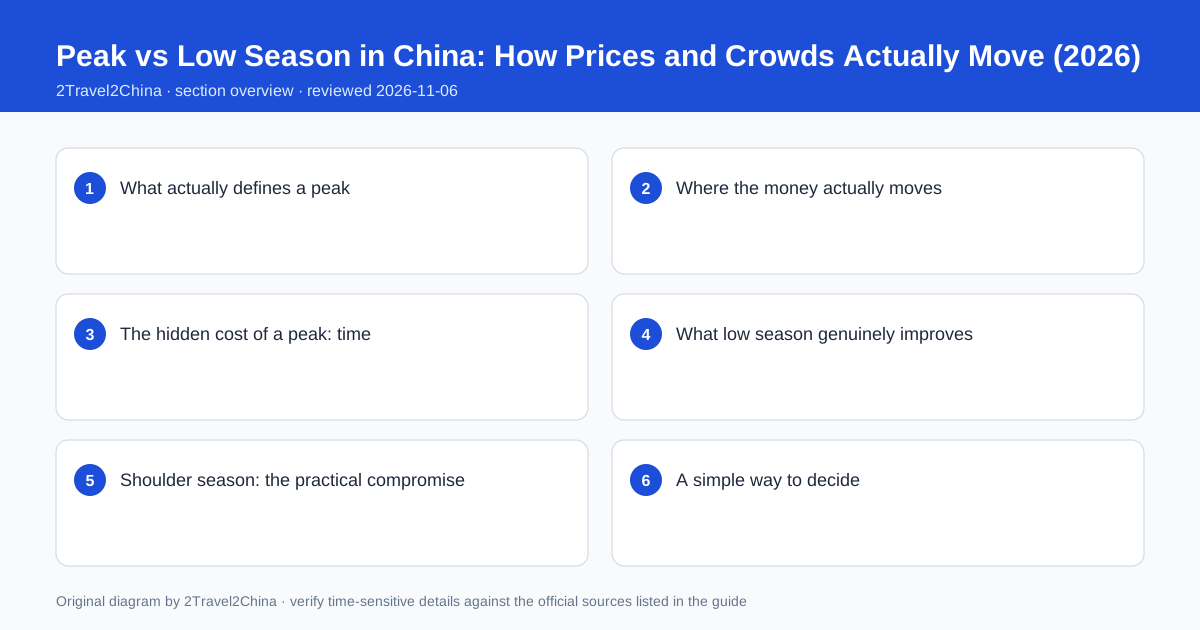
What actually defines a peak
A peak is created by a concentration of people with the same days off, not by weather alone. The National Day Golden Week, Spring Festival, Labour Day and the summer school holidays are the main drivers. The 2026 State Council notice set the National Day break at 1–7 October with two make-up working days, which is a good example of how a calendar arrangement produces a sharp, short spike. Weather creates a second, softer peak: October’s clear autumn and April’s mild spring bring visitors even outside the holiday weeks.
| Period | Driver | Price sensitivity |
|---|---|---|
| National Day Golden Week | National holiday | Highest for accommodation |
| Spring Festival | Family travel and closures | High transport demand, uneven availability |
| Labour Day | National holiday | Moderate to high |
| Summer school holidays | Family travel | Moderate, sustained |
| April–May, late September | Good weather | Mild increase in popular cities |
| December–February outside festivals | Cold in the north | Lowest in most regions |
A useful distinction is between a short intense peak and a long mild one. Golden Week compresses demand into seven days, so a hotel rate can double while a train fare stays almost unchanged. Summer spreads demand over six weeks, producing steady rather than extreme pressure. The planning response differs: a short peak needs advance booking and fewer bases, while a long mild peak mostly needs early starts and timed-entry slots.
Where the money actually moves
Accommodation is the flexible line item. Hotels in destination cities adjust rates dynamically, tighten cancellation windows and sell out their cheaper room categories first. International flights into China also move with demand. By contrast, high-speed rail fares are largely regulated and distance-based, and major attraction tickets are usually fixed or capped, so those lines barely change. The total cost of a peak-week trip therefore rises mainly through hotels and flights, not through the things you do each day.
| Line item | Peak movement | Planning response |
|---|---|---|
| Hotel room | Largest swing | Book early, prioritise a refundable rate |
| International airfare | Significant | Fix the flight before the holiday notice shifts demand |
| High-speed rail | Small; availability is the problem | Be ready at ticket release |
| Attraction tickets | Usually fixed | Timed-entry slots matter more than price |
| Local transport and food | Minimal | Budget changes little day to day |
| Guided tours and drivers | Moderate to high | Confirm the rate and cancellation terms |
This is why a "cheaper low-season trip" is often only modestly cheaper in total. If accommodation is a third of the budget and it falls by a quarter, the whole trip falls by less than a tenth. What improves much more is availability: the ability to choose a hotel near a metro line, to get a train at a convenient hour, and to enter a museum without a timed slot weeks in advance.
What low season genuinely improves
Outside the holiday weeks and the summer school break, the same sites are quieter, hotel choice is wider, cancellation terms are more generous, and rail seats at convenient times are easier to find. In the north this comes with cold and short daylight; in the Yangtze Delta with damp chill; in the far south it can be the most comfortable time of the year. The gain is therefore not uniform across the country.
| Region | Low-season advantage | Trade-off |
|---|---|---|
| North China | Quiet heritage sites, clear winter light | Cold, short days |
| Yangtze Delta | Fewer crowds in gardens and museums | Damp, chilly, grey skies |
| South and Hainan | Mild weather while the north is cold | Some peak pricing around New Year |
| Far north-east | Ice season is the attraction | Severe cold, limited daylight |
| South-west plateau | Clear dry days in winter | Cold evenings at altitude |
Pick the low-season region deliberately. A December trip to Hainan or the Yunnan plateau is a genuine weather win with fewer crowds; a December trip to Beijing is a different kind of trip, quieter but colder and with earlier site closures. Neither is a mistake, but they should not be planned as the same itinerary with a different date.
Shoulder season: the practical compromise
The weeks immediately outside a holiday break are often the best value: the weather that made the peak attractive is still there, but the concentrated demand has gone. Late September before National Day, mid-October after the break, late May before the summer holidays and early November after the autumn rush all tend to combine manageable crowds with decent conditions. The exact dates depend on the current year’s holiday notice.
Read the holiday notice
Fix the exact break dates and make-up working days for the current year.
Place the trip just outside the break
A week either side often keeps the weather without the peak.
Keep the flight fixed, hotels flexible
Book a refundable rate so a calendar correction is cheap.
Check museum holiday schedules
Closing days can shift around a break.
Re-check prices two weeks out
Hotel rates move dynamically; a better room may open up.
Shoulder season is not a secret that removes all planning. It still needs timed-entry slots at the most popular sites and a rail account ready at ticket release. What it removes is the need to design the entire route around a seven-day national surge. For a first trip with a fixed amount of leave, it is usually the best compromise between cost, weather and time.
A simple way to decide
Start with the dates you actually have, then ask three questions. Do they overlap a national holiday break? Which regions are in a comfortable season on those dates? And is the itinerary shaped for the expected crowd level? If the answer to the first is yes, reduce the number of bases and book early. If the second is no, change the route rather than the packing. If the third is no, drop a city.
- If dates overlap a holiday: fewer bases, timed entries, early starts, no transfer on break edges
- If the season is wrong for the region: change the route, not the clothing
- If the budget is tight: target accommodation, not rail or attraction tickets
- If the goal is quiet: choose shoulder weeks just outside the break
- If the goal is a specific event: accept the crowd and plan around it
The final point matters for trips built around an event — Harbin’s ice season, a festival, a specific exhibition. Those dates are not negotiable and the crowd is part of the experience. In that case the right move is to stop comparing prices with a quiet week and instead spend the planning effort on bookings, buffers and a realistic daily pace.
Hotel rates, airfares, holiday arrangements and attraction booking rules change dynamically and by year. Use this guide to decide which line items to target, then check current prices and the current year State Council notice before booking non-refundable travel.
Frequently asked questions
Is a low-season trip to China much cheaper?
Usually only modestly cheaper in total. Accommodation and international flights move the most; high-speed rail fares and attraction tickets barely change. The bigger gain is availability and fewer crowds.
Which costs rise most during Golden Week?
Hotel rates and airfares. Rail fares are largely distance-based and attraction tickets are usually fixed, so the real constraints are sold-out seats, timed-entry caps and tighter cancellation windows.
What is shoulder season in China?
The weeks just outside a national holiday break — for example late September before National Day or mid-October after it. Weather is often similar, but concentrated demand has gone.
Does low season mean bad weather everywhere?
No. December is cold and dark in the north but mild in Hainan and clear on the Yunnan plateau. Choose the region for the season rather than applying one national answer.
Should I reduce the number of cities for a peak-week trip?
Yes. Queues, timed entries and crowded interchanges consume hours. Two bases with unhurried days usually deliver more sightseeing than four cities with constant transfers.