China Public Holidays and Festival Calendar for Visitors (2026)
China does not publish a fixed holiday calendar that repeats every year. The State Council General Office issues an annual notice setting the days off and the adjusted working days around them. For 2026 the National Day break runs from 1 to 7 October, with 20 September and 10 October designated as make-up working days. Those dates matter to visitors because they move train availability, hotel prices and attraction reservation windows far more than the weather does.
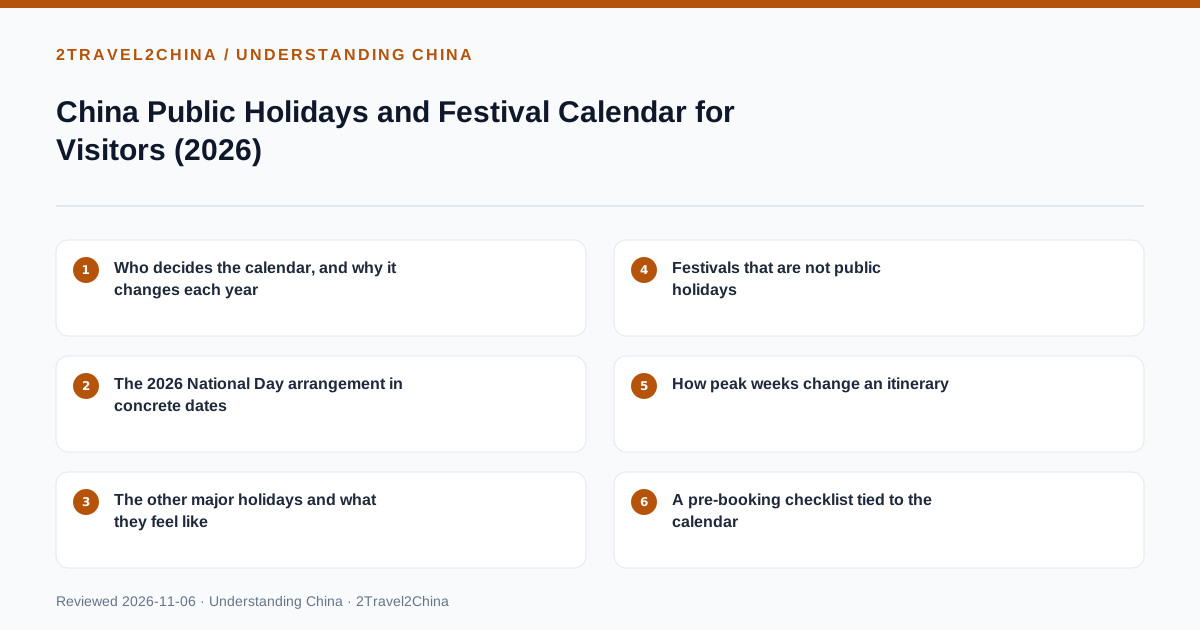
Who decides the calendar, and why it changes each year
The annual arrangement is published by the State Council General Office as a notice on part of the year holiday scheduling. It sets both the days off and the adjusted working weekends used to build a longer continuous break. Because the notice is annual, a calendar copied from a travel blog written two years ago is not reliable: the exact dates, the number of consecutive days off, and which weekends become working days all move.
This make-up day mechanism is the part foreign visitors find most confusing. A seven-day break does not mean seven days of statutory holiday; it is usually a shorter statutory period combined with adjacent weekends and two compensated working days. For a traveller the mechanism itself is less important than the outcome: one or two very large travel peaks, with crowding concentrated into a predictable window.
| What the notice sets | Why a visitor cares |
|---|---|
| The continuous days off | Determines the peak travel window and crowd levels |
| Make-up working weekends | Shifts which weekends are busy before and after the break |
| Which festivals get a break | Decides whether a cultural event coincides with mass domestic travel |
| Annual revision | Means last year calendar cannot be reused |
The 2026 National Day arrangement in concrete dates
For 2026, reporting on the State Council General Office notice gives the National Day holiday as 1 to 7 October, seven consecutive days, with Sunday 20 September and Saturday 10 October designated as working days. Railway ticket reservation for the period opened in advance, with bookings for 30 September available from 2 August on the pilot booking service reported by Chinese media. That is a useful illustration of how early the peak begins to affect logistics.
The practical reading is that the travel peak starts before the official first day. People leave after work on the last working day, and they return on the final day of the break. So a visitor should treat roughly 30 September through 7 October as one continuous high-demand window rather than assuming 1 October is the first busy day. Popular train departures, hotels near major stations and timed attraction slots all tighten together.
- Check the State Council notice for the current year before fixing travel dates.
- Treat the evening before the break and the final day as part of the peak.
- Book high-speed rail through 12306 as early as the sales window allows.
- Reserve attraction tickets at the same time as train tickets; many sites use timed entry.
- Expect higher accommodation prices in gateway cities and at scenic destinations.
Holiday dates are set annually and can be adjusted. Confirm the current State Council General Office notice and the railway sales window before booking, rather than relying on a reproduced calendar.
The other major holidays and what they feel like
China has several holiday periods across the year, including New Year's Day, Spring Festival, Qingming, Labour Day, Dragon Boat Festival, Mid-Autumn Festival and National Day. Spring Festival is the largest population movement and is tied to the lunar calendar, so its Gregorian date changes each year. Mid-Autumn and Dragon Boat are also lunar, which is why their dates move. National Day in early October is fixed and therefore the easiest for a visitor to plan around.
The character of each period differs. Spring Festival is about family travel, with many small businesses closing and a different rhythm in cities; the days immediately before it are intensely busy. Qingming is associated with tomb-sweeping and short trips. Labour Day and National Day are the two classic sightseeing peaks. A traveller who can choose between an early-May and a late-May trip will have a noticeably different experience at the same attractions.
| Period | Date basis | What a visitor notices |
|---|---|---|
| New Year's Day | Fixed, 1 January | Short break, moderate travel demand |
| Spring Festival | Lunar calendar | Largest migration, many shops close, family-oriented cities |
| Qingming | Solar term, early April | Short break, domestic short trips |
| Labour Day | Fixed, 1 May | A major sightseeing peak |
| Dragon Boat | Lunar calendar | Short break, regional boat races |
| Mid-Autumn | Lunar calendar | Short break, sometimes merges with National Day |
| National Day | Fixed, 1 October | Seven-day peak in 2026, heaviest attraction crowding |
Festivals that are not public holidays
A crowded calendar is not the same as a crowded country. Many events that interest international visitors are local festivals, light shows, sporting events or seasonal phenomena with no statutory holiday attached. The Guangzhou International Light Festival, the Harbin Ice and Snow World season, autumn foliage peaks, the Shanghai import expo and regional cycling races all draw visitors on their own schedules.
This distinction is useful when planning. A local festival in a second-tier city can be busy in one district and quiet elsewhere, whereas a national holiday makes every major station and every famous attraction busy at once. Our news section covers dated events, and the public holiday calendar tool helps you see where a festival sits relative to a national break.
- Separate national holidays from local events when checking crowd risk.
- For seasonal phenomena such as foliage or ice, use a month-by-month calendar rather than a single date.
- Check whether an event requires its own ticket or timed reservation.
- Look at the city guide for the specific district before assuming the whole city is busy.
How peak weeks change an itinerary
The biggest planning error is building an itinerary that only works if everything runs smoothly. During a golden week a sold-out train, a fully booked museum slot or a two-hour queue is normal, not an exception. Build in slack: fewer cities, longer stays in each, one flexible day, and a backup attraction that does not require a timed ticket. The rail network is large, but popularity is concentrated on a handful of famous routes.
A second tactic is to use the calendar positively. The make-up working weekends and the days immediately after a break are often quieter at major attractions, because domestic travellers are back at work. If your dates are flexible, shifting a city visit by three or four days can change the experience more than changing the city itself.
| Planning choice | Peak-week version | Why |
|---|---|---|
| Number of cities | Fewer, with longer stays | Reduces exposure to sold-out connections |
| Train booking | As early as the sales window allows | Popular departures sell out first |
| Attraction tickets | Reserve timed slots in advance | Many sites cap daily entries |
| Daily schedule | One anchor sight plus optional extras | Queues and transfer times expand |
| Alternative plan | Keep a no-reservation backup | Protects the day if a slot is unavailable |
A pre-booking checklist tied to the calendar
Before you buy a flight, put the year holiday notice next to your intended dates. If your trip touches a continuous break, treat train tickets, accommodation and timed attraction reservations as one booking task rather than three separate ones. Then check the weather-by-month tool, because an October national holiday and a November foliage trip in the same city can need very different packing.
- Read the current State Council holiday notice for the year of travel.
- Mark the first and last day of any continuous break, plus the make-up working weekends.
- Reserve rail, hotel and timed attraction slots in the same session.
- Keep one flexible day in the itinerary for a sold-out slot or a weather change.
- Recheck 12306 and the attraction booking system a week before departure.
Frequently asked questions
When is the 2026 National Day holiday in China?
The State Council General Office notice sets the 2026 National Day break as 1 to 7 October, seven consecutive days, with Sunday 20 September and Saturday 10 October as make-up working days. Confirm against the current official notice before booking.
Why do Chinese holidays include make-up working days?
A long continuous break is built by combining statutory holiday days with adjacent weekends and designating nearby weekend days as working days. The annual notice specifies both the days off and the compensated working days, so the pattern changes each year.
Which Chinese holiday is the busiest for travel?
Spring Festival is the largest annual population movement and is tied to the lunar calendar, so its date changes each year. National Day and Labour Day are the major fixed-date sightseeing peaks, with heavy demand on trains, hotels and timed attraction entries.
Do I need to book train tickets early for a Chinese holiday?
Yes. Around a continuous break, popular high-speed rail departures sell out and the travel peak begins the evening before the first official day off. Book through 12306 as soon as the sales window opens and use the official waitlist.
Are local festivals as crowded as national holidays?
Usually not. Local light shows, ice festivals, expos and seasonal events draw crowds to specific districts on their own dates, while a national holiday makes major stations and famous attractions busy nationwide. Check each event ticket and reservation rules separately.