Why China Built the World's Largest High-Speed Rail Network — and What It Means for Your Trip
China reported 165,000 km of railway in 2026, of which more than 50,000 km is high-speed line, and 97 percent of cities with more than 500,000 residents are connected to the high-speed network. Those figures are not just a national statistic: they explain why a multi-city itinerary can be built around short, frequent, city-centre-to-city-centre train legs. This guide covers the scale, the planning logic and the practical consequences for a visitor.
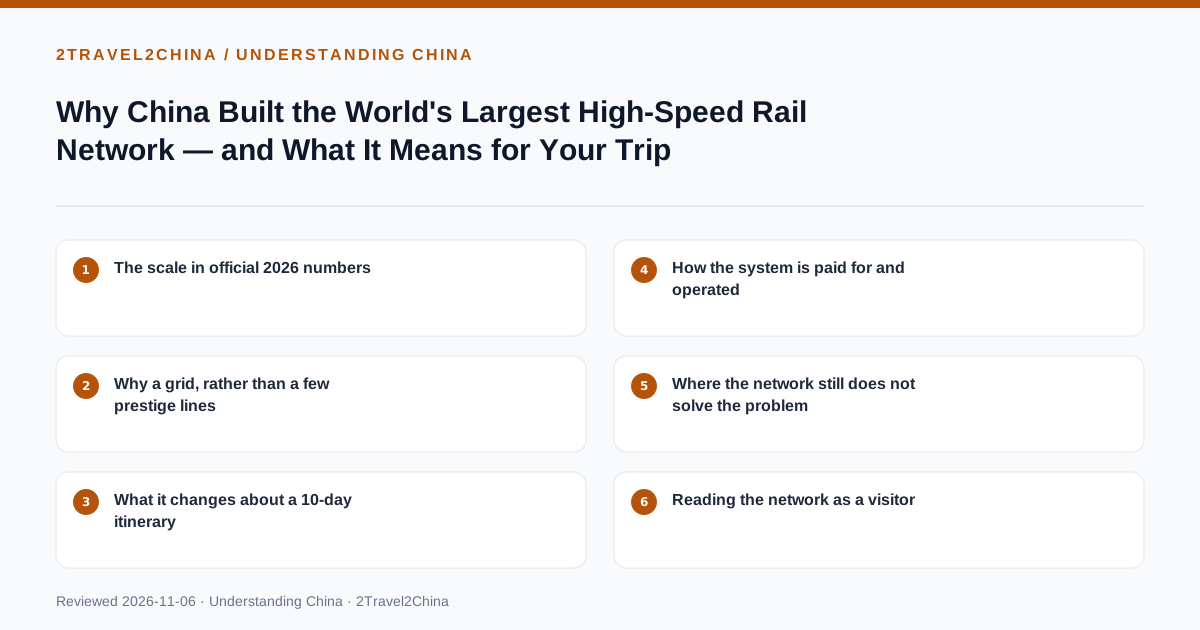
The scale in official 2026 numbers
At a State Council Information Office briefing in June 2026, a a China Railway customer service representative gave the current figures: 165,000 km of railway in operation, with high-speed lines exceeding 50,000 km. China Economic Net reported the same numbers in March 2026 and added that 97 percent of cities with a population above 500,000 are now connected to high-speed rail. The network is described officially as the world's largest and most modern high-speed system.
The growth is still budgeted rather than finished. China Economic Net reported 72.2 billion yuan of railway fixed-asset investment in the first two months of 2026, up 5.4 percent year on year, and a plan to open more than 2,000 km of new line during the year. Longer-range planning published in 2026 points to 180,000 km of railway and 60,000 km of high-speed line by 2030. For a visitor, that means a route planner based on a five-year-old map is already out of date.
| Measure | 2026 figure | What it means for a trip |
|---|---|---|
| Total railway | 165,000 km | Conventional trains still reach places high-speed does not |
| High-speed line | Over 50,000 km | Most intercity legs between major destinations are rail legs |
| Large-city coverage | 97% of cities over 500,000 people | A city you can name is probably on the network |
| New line planned in 2026 | More than 2,000 km | Check current timetables rather than old route maps |
| 2030 planning target | 180,000 km rail / 60,000 km high-speed | The network will keep changing during your next visit |
Why a grid, rather than a few prestige lines
Chinese planning describes the network as eight vertical and eight horizontal corridors. The point of a grid is not the speed of a single flagship service but connectivity: corridors cross, so a traveller can move between regions without returning to one of a handful of hubs. That is why a classic first-trip route linking Beijing, Xi'an and Chengdu works as a rail itinerary, and why secondary cities such as Suzhou, Hangzhou or Pingyao can be inserted without adding a flight.
There is also a deliberate mix of service types. Alongside 300 to 350 km/h services, the system runs slower conventional trains, overnight sleepers and low-fare public-service slow trains that continue to serve smaller counties. Official reporting in 2026 notes both the high-speed build-out and the retention of these slower services. For a budget traveller, the mix is useful: a fast daytime train for a long jump, a sleeper to save a hotel night, and a slow train for a short regional hop.
- Corridors cross, so multi-city loops do not always require returning to the arrival city.
- City-centre stations remove airport transfer time, which often decides whether a 1,000 km train beats a flight door to door.
- High frequency means a missed connection is usually an inconvenience rather than a ruined day.
- Conventional and sleeper services remain part of the network, not a legacy curiosity.
- The 2030 targets imply more new openings, so recheck the route for each trip.
What it changes about a 10-day itinerary
The practical effect is that distance stops being the main planning constraint. A 240-hour visa-free transit gives a visitor up to ten days, and a rail-based route can cover three or four cities in that window without a domestic flight. Beijing to Xi'an, Xi'an to Chengdu, or Shanghai to Hangzhou and Suzhou are all short enough that the train journey can sit inside a morning or an afternoon rather than consuming a full day.
That shifts the real constraints to ticket availability and station logistics. China Economic Net reported an expected 4.402 billion railway passenger trips in 2026 and a single-day peak of 14,037 multiple-unit trains during the Spring Festival travel period. Around National Day, Lunar New Year and the May holiday, popular departures sell out. Book through 12306, register with your passport, and use the official waitlist function rather than assuming a walk-up seat.
| Planning decision | Rail-friendly answer | Why |
|---|---|---|
| Two cities 500 km apart | Train, usually | City-centre stations and high frequency beat airport transfers |
| Two cities 1,500 km apart | Compare train and flight on total door-to-door time | A daytime high-speed train may still win on reliability |
| Peak holiday week | Book early and use the official waitlist | Demand spikes around the State Council holiday calendar |
| Overnight move | Consider a sleeper service | Saves a hotel night without losing a full day |
| Remote scenic region | Rail to the nearest hub, then road | Coverage is high but not universal in mountainous areas |
How the system is paid for and operated
Railway construction in China is treated as long-term public infrastructure, funded through state investment and railway financing rather than by expecting each individual line to recover its cost quickly. China Economic Net reported 72.2 billion yuan of fixed-asset investment in the first two months of 2026 alone, and official commentary for 2026 described a shift in emphasis from expanding route length toward improving network efficiency and service quality.
For the traveller, the visible results are standardised stations, a single national ticketing platform, and a fare system that varies by train class and speed. 12306 is the official channel and accepts passport-based registration for foreign visitors. Station signage in major hubs includes English, boarding uses the passport or the documented identity used at purchase, and seat classes range from second class through first class and business class.
Timetables, fares and station procedures change with each scheduling cycle. Use 12306 and the station announcement on the day rather than a fare table copied into a travel blog.
Where the network still does not solve the problem
High coverage is not universal coverage. Mountainous and sparsely populated regions can still require a long road transfer after the rail leg, and some destinations are served by a station bearing a regional name that is an hour or more from the attraction itself. Tibet has separate travel permit arrangements. A city appearing on a rail map does not mean the scenic site is next to the platform.
There are also days when flying is simply better: a very long cross-country jump, a tight connection with an international departure, or a route where the rail alternative requires an overnight change. The useful habit is to compare total door-to-door time and reliability, not just the timetabled journey. Our rail estimator tool does exactly that comparison for city pairs.
- Check the distance from the arrival station to the attraction before booking.
- For the last leg, confirm whether a shuttle, a licensed taxi or a ride-hailing app is available.
- Allow buffer time before an international flight; a train delay has fewer recovery options than a short taxi ride.
- Around public holidays, reserve accommodation and attraction tickets alongside the train ticket.
Reading the network as a visitor
The simplest way to use these numbers is to treat rail as the default and flights as the exception. Start with the cities you actually want to see, order them into a corridor rather than a star, then check whether each leg has a direct high-speed service of five hours or less. That usually produces a tighter itinerary than one built around whichever airport has the cheapest fare.
The same logic explains several other things visitors notice: why stations are large and far from old town centres, why ticket checks are strict about identity documents, and why a train departing on the minute is treated as normal. A network of this size only works if the boarding and identification process is standardised. Bring the passport you booked with, arrive early at major hubs, and keep the booking reference available offline.
Frequently asked questions
How big is China's high-speed rail network in 2026?
Official 2026 figures put total railway at 165,000 km, with high-speed lines exceeding 50,000 km, and 97 percent of cities with over 500,000 residents connected to high-speed rail. More than 2,000 km of new line was planned to open in 2026.
Why is high-speed rail better than flying between Chinese cities?
For distances up to roughly 1,000 km, city-centre stations, high frequency and no airport transfer often make the train faster door to door. It is also less vulnerable to weather disruption. Compare total journey time rather than timetabled travel time alone.
Do I need a Chinese phone number to book train tickets?
Foreign visitors can register on 12306 with a passport. Identity verification and ticket collection rules should be confirmed on the official platform, and you should bring the same passport used for the booking when you travel.
When do train tickets sell out?
Around the State Council holiday periods, especially Spring Festival, National Day and the May holiday. China Economic Net reported a Spring Festival peak of 14,037 multiple-unit trains in a single day in 2026. Book early and use the official waitlist function.
Does the high-speed network reach every tourist destination?
No. Coverage of large cities is 97 percent, but mountain and remote scenic areas often need a road transfer after the rail leg, and some regions have separate travel permit requirements. Check the distance from the station to the attraction.