China Speed: Delivery, E-Commerce and the Pace of Everyday Infrastructure
China speed is not about people walking faster. It describes how little time sits between deciding to do something and the system responding: a train booked in seconds, a payment completed with a QR code, a parcel arriving the next day, a meal delivered within the hour. Those conveniences rest on three layers — a very large rail network, a QR-based payment layer, and dense last-mile logistics — and they come with one counterintuitive rule for visitors: the faster the system, the more you need to book ahead.
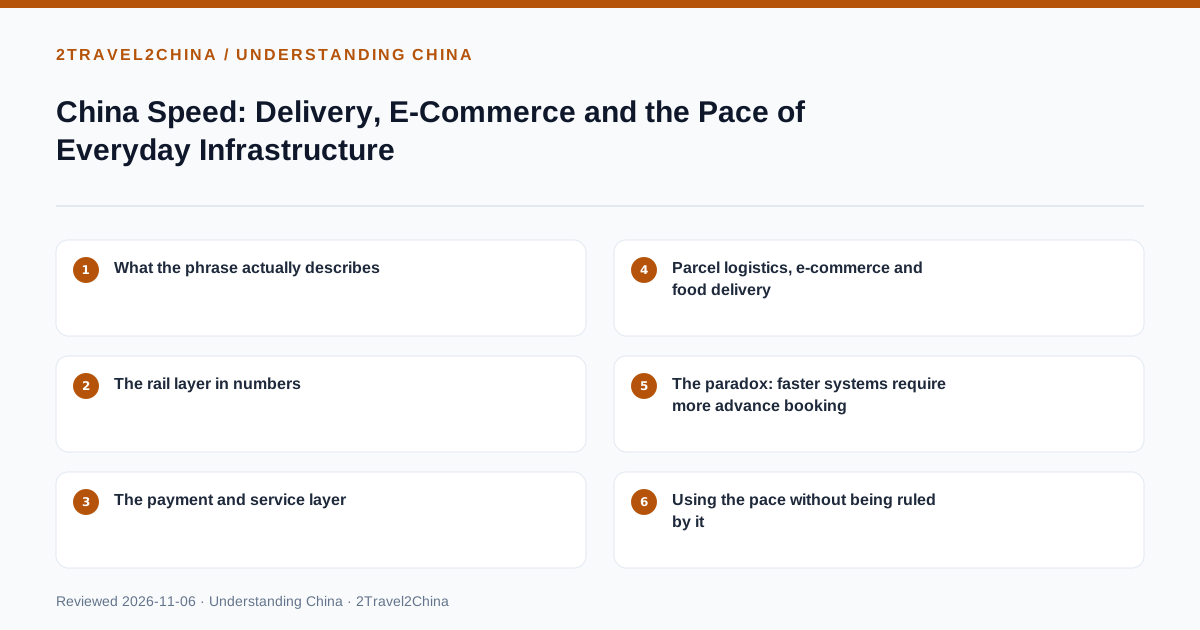
What the phrase actually describes
Visitors usually encounter the idea first as an observation about trains, then notice it everywhere else. A high-speed train departing on the minute, a payment that takes two seconds, a parcel tracked in real time and a hot meal arriving at a hotel door are all examples of the same thing: infrastructure that has been built to remove waiting from routine transactions. The phrase is about system response time, not about temperament.
It is also uneven. A first-tier city may have same-day delivery and English-language hospital booking, while a mountain county may still rely on a slow train and a weekly market. Official reporting in 2026 describes both the high-speed network expansion and the retention of low-fare public-service slow trains for smaller places. Treating China speed as a universal condition leads to bad planning; treating it as a dense urban layer works well.
| Layer | What it removes | Where it is strongest |
|---|---|---|
| Rail network | Long intercity travel time | Corridors between large and medium cities |
| QR payment layer | Cash handling and card terminals | Almost all urban retail and services |
| Last-mile logistics | Waiting for goods and food | Dense urban districts |
| Digital booking layer | Queueing for a slot | Museums, hospitals, attractions, government services |
The rail layer in numbers
Official 2026 figures put China's total railway network at 165,000 km, with high-speed lines exceeding 50,000 km, and 97 percent of cities with more than 500,000 residents connected to the high-speed network. China Economic Net reported 72.2 billion yuan of railway fixed-asset investment in the first two months of 2026 and a plan to open more than 2,000 km of new line during the year. The scale is what makes high frequency possible.
Frequency is the part that changes behaviour. When departures on a busy corridor are spaced minutes apart rather than hours, a traveller can treat the station as a walk-up option on ordinary days and stop building the day around a single timetable. That convenience reverses during holiday peaks, when demand concentrates; the same network then requires booking as early as the sales window allows.
- 165,000 km of railway in operation in 2026, with high-speed lines above 50,000 km.
- 97 percent of cities above 500,000 residents connected to high-speed rail.
- More than 2,000 km of new line planned to open in 2026.
- 2030 planning targets of 180,000 km of rail and 60,000 km of high-speed line.
- Sleeper and slow services remain part of the same network.
The payment and service layer
The second layer is the one visitors notice most. A QR code is the default interface for paying, and the app that holds it also carries metro ride codes, attraction reservations, hospital registration and government service entry points. In 2024 the People's Bank of China directed payment institutions to raise the foreign-card mobile-payment ceiling to USD 5,000 per transaction and USD 50,000 per year, and the National Immigration Administration guide lists overseas e-wallets that can be used directly on the mainland.
Public services have moved onto the same rails. On 21 September 2026 the National Immigration Administration extended online accommodation registration nationwide through its service portal, the 12367 app and WeChat and Alipay mini-programs, with the local police-station channel retained. A process that once meant finding a station and waiting at a counter can now be completed from a phone within the 24-hour legal window.
| Task | Older route | Common current route |
|---|---|---|
| Pay at a small shop | Cash or a card terminal | Scan a merchant QR code or show a payment code |
| Register an address | Visit the local police station | 12367 app or mini-program, nationwide since Sep 2026 |
| Book a museum slot | Queue at the ticket office | Timed reservation in a mini-program |
| Buy a train ticket | Station ticket window | 12306 with passport-based registration |
| Get a metro ride code | Token or single-journey card | Transit code inside Alipay or WeChat |
Parcel logistics, e-commerce and food delivery
The third layer is physical density: a very large express-delivery network with local depots, courier routes, parcel lockers and community collection points. In urban China, a parcel ordered in the evening commonly arrives the next day, and food or groceries can be delivered within the hour. Sector information is published by the State Post Bureau, and retail and e-commerce activity by the Ministry of Commerce and the National Bureau of Statistics; the scale of the network is what makes these short delivery windows routine rather than exceptional.
For a visitor, this shows up in small practical ways. A forgotten charger, sunscreen or adaptor can be ordered to a hotel instead of hunted through shops. Luggage can be shipped ahead between cities. A late arrival does not mean going without food. But it also depends on having a working payment method, a phone number that can receive a courier call, and an address written in Chinese characters that the courier can actually use.
- Use the hotel full Chinese address and ask the front desk whether they accept guest parcels.
- Keep your phone reachable; couriers often call or message on arrival.
- Check parcel locker or collection-point rules before shipping to an apartment.
- Do not ship items you need within the next few hours during a holiday peak.
- Confirm that the delivery app works with your payment setup before relying on it.
The paradox: faster systems require more advance booking
Here is the counterintuitive part. Because these systems are efficient, demand concentrates tightly. A museum that can process thousands of timed entries a day still sells out for a holiday week; a railway that runs thousands of trains a day still runs out of seats on the evening before a break. Fast execution does not create spare capacity at the moment everyone wants it.
The 2026 National Day arrangement illustrates the pattern: seven consecutive days off from 1 to 7 October, with two make-up working weekends, produces a single nationwide peak. The visitor response is to reserve earlier, not later — train tickets through 12306, timed attraction entries, and a hotel with a confirmed address in Chinese characters. Speed rewards preparation rather than spontaneity.
| Fast system | What still needs booking | When |
|---|---|---|
| High-speed rail | Seat on a specific departure | As soon as the sales window opens |
| QR payment | A working funding source and verification | Before you fly |
| Museum timed entry | A specific date and time slot | Days to weeks ahead in peak season |
| Express delivery | A usable Chinese address and reachable phone | Before placing the order |
| Online address registration | The exact address and arrival date | Within 24 hours of moving in |
Using the pace without being ruled by it
The practical approach is to let the infrastructure compress logistics while keeping a human margin in the itinerary. Use rail for intercity legs, QR payment for everyday spending, and delivery for things you forgot — but keep one flexible day, one offline backup for addresses and payments, and one attraction that does not require a timed ticket. That combination gives you the benefit of a fast system without depending on every part of it working at once.
It is also worth remembering that the slow layer still exists. Public-service slow trains, small county markets and a handwritten note from a shopkeeper are part of the same country. A visitor who expects every interaction to behave like a first-tier city app will be surprised; one who carries a Chinese-character address, a little cash and some patience will find the fast layer and the slow layer both usable.
Frequently asked questions
What does China speed actually mean?
It describes short system response times in everyday life: trains booked in seconds, QR payments completed in moments, next-day parcels and fast local delivery. It is about infrastructure density, not about people being hurried, and it is strongest in large urban areas.
How large is the rail network behind it?
Official 2026 figures report 165,000 km of railway with more than 50,000 km of high-speed line, and 97 percent of cities above 500,000 residents connected. More than 2,000 km of new line was planned to open in 2026.
Can I really get next-day delivery as a visitor?
In dense urban areas, commonly yes, provided you have a working payment setup, a reachable phone number and the hotel full Chinese address. Confirm with the front desk that they accept guest parcels, and expect delays around national holiday peaks.
Why do I still need to book ahead if everything is fast?
Efficiency concentrates demand. Timed museum entries and popular train departures sell out during holiday peaks even though the systems process very high volumes. Reserve through 12306 and attraction booking systems as soon as the sales window opens.
What changed for address registration in 2026?
On 21 September 2026 the National Immigration Administration extended online accommodation registration nationwide via its service portal, the 12367 app and WeChat or Alipay mini-programs. The local police-station channel remains available and carries equal legal effect.