Mid-Autumn and Dragon Boat Festivals: A Visitor's Guide (2026 Dates)
After Spring Festival, Mid-Autumn and Dragon Boat are the two most significant traditional festivals in China. Both follow the lunar calendar, both centre on family, and both have a signature food and a public spectacle. In 2026 Dragon Boat falls on 19 June and Mid-Autumn on 25 September, three months apart and, unusually, with no overlap with National Day. This guide compares them side by side so you can decide which is worth building a trip around.
The short answer: two lunar festivals, three months apart
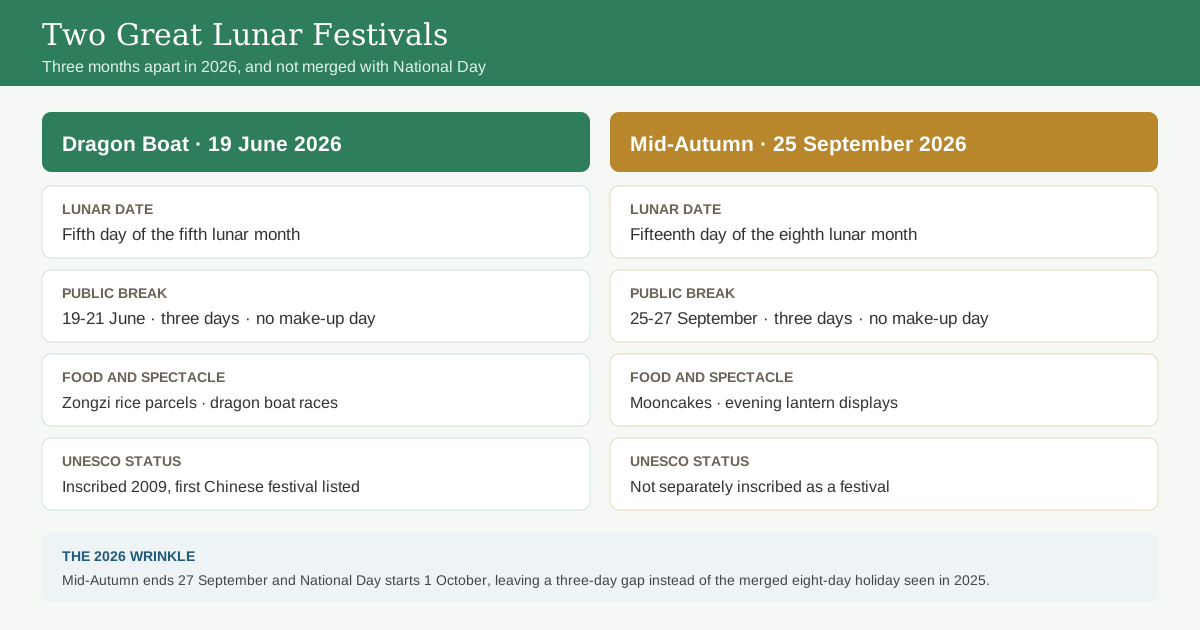
Dragon Boat is held on the fifth day of the fifth lunar month, which in 2026 is 19 June. Mid-Autumn is held on the fifteenth day of the eighth lunar month, 25 September in 2026. Both are statutory public holidays: three days each in 2026, from 19 to 21 June and from 25 to 27 September. Neither date is fixed in the Gregorian calendar, so both move by about a month from year to year.
| Aspect | Dragon Boat | Mid-Autumn |
|---|---|---|
| 2026 date | 19 June, Friday | 25 September, Friday |
| Lunar position | Fifth day, fifth month | Fifteenth day, eighth month |
| Public break | 19-21 June, three days | 25-27 September, three days |
| Make-up working day | None | None |
| Core theme | Remembrance and warding off evil | Reunion and harvest |
| Signature food | Sticky rice parcels, zongzi | Mooncakes, yuebing |
What Dragon Boat commemorates, and what visitors can watch
Dragon Boat, also called Duanwu, is the older of the two in UNESCO terms. It falls on the fifth day of the fifth lunar month and is linked to poet Qu Yuan, said to have drowned in protest in the fourth century BCE. Its best-known custom is dragon boat racing: long boats with carved dragon heads paddled to drums. UNESCO inscribed the festival on its Representative List of Intangible Cultural Heritage of Humanity in 2009, the first Chinese festival listed.
For a visitor this is the easier festival to plan around, because the races are public events held on rivers and lakes in many cities. Southern cities with strong water traditions are the most reliable choices. Race times are set locally and are usually in the morning, so check the host city's official announcement rather than assuming a single national schedule. The food side is simpler: zongzi, sticky rice wrapped in leaves, are sold in shops and restaurants for several weeks around the date.
- Check the city tourism board for race locations and start times, which are not uniform nationwide.
- Arrive early; the best riverbank viewing spots fill up before the first race.
- Try zongzi from a shop rather than expecting it on every restaurant menu.
- Combine the festival with a city that has a riverfront, not a landlocked sightseeing route.
The racing tradition is strongest in southern China, where rivers and a mild early-summer climate make the fifth lunar month a natural season for water events. Cities along the Pearl River delta and in Hunan and Fujian typically stage the largest races, and Hong Kong, China also holds a well-known international dragon boat competition. The boats themselves are long, narrow craft with a carved dragon head at the bow and a drummer who sets the paddling rhythm. Races are usually held as a series of heats over one or two days, with local teams, university crews and visiting international squads competing in separate categories.
Beyond the races, Dragon Boat has a quieter set of customs that visitors often notice in shops and street scenes. Fresh mugwort and calamus are hung at doorways, and coloured silk threads are tied around wrists, all traditionally intended to ward off illness and misfortune in the hot, wet fifth month. These practices are easy to see without a ticket and give the festival a texture that the races alone do not show.
What Mid-Autumn marks, and why the date is different in 2026
Mid-Autumn falls on the fifteenth day of the eighth lunar month, a date chosen because it is the night of a full moon in the traditional calendar. It is a harvest and reunion festival: families gather, eat mooncakes and view the moon together. Unlike Dragon Boat, Mid-Autumn is not separately inscribed by UNESCO as a festival, although mooncake-making and related practices are recognised at national level in China.
The 2026 arrangement is notable for what does not happen. In some years the Mid-Autumn date falls close enough to 1 October that the two holidays merge into an eight-day break, as in 2025. In 2026 the State Council set Mid-Autumn as 25 to 27 September and National Day as 1 to 7 October, leaving a three-day gap. That separation means two shorter peaks rather than one very long one, and it gives flexible travellers a quieter window between them.
In 2026 you do not need to choose between Mid-Autumn and National Day. They are separate holidays with three ordinary days in between, so a trip in late September can avoid the first week of October entirely.
The public face of Mid-Autumn is the lantern display. Cities and parks install large illuminated installations in the days around the festival, and families walk through them in the evening after dinner. In many places the displays stay open for a week or more rather than a single night, which makes the festival easier to catch than an event with a fixed start time. Parks in major cities often charge an entry fee during the display period and may require advance booking, so check the local operator before you go.
Food and public events, compared
Both festivals have a food that is almost symbolic of the day. Zongzi are sticky rice parcels wrapped in leaves and filled with savoury or sweet ingredients; mooncakes are dense round pastries with lotus seed, egg yolk or nut fillings, often given as gifts. Each food has a short commercial season, appearing in shops weeks before the festival and disappearing quickly afterwards.
| Experience | Dragon Boat | Mid-Autumn |
|---|---|---|
| Signature food | Zongzi, sticky rice in leaves | Mooncakes, round filled pastries |
| Public spectacle | Dragon boat races on rivers | Lantern displays in parks and squares |
| Time of day | Races usually in the morning | Moon viewing and lanterns at night |
| Gift culture | Modest; food shared at home | Strong; mooncakes given to colleagues and family |
| Visitor access | Watch races from the riverbank | Walk through lantern displays |
Why the two festivals move, and what that means for planning
Both festivals are dated by the lunisolar calendar, in which months follow the phases of the moon and a leap month is inserted periodically to keep the years aligned with the seasons. As a result, Dragon Boat can fall anywhere from late May to late June, and Mid-Autumn from early September to early October. A guide that quotes one date without a year will be wrong within a few seasons.
The practical consequence is that festival-based trips need the year's State Council notice, which is usually published in early November for the following year. Once the notice is out, the three-day breaks are fixed and the fixed-date National Day week can be placed around them. In 2026 the Mid-Autumn date is early enough in the month that it does not touch the National Day peak, which is the cleanest separation in several years.
Which festival should a visitor choose?
Choose Dragon Boat if you want a daytime public event with a clear start time and a natural reason to visit a river city. Choose Mid-Autumn if you prefer evening atmosphere, lantern displays and food culture, and if your dates are in late September. Both are three-day holidays in 2026, so neither demands the long lead time that National Day or Spring Festival does.
- Dragon Boat suits a short city break in a river or lake destination in June.
- Mid-Autumn suits a late September city trip combined with early autumn sightseeing.
- Neither festival requires the nine-day planning horizon of Spring Festival.
- If you want both, they are three months apart and can be separate trips in one year.
A final factor is the weather. Dragon Boat falls in June, when southern China is in the early monsoon and heavy rain is common; a riverfront festival is still worth the trip, but an outdoor race can be delayed or moved. Mid-Autumn falls in late September, which is one of the most comfortable periods across much of the country, with clear autumn air in the north and warm evenings further south. That difference is a genuine reason to prefer Mid-Autumn if your dates are flexible and you want a festival you can enjoy outdoors without contingency plans.
Frequently asked questions
When is the Dragon Boat Festival in 2026?
Dragon Boat Festival falls on 19 June 2026, the fifth day of the fifth lunar month. The public holiday runs 19 to 21 June, three days, with no make-up working day. UNESCO inscribed the festival on its Representative List of the Intangible Cultural Heritage of Humanity in 2009, the first Chinese festival to be listed.
When is Mid-Autumn Festival in 2026?
Mid-Autumn Festival falls on 25 September 2026, the fifteenth day of the eighth lunar month. The public break runs 25 to 27 September, three days, with no make-up working day. In 2026 it is separate from the National Day holiday, which begins on 1 October, leaving a three-day gap between them.
Does Mid-Autumn always overlap with National Day?
No. Because Mid-Autumn follows the lunar calendar and National Day is fixed on 1 October, they sometimes fall close together and merge into an eight-day break, as in 2025. In 2026 they are three weeks apart, so the two holidays produce separate travel peaks rather than one continuous week.
Can tourists watch dragon boat races in China?
Yes. Races are public events held on rivers and lakes in many cities, especially in the south. Start times and locations are set by each host city, so check the local tourism board announcement. Arrive early, because riverbank viewing areas fill up well before the first race of the day.
Is the Dragon Boat Festival about Qu Yuan?
The festival is strongly associated with the poet Qu Yuan, who is said to have drowned himself in protest in the fourth century BCE. Its customs also include warding off evil with herbs and charms. UNESCO recognised the festival in 2009 as an intangible cultural heritage practice of the Chinese people.