Solo Female Travel in China: Safety and Practical Advice (2026)
China is widely regarded as a manageable destination for women travelling alone, and violent crime against visitors is uncommon. The practical issues are the ordinary ones: licensed transport, a hotel that can register a foreign passport, a language gap when something goes wrong, and the low-level attention that a solo traveller can attract in a crowd. This guide focuses on those specifics rather than on generalities.
A realistic baseline
Late-night city centres in major Chinese cities are often busy with people, well lit and served by public transport and licensed taxis. That is the main reason solo travel feels manageable here: the streets do not empty early. Violent crime against visitors is uncommon. The risks that do affect a solo traveller are more mundane — an unlicensed car, a misunderstanding over a fare, a phone with no battery, or a crowded site where personal space is interpreted differently.
| Concern | Actual likelihood | Practical response |
|---|---|---|
| Violent crime against visitors | Uncommon | Standard city awareness |
| Unlicensed transport | Concentrated at arrivals | Use signed ranks and in-app rides |
| Overcharging | Low but real | Meters, app records, receipts |
| Staring or attention in a crowd | Common in some settings | Usually curiosity, not a threat |
| Language gap in a problem | The most likely difficulty | Written addresses and offline tools |
The last row is the one worth planning around. A minor problem becomes stressful when it cannot be explained. A written Chinese address, an offline translation pack, a reachable phone number and a charged phone turn almost every small difficulty into a routine transaction.
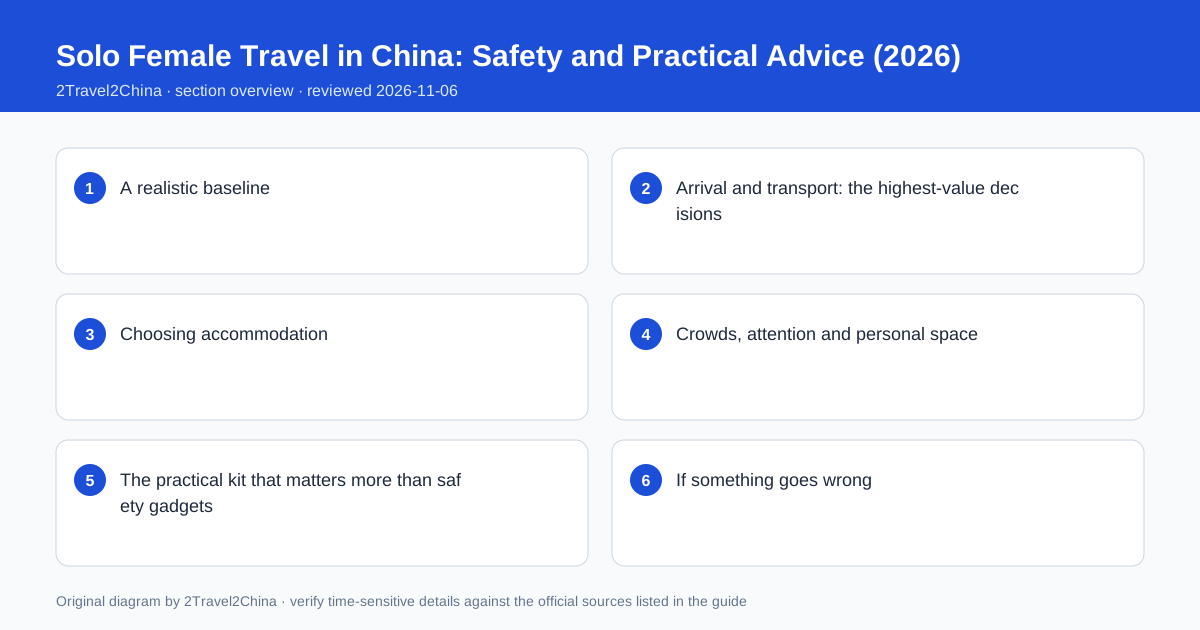
Arrival and transport: the highest-value decisions
Arrivals are where a solo traveller is most exposed to poor decisions: tired, carrying luggage, and being offered a car by someone in the terminal. Use the signed, staffed licensed taxi rank or the numbered ride-hailing pickup zone, ignore unsolicited approaches, and keep the app order open rather than accepting a private cash arrangement. Share the trip with a contact for a late or unfamiliar route.
Before landing
Save the hotel address in Chinese and note the arrival terminal.
In the hall
Walk past anyone offering a car; go to the signed rank or pickup zone.
Before departure
Confirm the plate, the meter, or the in-app fare and route.
During the ride
Follow the route on the map and use the share-trip feature.
On arrival
Keep the receipt; it holds the plate, time and fare.
For day-to-day movement, the metro is excellent: busy, well lit, bilingual signage and a predictable rhythm. For a late return, a licensed car from a staffed rank or an in-app ride is a better choice than an unmarked vehicle. The rule is not "avoid being out late" but "keep the transport recorded".
Choosing accommodation
Two criteria matter more than the star rating: the property must be able to register a foreign guest with the local public security authority, and it should be close to a metro line or a well-lit main street. Most international and mid-range city hotels satisfy both; some small guesthouses and budget hostels cannot register a foreign passport at all. Confirm before booking, especially in smaller cities.
| Factor | What to check | Why |
|---|---|---|
| Foreign guest registration | Ask the property directly | Some small properties cannot do it |
| Location | Near a metro station and a main street | Simplifies late returns |
| 24-hour front desk | Present or clearly reachable | Help with a car or a problem at any hour |
| Room access | Modern key card, lift to floor | Standard in city hotels |
| Reviews from solo travellers | Recent, specific comments | Better signal than a general rating |
A 24-hour front desk is worth more than a slightly cheaper room. It is a reliable source of a licensed car, a written address and help with a booking problem at 23:00. Keep the hotel’s name and address in Chinese on the phone, and take a card from the desk — a physical fallback when the battery dies.
Crowds, attention and personal space
In some settings, a solo foreign traveller may attract looks, a request for a photograph, or a friendly attempt at conversation. In the vast majority of cases it is curiosity rather than a threat, and a brief, neutral response ends it. Personal space in a queue or on a crowded platform can be tighter than some visitors expect, which is a crowd-density norm rather than targeted behaviour.
- A short, neutral response is enough; no explanation is owed
- Move towards staff, a lit entrance or a busy group if attention feels persistent
- Keep valuables zipped and in front in dense crowds and markets
- Avoid carrying a passport openly; keep a copy on the phone
- Trust a specific uncomfortable feeling over a general rule about a place
The useful skill is being comfortable ending an interaction without apology. A simple "no, thank you", a step away, and continuing with the day resolves nearly all of it. If a situation feels wrong, go into a hotel, a mall or a station — staffed, lit places are plentiful in Chinese cities — rather than trying to reason with it on the street.
The practical kit that matters more than safety gadgets
For a solo traveller, resilience is mostly about communication and power. Two verified payment wallets, a working map, an offline translation pack, a written Chinese address, a reachable contact and a power bank solve more problems than any novelty device. Share the itinerary and the hotel name with someone at home, and check in at a predictable interval.
- Two verified payment wallets and a second linked card
- Offline maps, translation pack and saved Chinese addresses
- A small power bank and a short cable in the day bag
- Offline copies of the passport page, bookings and insurance certificate
- A 24-hour assistance number and a contact who knows the itinerary
- A small amount of RMB cash in small notes
A dead phone is the only genuinely total failure: it removes payment, maps, translation, the ride home and the ability to call. A power bank and a written hotel address are the two items that most directly protect a solo traveller, and both weigh almost nothing.
If something goes wrong
For a lost item, a disputed fare or a booking problem, use the record: an in-app receipt has the plate and route, a hotel has the registration, and a booking confirmation has the dates. Escalate through the platform, the front desk or the operator rather than arguing at the roadside. For anything involving personal safety, go to a staffed, lit place and call the local emergency number; the hotel front desk can help make that call.
Get to a staffed place
A hotel lobby, station office, mall service desk or police station.
Use the record
Receipt, plate, booking confirmation or registration detail.
Ask for help in writing
Show a translated sentence; it avoids a spoken language gap.
Contact the hotel
A 24-hour desk can arrange a car, a call or a translation.
Keep the insurance assistance number handy
Saved offline as well as in the phone.
None of this is specific to being a woman; it is simply more valuable when travelling alone, because there is no companion to hold the map, make the call or remember the plate. Prepare those small redundancies once, and the trip becomes an ordinary one — busy, varied and largely uneventful.
Local conditions, transport rules and emergency procedures vary by city and change over time. Confirm current emergency numbers and visitor guidance from official local sources before travel, and use licensed operators and staffed venues for late-night transport.
Frequently asked questions
Is China safe for a woman travelling alone?
Generally yes. Violent crime against visitors is uncommon and city centres stay busy late. The practical issues are licensed transport, a hotel that can register a foreign passport, and the language gap when something goes wrong.
What is the most important safety decision on arrival?
Use the signed, staffed licensed taxi rank or the numbered ride-hailing pickup zone, ignore unsolicited offers inside the terminal, and keep the app order open rather than paying privately.
What should I check when booking a hotel alone?
That it can register a foreign passport, that it is near a metro line or a well-lit main street, and that it has a 24-hour front desk. Some small guesthouses cannot register foreign guests at all.
How should I handle unwanted attention in a crowd?
A short, neutral response and moving on resolves almost all of it. If attention persists, go into a staffed, lit place such as a hotel, mall or station office.
What should a solo traveller always carry?
Two verified payment wallets, offline maps and translation, the hotel address in Chinese, a power bank, offline document copies and a small amount of RMB cash. A dead phone is the only total failure.