Taxi and Ride-Hailing Scams in China: What Actually Happens and How to Avoid It
The risk of a taxi problem in China is low, but it is concentrated in a few predictable situations: an airport arrival, a late-night pickup, an unmarked car and a fare agreed outside any app or meter. Almost every reported incident fits one of those four. This guide describes what actually happens, without inflating it, and gives a short routine that removes nearly all of it.
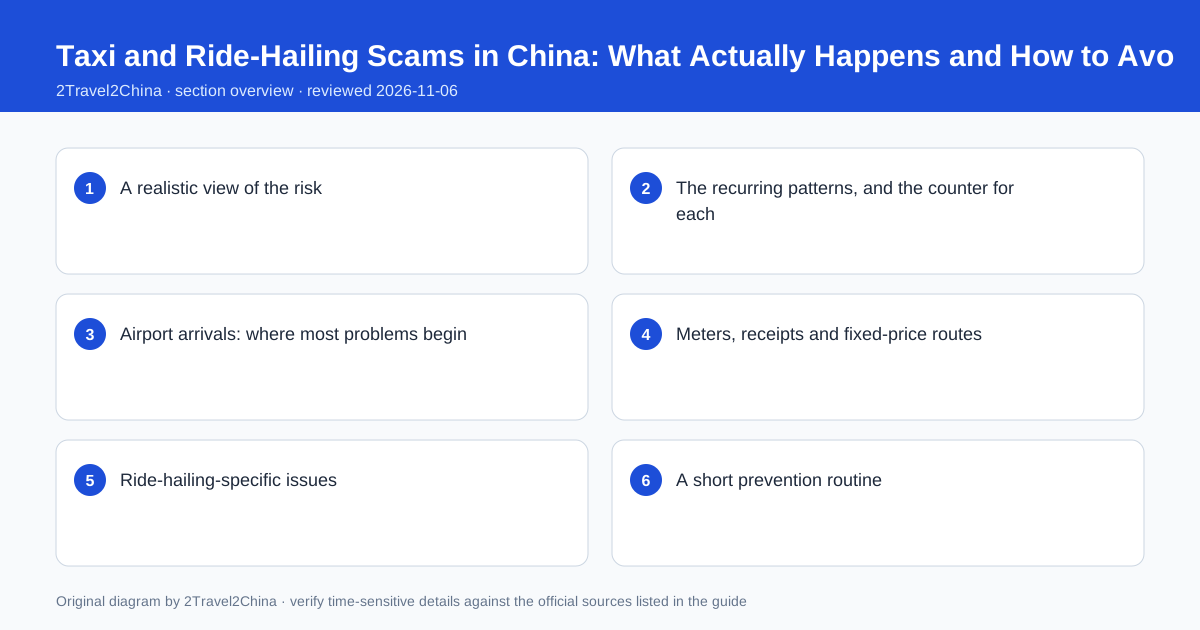
A realistic view of the risk
Most taxi and ride-hailing trips in Chinese cities are unremarkable: a licensed car, a metered or app-calculated fare, and no conversation. The problems visitors report are not usually elaborate cons but ordinary opportunism aimed at someone who cannot read the surroundings and is tired after a long flight. An unlicensed driver approaches in the arrivals hall, quotes a flat price several times the meter, or takes a longer route. The defence is not suspicion of everyone; it is using the licensed channel and keeping the transaction recorded.
| Situation | Risk level | Why |
|---|---|---|
| Licensed rank at an airport | Low | Staffed, queued, registered vehicles |
| In-app ride-hailing | Low | Plate, route, fare and receipt recorded |
| Hotel-arranged car | Low | The hotel has a relationship with the operator |
| Unsolicited approach in arrivals | Higher | Unlicensed, no meter, no record |
| Unmarked car after midnight | Higher | No plate record and few witnesses |
It helps to separate a genuine scam from a misunderstanding. A detour can be a road closure; a higher fare can be a toll or a legitimate night rate; a driver who insists on the meter is doing the right thing. The recurring red flags are structural rather than behavioural: no meter, no app record, a flat price agreed before departure, or a request to cancel an order and pay privately. Those four cover the overwhelming majority of real cases.
The recurring patterns, and the counter for each
The classic is the unlicensed airport car: someone approaches inside the terminal, offers a "taxi", and quotes a fixed price to the city centre. A second is the broken-meter story, where the driver claims the meter is faulty and proposes a flat fare. A third is the long route, which is harder to detect without a map. A fourth is the switch, where a traveller cancels an in-app order on the driver’s suggestion and pays cash directly, losing the plate and route record.
| Pattern | How it starts | The counter |
|---|---|---|
| Unlicensed airport car | Someone approaches you in the arrivals hall | Walk to the signed, staffed taxi rank |
| Broken meter | A flat price is proposed before departure | Decline and take the next licensed car |
| Long route | The route drifts away from the map | Follow the in-app map and keep the receipt |
| Cancel-and-pay-cash | Driver asks you to cancel the app order | Keep everything inside the app |
| Wrong change or note swap | Confusion over a 100-yuan note | Use small notes and count change at the window |
None of these require confrontation. Declining a car, walking twenty metres to a rank, or keeping an app order open are quiet, unremarkable actions. If a driver is insistent, the simplest response is to leave the vehicle and take the next one. A licensed rank at a major airport or station usually has a marshal who can help, and a written Chinese destination removes the language gap without an argument.
Airport arrivals: where most problems begin
Airport arrivals concentrate every risk factor at once: fatigue, luggage, a new city, a phone that may not have data yet, and a crowd of people offering transport. The licensed taxi rank is signposted and usually outside the arrivals doors, with a queue and a marshal. Ride-hailing pickups are on a designated floor or zone with a number. Ignore anyone who approaches you inside the hall offering a car, and follow the signs to the official area rather than negotiating at the kerb.
Before landing
Save the hotel address in Chinese and confirm which terminal you arrive at.
In the hall
Walk past unsolicited offers; do not discuss a price with them.
At the rank
Join the signed queue and take the next licensed car.
Before departure
Confirm the meter is running or the app fare is displayed.
On arrival
Take the receipt and check the fare against the estimate.
If you plan to use ride-hailing, connect to airport Wi-Fi or enable roaming before leaving the terminal so the booking completes with a stable connection. Pickup zones at large airports are numbered and sometimes split by car type, so read the in-app instruction rather than standing at the closest door. A fixed-price hotel car is a good third option for a very late arrival, and its cost is usually worth the absence of decisions after a long flight.
Meters, receipts and fixed-price routes
A licensed taxi uses a meter, with a base fare, a distance rate and legitimate additions such as tolls or a night surcharge where local rules allow. The meter should be visible and started at departure. Receipts are printed or issued through the app and record the plate, company, distance, time and fare. Ask for one as a matter of routine, not because you suspect a problem — it is the single most useful document if a bag is left behind or a charge is queried later.
- Confirm the meter is reset and running before the car moves
- Expect tolls and any published night surcharge to appear separately
- Ask for a printed receipt at the end of every taxi trip
- Keep the in-app receipt for ride-hailing; it contains the plate and route
- Compare a surprisingly high fare with the receipt breakdown, not from memory
A flat price is not automatically a scam: airport transfer desks and hotel cars quote fixed fares openly, and that is fine because the price is agreed with a legitimate operator before departure and recorded. The problematic version is a flat price proposed by an unlicensed driver who has no meter and no receipt. The distinction is the presence of a licensed operator and a record, not the shape of the price.
Ride-hailing-specific issues
In-app rides remove most of the old risks because the plate, route, fare and timestamp are recorded. The remaining issues are smaller: a wrong pickup pin at a large interchange, an order cancelled by the driver when a group has too much luggage for the selected class, a request to pay a toll in cash, or a suggestion to cancel the order and settle privately. The last one is the only one with real downside, because it removes the record.
| Issue | What it looks like | Response |
|---|---|---|
| Wrong pickup pin | Car waits on the other side of a complex | Cancel in the free window and reorder |
| Order cancelled after seeing bags | Driver declines a four-person group | Choose a larger car class |
| Cash toll request | A small amount asked for at a barrier | Check whether it appears in the fare breakdown |
| Private payment suggestion | Driver asks you to cancel the app order | Decline; keep the trip in the app |
| Fare higher than estimate | Traffic or a changed route | Query with the receipt and route attached |
Use the share-trip feature for a long or late ride, follow the route on the map without narrating it to the driver, and keep the receipt. If an item is left in the car, the trip record gives the plate and time, and the platform can contact the driver. This is why off-platform payment is such a poor trade: the small convenience of cash removes the only reliable route back to the vehicle.
A short prevention routine
The whole prevention routine fits on a card: use the licensed rank or the app, confirm plate and meter, follow the route, keep the receipt. Nothing here requires fluency in Chinese or a suspicious attitude. It is the same routine a resident follows, and it works because it keeps the transaction inside a system that records the car and the fare.
- Save hotel, station and airport addresses in Chinese on the phone
- Use signed, staffed ranks and ignore approaches inside the arrivals hall
- Confirm the plate and the meter, or the app fare, before departure
- Follow the route on a map and keep the receipt at the end
- Decline any request to cancel an app order and pay privately
- Carry a small amount of RMB in small notes as a fallback
If something does go wrong, note the plate, the time and the place, keep the receipt, and raise it through the platform or the taxi company rather than arguing at the roadside. For an essential service that refuses a reasonable resolution, the local transport complaint channel is available. Most visitors will never need any of that — but the routine costs nothing and makes the first late-night arrival in a new city considerably calmer.
Licensing rules, fare structures, complaint channels and app features are set locally and change over time. Use licensed transport, check the current official signage at the airport or station, and verify any time-sensitive transport rule against local government or operator sources.
Frequently asked questions
Are taxis in China safe for tourists?
Generally yes. Licensed ranks and in-app ride-hailing record the plate, route and fare, and most trips are unremarkable. The risk is concentrated in unlicensed cars that approach travellers inside arrivals halls and quote flat prices.
What is the most common taxi scam at Chinese airports?
An unlicensed driver approaches in the terminal, offers a car and quotes a fixed price well above the meter. Walk past them to the signed, staffed taxi rank or the designated ride-hailing pickup zone.
What should I do if a driver says the meter is broken?
Decline the ride and take the next licensed car. A broken meter combined with a flat price removes both the fare calculation and the record, and it is not worth negotiating over.
Should I cancel a ride-hailing order if the driver asks me to pay cash?
No. Keeping the trip inside the app preserves the plate, route, timestamp and receipt — the only reliable way to resolve a lost item or a disputed fare afterwards.
Do I need a receipt for every taxi ride?
It is a good habit. A printed or in-app receipt records the plate and fare, and it is the document you need for a forgotten bag or a charge query. Ask for one as routine, not as an accusation.