Using the Metro in China: Tickets, QR Codes, Apps and Etiquette (2026)
Chinese city metro systems are clean, frequent, cheap and extensively signposted in English, and they are the fastest way to cross a large city at rush hour. The unfamiliar parts are small: a security scan at the entrance, a ticket machine that may want a QR code, and a gate that behaves differently for a single-use token and a phone. This guide covers the whole flow and the differences between the major networks.
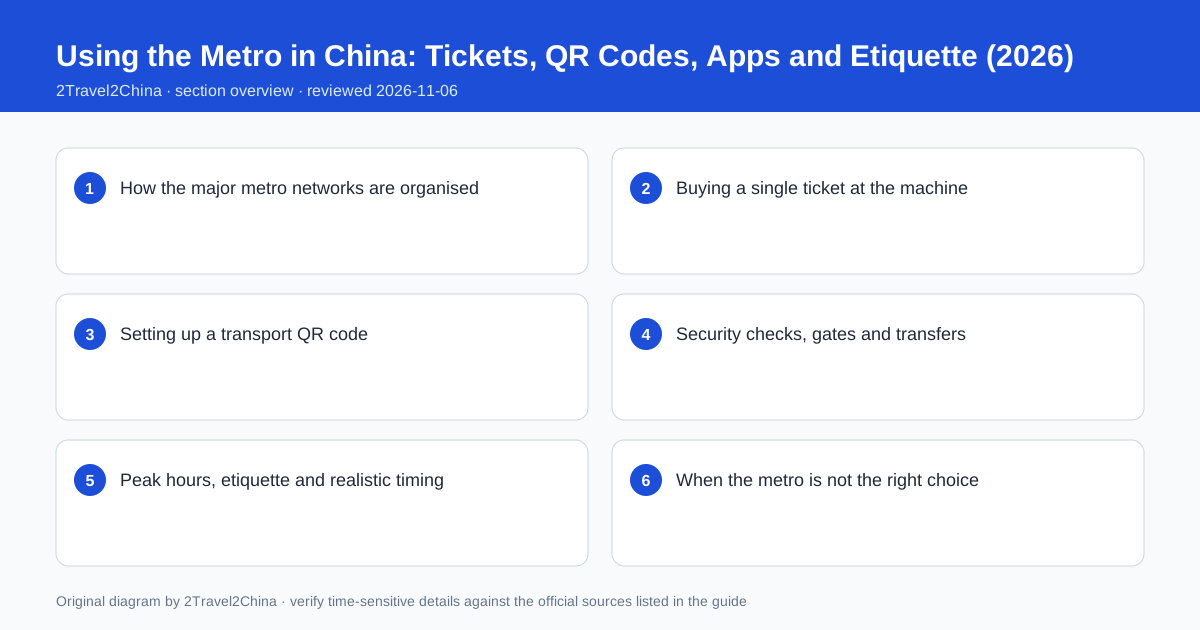
How the major metro networks are organised
Beijing, Shanghai, Guangzhou, Shenzhen, Chengdu, Xi’an, Hangzhou and several other cities operate large, numbered metro networks with interchange stations, English station names on signage and platform displays, and fares based on distance travelled. Shanghai’s is among the busiest in the world, Beijing’s is extensive and grid-like, and Guangzhou’s links the main railway stations with the Canton Fair complex. For a visitor, the practical difference is not the map but the ticketing: some cities rely heavily on transport QR codes inside Alipay or WeChat, while others still sell single-use tokens at machines and staffed counters.
| City | Useful for a visitor | Ticketing note |
|---|---|---|
| Beijing | Forbidden City, Temple of Heaven, Summer Palace approaches | Single-use tokens and transport QR codes both common |
| Shanghai | The Bund, museums, Hongqiao and Pudong links | QR codes widely used; machines still sell single tickets |
| Guangzhou | Baiyun airport, Canton Fair, railway stations | Tokens and QR codes; airport line has its own fare |
| Chengdu | City centre, panda base transfer, east railway station | QR codes and machines, clear English signage |
| Xi’an | City wall, museum, north railway station | Compact network, straightforward single tickets |
Line numbers and colours are consistent between the map, the platform and the train, and the direction is shown by the terminal station name rather than by "northbound" or "southbound". Before boarding, check the terminus displayed on the platform screen against the line map. It is a small habit that prevents most wrong-direction trips. Offline map apps that include Chinese metro diagrams are useful, but the station wall map is authoritative when a line has been extended recently.
Buying a single ticket at the machine
Ticket machines in major stations have an English-language option. You select the destination station or the fare, choose the number of tickets, and pay. The output is usually a single-use token or a thin card that you tap at the entry gate and insert or return at the exit gate. Older machines took coins and small notes; many now accept a QR payment from a domestic wallet, which is the point where a visitor with only a foreign card can get stuck. A staffed service counter is the reliable fallback.
Find a machine with an English option
Most stations have at least one; look near the concourse rather than at the platform.
Select the destination or fare
Fares are distance-based; the machine shows the amount before payment.
Pay with a method you have
Coins, small notes or a wallet QR code, depending on the machine.
Keep the token until you exit
The exit gate takes it back; losing it means a replacement fare.
Use the service counter if blocked
Staff can sell a single ticket and will understand a written station name.
The token is not a souvenir. Exit gates in many cities reclaim it, and a token that has been taken home cannot be reused. If the machine rejects a foreign-card wallet QR code, do not keep retrying: ask at the counter, show the destination station name in Chinese on your phone, and buy a single ticket with cash. This is one of the few everyday situations where a small note is genuinely handy.
Setting up a transport QR code
The smoother long-term option is a transport QR code inside Alipay or WeChat. In Alipay it sits under the transport or city-services section; you choose the city, enable a transit code and authorise deduction from the linked payment method. The code is then scanned at the gate rather than at a machine, and the fare is deducted automatically. WeChat offers an equivalent mini-program. Setup is city-specific, so you enable a separate code for each metro system you use.
- Open the transport section of Alipay or WeChat and choose the city
- Enable the transit code and accept the authorised deduction terms
- Confirm the wallet has a verified passport record and a linked card
- Generate the code before reaching the gate, not while standing at it
- Check that the deduction appeared after the ride to catch a failed settlement
A transport QR code removes the ticket machine entirely and works across buses and some ferries in the same city. The trade-off is that it depends on a working phone: a flat battery at the exit gate is an annoying but solvable situation, usually handled at the service counter. Visitors who already set up Alipay for payments will find this is a two-minute addition. Those who did not should use single tickets for a short stay rather than setting up an account in a station concourse.
Security checks, gates and transfers
Most Chinese metro stations have a security check at the entrance: bags pass through an X-ray scanner and liquids may be checked. It is routine, quick and applies to everyone. Keep a water bottle accessible rather than buried, and allow a few extra minutes at the busiest stations. After the check, the entry gate reads a token, a card or a QR code; the exit gate reads it again and calculates the fare for distance-based systems. Transfers between lines happen inside the paid area, so you do not exit and re-enter.
| Step | What happens | Visitor note |
|---|---|---|
| Entrance | Bag X-ray and occasional liquid check | Allow a few minutes at rush hour |
| Entry gate | Tap token or scan transit QR code | Have the code open before the gate |
| Interchange | Follow line colour and terminus name | Transfers stay inside the paid area |
| Exit gate | Tap again; token is reclaimed | A lost token means a replacement fare |
| Overstay or overtravel | Service counter adjusts the fare | Staff handle it quickly with a written destination |
Queue discipline is orderly but dense at peak hours. Stand to the side of the door, let passengers exit first, and move into the carriage rather than blocking the doorway. On escalators, standing on the right and walking on the left is the common convention in many cities, though local practice varies. These are minor courtesies, but following them makes a crowded interchange noticeably easier.
Peak hours, etiquette and realistic timing
Weekday peaks are roughly 07:30–09:30 and 17:30–19:30, and the difference between a quiet midday carriage and a rush-hour one is dramatic. A metro journey that takes 25 minutes at 11:00 can take 40 minutes door-to-door at 08:30 once the security queue, the walk to the platform and one missed train are counted. Plan museum openings and train departures with that margin. The last-train times vary by line and are displayed at the platform; check them if an evening event runs late.
- Avoid the two weekday peaks when you have luggage or a fixed appointment
- Keep the passport and phone in a zipped pocket rather than a back pocket
- Offer priority seats to older passengers, pregnant women and people with small children
- Keep voice calls short and quiet; speakerphone is unusual on public transport
- Check the last-train time for your line before an evening show or a long dinner
Station names appear in Chinese and English on signage and on most platform displays, but announcements are often Chinese-first. Writing the destination in Chinese on your phone is a reliable backup when asking a member of staff for help. For a visitor, the metro is usually the least stressful part of a China trip: once the ticket method is settled, the network does the rest.
When the metro is not the right choice
The metro is not always the answer. A late-night arrival with luggage, a hotel more than a kilometre from the nearest station, a group of three or four with bags, or a cross-town trip with two interchanges can all be faster and simpler by car. Conversely, a cross-city trip at 08:30 that must arrive at a fixed time is almost always better underground, because road traffic is unpredictable while rail is not.
| Situation | Better choice | Reason |
|---|---|---|
| Rush-hour cross-city, fixed arrival | Metro | Immune to road congestion |
| Late night with luggage | Licensed taxi or ride-hailing | Door-to-door, fewer transfers |
| Hotel far from a station | Ride-hailing for the last leg | Avoid a long walk with bags |
| Airport with a dedicated rail link | Airport express or metro | Predictable timing and low fare |
| Group of four with bags | One car | Often cheaper and simpler in total |
A sensible pattern is to use the metro for daytime sightseeing and a car for the two ends of the trip: arrival and departure. Set up the transit code on the first quiet afternoon, keep a little cash for a single-ticket fallback, and use a licensed car when the luggage or the hour makes the stairs and interchanges a poor trade. That combination covers almost every city on a first itinerary.
Metro ticketing options, fare rules and last-train times are set by each city’s operator and change as lines open. Check the operator’s current information at the station, and verify entry and transit rules against official sources when a scheme affects your eligibility to travel.
Frequently asked questions
Can foreigners use the metro in China without a Chinese app?
Yes. Major stations sell single-use tickets at machines with an English option, and staffed service counters can sell one if a machine requires a domestic wallet QR code. Show the destination station name in Chinese if needed.
What is a transport QR code?
A city-specific transit code inside Alipay or WeChat that you scan at the gate instead of buying a token. The fare is deducted automatically. You enable a separate code for each city’s metro system.
Is there a security check on Chinese metros?
Yes. Bags pass through an X-ray scanner at the entrance and liquids may be checked. It applies to everyone, is quick, and is worth allowing a few minutes for at busy stations during rush hour.
Do I need to exit and re-enter when changing lines?
No. Interchanges happen inside the paid area, so you follow the line colour and terminus signage to the new platform. You only tap again at the exit gate of your destination station.
Is the metro safe and practical late at night?
It is generally safe and orderly, but last-train times vary by line and are displayed at the platform. After the last train, use a licensed taxi or ride-hailing service rather than assuming the network runs all night.