Airport Transfers in China: Beijing, Shanghai and Guangzhou (2026)
The airport-to-hotel transfer is the one journey worth planning before you fly. It is the first test of your payment setup, the moment you have the most luggage and the least local data, and the point where a late flight can break the next day. Beijing, Shanghai and Guangzhou all have good rail links, staffed taxi ranks and designated ride-hailing zones. This guide compares them and gives a timing buffer that works.
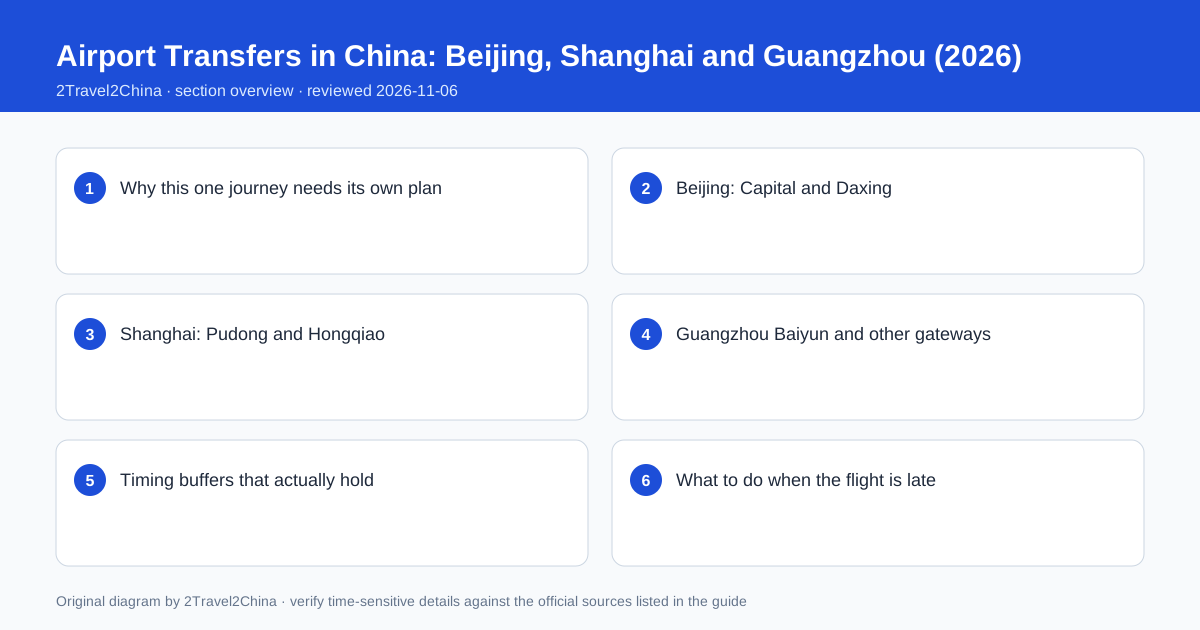
Why this one journey needs its own plan
A city-centre metro ride is a routine decision; an airport transfer is a chain. Immigration and baggage take an unpredictable amount of time, a new SIM or eSIM may need activation, the wallet has to work for the first time, and the destination address must be entered into a system you have not used before. Any one of those adds ten minutes. Together they can turn a comfortable connection into a missed hotel check-in or a missed onward train, so the transfer deserves a written plan rather than an improvised one.
| Factor | Typical effect | Mitigation |
|---|---|---|
| Immigration and baggage | Highly variable by flight and hour | Do not book a tight onward connection |
| Phone and wallet setup | First real test abroad | Verify both wallets before departure |
| Luggage volume | Makes stairs and interchanges slow | Consider a car for the arrival leg |
| Traffic | Unpredictable at peak hours | Rail for fixed-time arrivals |
| Terminal confusion | Large airports have multiple zones | Note terminal and pickup zone in advance |
Write down four things before boarding: the arrival terminal, the hotel address in Chinese, the chosen transport mode with its fallback, and the latest acceptable arrival time. Offline copies matter because the arrivals hall is exactly where a roaming connection is least reliable. A single note on the phone, readable without network, removes most of the friction.
Beijing: Capital and Daxing
Beijing has two main international airports. Beijing Capital International Airport is to the north-east and connected to the city by the Airport Express line, which links into the metro network at Dongzhimen. Beijing Daxing International Airport is to the south and has a dedicated express rail link as well as metro and road connections. Which one you use is decided by the airline, not by preference, so check the booking rather than assuming "Beijing" means a single terminal.
| Airport | Rail option | Road option |
|---|---|---|
| Capital (PEK) | Airport Express to Dongzhimen, then metro | Licensed rank or ride-hailing to the north-east districts |
| Daxing (PKX) | Daxing Airport Express into the metro network | Longer road transfer to the city centre |
| Either | Connect to the city metro for the final leg | Hotel car for a very late arrival |
| With luggage | Rail plus a short taxi for the last kilometre | One car door-to-door is simpler |
For a first arrival with two suitcases, the pragmatic choice is often a car from the signed rank rather than rail plus two metro interchanges. For a solo traveller at midday with a small bag, the express link is fast, cheap and immune to traffic. Decide based on luggage and hour rather than on price alone. Beijing’s distances are large: a "city centre" address can still be a long final leg from the express terminus.
Shanghai: Pudong and Hongqiao
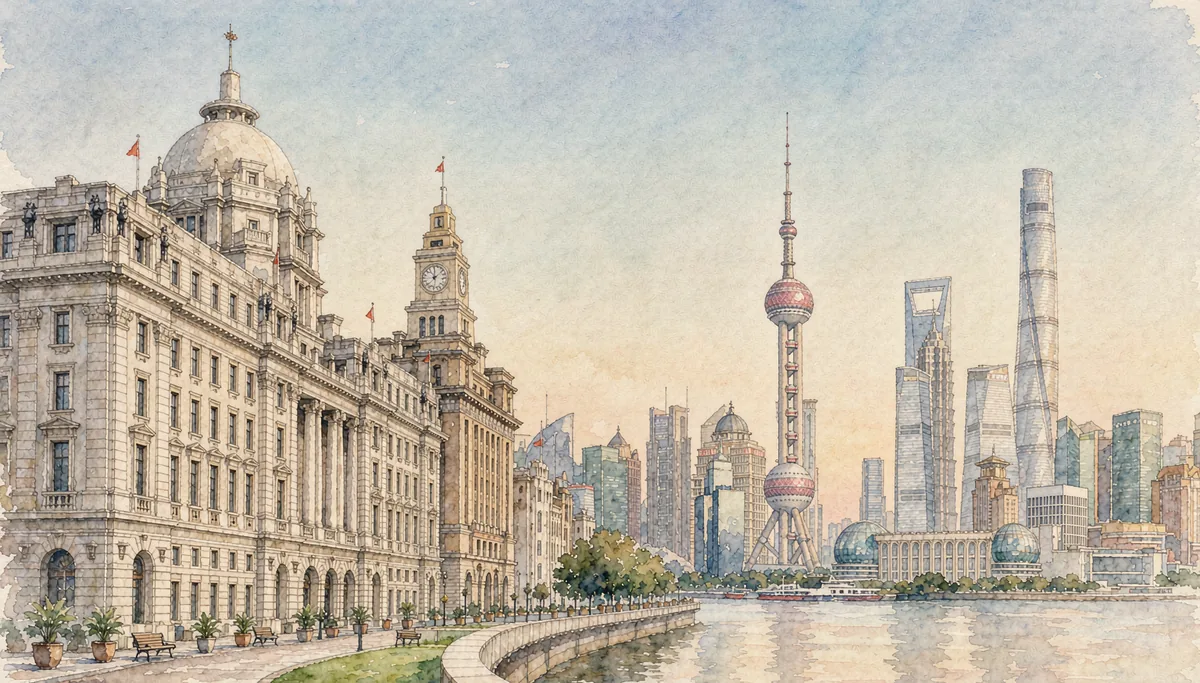
Shanghai Pudong International Airport is the main long-haul gateway to the east; Hongqiao is closer to the city and doubles as a major high-speed rail hub. Pudong is connected by metro and by the maglev line, which reaches the edge of the metro network quickly and then requires a transfer. Hongqiao is effectively inside the urban transport grid, with metro lines and the railway station integrated. A traveller arriving to connect immediately to a train should note that Hongqiao and Pudong are different places, not two terminals of one airport.
- Confirm whether the flight arrives at Pudong (PVG) or Hongqiao (SHA)
- For Pudong, compare the maglev plus metro transfer against a direct metro ride
- For Hongqiao, use the metro or a short taxi; the railway station is adjacent
- Allow for a long walk inside Pudong between the gate and the transport concourse
- Use a licensed rank or the numbered ride-hailing pickup zone after a late flight
The maglev is fast and interesting, but the total door-to-door time depends on the transfer at the other end and on where the hotel is. For a hotel near a metro line served directly from the airport, a single metro ride can be faster overall than a fast train plus a change. The Bund and the old city are not adjacent to either airport. Save the nearest metro station to the hotel in Chinese and check the last-train time if the flight lands in the evening.
Guangzhou Baiyun and other gateways
Guangzhou Baiyun International Airport is connected to the city metro, and the same network serves the main railway stations and the Canton Fair complex. During fair periods the roads and hotels around the complex are much busier, so rail becomes more valuable precisely when a visitor is most tempted to take a car. Chengdu, Xi’an, Hangzhou and other major gateways follow a similar pattern: a metro or express link, a signed licensed taxi rank and a designated ride-hailing zone.
| Gateway | Rail link | Planning note |
|---|---|---|
| Guangzhou Baiyun | Metro into the city network | Very busy during Canton Fair periods |
| Chengdu | Metro and airport rail connections | Two airports; confirm which one on the ticket |
| Xi’an | Airport road link plus metro options | City wall area is a longer final leg |
| Hangzhou | Metro link to the city | West Lake is not next to the station |
| Hongqiao (Shanghai) | Metro and high-speed rail integrated | Not the same place as Pudong |
Always confirm which airport the ticket names. Several Chinese cities have more than one, and a few have opened a new one relatively recently, so an old blog post may describe the wrong terminal. The airline confirmation is authoritative. If a domestic connection follows the international arrival, allow a generous buffer: a change of airport is a cross-city journey, not a terminal transfer.
Timing buffers that actually hold
A useful buffer is built from the parts of the journey, not from a single guess. Immigration, baggage, finding the rank or metro entrance, the ride itself and the walk from the station to the hotel each add time. Add them, then add a margin for a delayed inbound flight. For a same-day high-speed rail connection, the margin should be wider still, because a missed reserved train compresses the rest of the itinerary.
After landing
Allow for immigration, baggage and a long walk through the terminal.
Before leaving the airport
Activate data, confirm the wallet works and re-read the Chinese address.
Choose the mode
Rail for a fixed-time arrival; a car for luggage or a late hour.
Add the last leg
Count the walk or short taxi from the station to the hotel door.
Protect onward plans
Never place a reserved train immediately after an international arrival.
The most common itinerary mistake is booking a high-speed train two hours after an international landing. It looks feasible on a timetable and is not feasible in practice. Give the arrival day a light schedule: check in, eat nearby, and set up the phone properly. That slack protects the following days, and it costs one afternoon rather than an entire trip.
What to do when the flight is late
A late arrival changes three things: the last train may have gone, the licensed rank is still there but the queue may be longer, and a hotel may have a check-in cutoff. Check the last-train time for the airport line before boarding the flight. If the delay makes rail unrealistic, switch to a licensed taxi or a pre-arranged hotel car and notify the hotel with a short message. Keep the booking rather than cancelling it silently.
- Check whether the airport rail link is still running at the new arrival time
- Message the hotel that you will arrive late; save the reply offline
- Use the staffed licensed rank rather than an unsolicited approach in the hall
- Keep the receipt with the plate for any later query
- Move the next morning’s first activity later rather than cancelling the whole day
A delayed arrival is also the moment when a pre-verified wallet earns its keep. If the card was blocked or the passport record expired, the licensed rank and a small amount of RMB cash will still get you to the hotel. Resolve the wallet problem the next morning with a stable connection and access to your bank, rather than troubleshooting in the arrivals hall at midnight.
Airport rail links, last-train times, pickup zones and fare rules are set by local operators and change as lines open or terminals shift. Confirm the current terminal and transport options with the airline and the airport operator before you travel.
Frequently asked questions
Which airport will I arrive at in Beijing or Shanghai?
Beijing has Capital (PEK) and Daxing (PKX); Shanghai has Pudong (PVG) and Hongqiao (SHA). The airline confirmation is authoritative, and in Shanghai the two are far apart — Hongqiao is not a terminal of Pudong.
Is the airport express rail always faster than a taxi?
No. Rail is immune to traffic but often needs a transfer and a final leg to the hotel. For a solo traveller at midday it often wins; with heavy luggage or a late arrival, a licensed car door-to-door can be faster overall.
How much time should I allow between landing and a high-speed train?
Substantially more than the driving time. Immigration, baggage, finding the transport entrance, the ride itself and the station check all add up. Avoid placing a reserved train shortly after an international arrival.
Where should I go for a taxi at a Chinese airport?
The signed, staffed licensed taxi rank outside arrivals, or the numbered ride-hailing pickup zone shown in the app. Ignore anyone who approaches inside the hall offering a car.
What should I prepare before the flight lands?
The arrival terminal, the hotel address in Chinese, the chosen transport mode and a fallback, and the last-train time for the airport line. Save them offline so they work without a data connection.