How Much English Is Spoken in China? A Travel Reality Check (2026)
The honest answer is that English works well in a narrow set of places and barely at all in others. International hotels, airports, high-speed stations and major museums generally have staff or signage that can handle a visitor’s basic needs. A neighbourhood restaurant, a taxi or a small shop often cannot. This guide maps where the gap is and the small preparations that make it a non-issue.
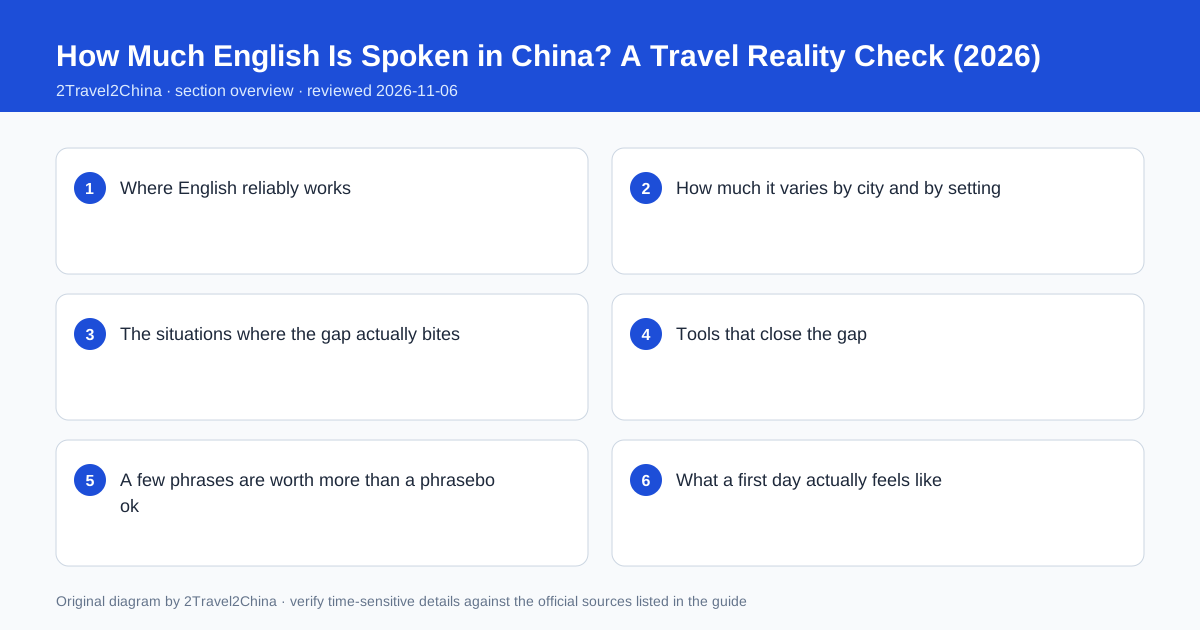
Where English reliably works
English is most dependable where the infrastructure is designed for international visitors. Airport and high-speed rail signage is bilingual, station announcements often include English, and major museums label galleries and key objects in English. International and mid-range city hotels have front-desk staff who can handle check-in, a taxi booking and a simple request. In Shanghai, Beijing and Guangzhou, the density of English-capable service staff is noticeably higher than in smaller cities.
| Setting | English level | What you can expect |
|---|---|---|
| International hotel front desk | Good | Check-in, directions, booking a car |
| Airport and high-speed station | Good signage, variable staff | Bilingual signs, some English at desks |
| Major museum | Good signage | English labels, maps, sometimes audio guides |
| City metro | Good signage | Bilingual station names and maps |
| Neighbourhood restaurant | Limited | Picture menus or a pointing system |
| Taxi or small shop | Limited | A written Chinese address is essential |
Signage is often better than speech. A visitor can navigate an entire metro system, a station and a museum without a conversation, because the words they need are printed in both languages. The gap appears at the exact point where a transaction becomes specific — a dietary requirement, a changed booking, a missing item — and that is where a written phrase or a translation app earns its place.
How much it varies by city and by setting
City matters less than setting. A front desk in a second-tier city may handle English better than a noodle stall in central Shanghai. International business districts, university areas and major tourist zones have more English exposure; residential neighbourhoods and local markets have less. Younger staff are more likely to have studied English, but conversational confidence varies widely, and someone may understand a written question far better than a spoken one.
- Judge by the type of place, not only by the city tier
- Written English is often understood better than spoken English
- Short, simple sentences work better than a long explanation
- A Chinese-character address or phrase removes most ambiguity
- Do not interpret a hesitant reply as unhelpfulness; it is usually a language gap
This is also why showing is more effective than asking. A phone screen with the Chinese name of a station, a dish or a hotel solves a transaction in seconds, while a spoken question can take a minute and still end in a shrug. Keep a short list of saved phrases and addresses in a plain notes app so they are available without a data connection.
The situations where the gap actually bites
Most of a trip needs no conversation: a metro gate reads a code, a QR payment settles, a train gate reads a passport. The situations that need language are specific and predictable — ordering food with a dietary restriction, explaining a wrong pickup point to a driver, checking whether a hotel can register a foreign passport, asking about an ingredient or an allergy, and resolving a booking discrepancy.
| Situation | Why it is hard | What works |
|---|---|---|
| Food allergy or dietary need | Ingredients and cooking methods are specific | A written Chinese card explaining it |
| Wrong pickup point | Place names and entrances are precise | A written Chinese address and landmark |
| Hotel registration question | An administrative rule, not small talk | A translated sentence plus the passport |
| Booking discrepancy | Names, dates and numbers | Show the confirmation on the screen |
| Medical issue | Precision matters | A translation app plus professional help |
For a food allergy, a printed or saved card in Chinese is more reliable than a translation app opened in a noisy kitchen. For a booking problem, showing the confirmation on the screen is better than describing it. In each case the goal is not to speak Chinese but to remove the need for the other person to interpret spoken English.
Tools that close the gap
A translation app with an offline Chinese pack, a saved set of addresses in Chinese characters, and a photo or image-based menu reader cover almost everything. Offline matters: the places where translation is most needed — a basement restaurant, a station concourse, a taxi at night — are exactly where a connection can be weakest. A few written numbers and dates also help, because Arabic numerals are shared even when the words are not.
Before departure
Install a translation app and download the offline Chinese pack.
Save key strings
Hotel, station, airport and first-day addresses in Chinese characters.
Add specific needs
An allergy or dietary card in Chinese, if relevant.
Use the camera mode
Point it at a menu or a sign rather than typing a description.
Confirm with numbers
Write the price, date or platform number on the screen.
Arabic numerals are a quiet advantage. Showing "2", "14:30" or "platform 6" on a phone resolves a surprising number of small misunderstandings, including queue numbers, table numbers and departure times. Where a spoken number might be misheard, the written digit is unambiguous.
A few phrases are worth more than a phrasebook
A long phrasebook is less useful than five saved strings: the hotel address, "I do not eat X" if relevant, "please write it down", "how much", and the name of the nearest metro station. Each maps to a real transaction rather than to a hypothetical conversation. Save them as text and as an image so they work on a locked or low-battery phone.
- The hotel name and address in Chinese characters, from the booking confirmation
- The two or three station names you will use that day
- A dietary or allergy sentence written out in Chinese
- A short request to write something down or show the price
- A screenshot of the return ticket and the passport page
The attitude matters as much as the tools. A short, factual exchange with a written prompt resolves far more than a loud or elaborate English sentence. Most service staff are trying to help and are constrained by the same gap; making the question easy to answer is the quickest route to an answer.
What a first day actually feels like
In practice the first day is the hardest and the rest is surprisingly smooth. Arrival combines fatigue, a new SIM, a first wallet payment and a transfer — all at once. By day two the metro signs, QR codes and a handful of saved phrases have become routine. Most visitors end a trip having had fewer conversations than they expected, because the systems they use are designed to work without one.
- Expect day one to be the only genuinely difficult day
- Set up wallets, maps and addresses before the flight, not in the arrivals hall
- Use signage and QR systems rather than asking for directions
- Keep a no-phone fallback: a written address and a little cash
- Treat a language gap as a logistics detail, not a barrier
The gap is real but narrow. It does not prevent a trip, and it does not require language study. It requires about twenty minutes of preparation — an offline pack and a handful of Chinese strings — plus the habit of showing rather than explaining. That is enough for almost every situation a first-time visitor meets.
English signage, staff language ability and app features vary by venue, city and operator. Install offline tools before departure and confirm current visitor information with the specific hotel, station or attraction when a detail matters.
Frequently asked questions
Do people speak English in China?
In international hotels, airports, high-speed stations and major museums, often enough for a visitor’s needs. In neighbourhood restaurants, taxis and small shops, much less. Signage is generally more reliable than conversation.
Can I travel in China without speaking Chinese?
Yes. Metro signage, QR payments, passport-linked rail tickets and bilingual museum labels handle most of the trip without a conversation. A translation app with an offline pack and saved Chinese addresses cover the rest.
Is English more common in Beijing and Shanghai?
Generally yes in international districts and tourist zones, but the type of place matters more than the city. A hotel front desk in a smaller city may handle English better than a small stall in a major one.
How do I handle a food allergy without Chinese?
Use a saved or printed card in Chinese that states the specific ingredient and the consequence. It is more reliable than a spoken explanation in a busy kitchen.
What should I save on my phone before arrival?
The hotel name and address in Chinese characters, the station names you will use, any dietary or allergy sentence, and offline copies of bookings and the passport page.