Toilets in China: What to Expect and How to Prepare (2026)
Public toilets are one of the small, persistent worries of a first trip to China, and the reality is more varied and more manageable than the reputation. Modern malls, airports, museums and high-speed stations usually have seated cubicles; older public facilities and some rural sites still have squat toilets. This guide explains what you will actually find and the small kit that removes the uncertainty.
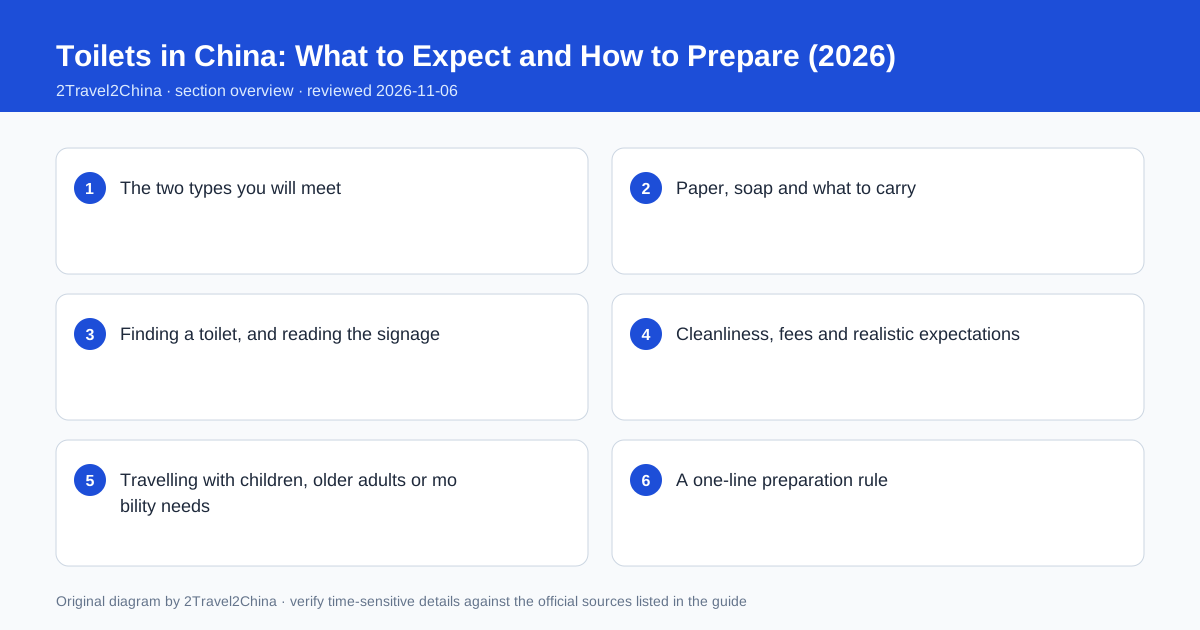
The two types you will meet
Most visitors encounter both squat and seated cubicles on the same trip. A squat toilet is a porcelain fixture set into the floor, used facing the door, with a flush pedal or a cistern. A seated cubicle is the familiar Western-style fixture. Newer public buildings, international hotels, airports, major museums and shopping centres are predominantly seated, often with at least one accessible cubicle. Older street-level public toilets, some scenic-area facilities and rural stops are more likely to be squat.
| Setting | Likely fixture | What to expect |
|---|---|---|
| International hotel | Seated | Paper, soap, often a bidet or spray |
| Airport and high-speed station | Mostly seated | Paper usually available, busy at peak times |
| Shopping centre and museum | Mostly seated | Well maintained, clear signage |
| Older public toilet | Often squat | Bring your own paper and sanitiser |
| Scenic area or rural stop | Mixed, often squat | Variable cleanliness, limited supplies |
The direction to face on a squat fixture is a common source of confusion. Face the door, with the hooded end away from you, and keep bags zipped and off the floor. There is no special technique beyond that. Travellers with knee, hip or balance concerns should look for the accessible cubicle, which is almost always seated, or plan around a hotel, mall or museum rather than a street-level facility.
Paper, soap and what to carry
The reliable rule is that paper is not guaranteed. Many modern facilities provide it, sometimes from a dispenser in the cubicle and sometimes from a shared dispenser at the entrance — which is worth noticing before you go in. Older public toilets often sell or issue paper at the door, or provide none. Soap and hand drying vary in the same way. A small day kit solves all of it without taking up space.
- A pocket pack of tissues, kept in the day bag rather than the suitcase
- A small bottle of hand sanitiser for when soap or water is unavailable
- A few small notes or coins where a facility charges a fee
- A zip bag for used tissues when a bin is not provided in the cubicle
- Any personal medication or hygiene items, since vending is unpredictable
Carrying tissues is normal for residents as well as visitors, so there is nothing conspicuous about it. Keep one pack in a jacket pocket and one in the day bag, because the moment you need it is rarely the moment you are standing next to your luggage. A small phone pouch or zipped pocket also prevents the common accident of a phone slipping from a pocket while using a squat cubicle.
Finding a toilet, and reading the signage
Chinese public toilets are usually signed with the characters for male and female, often alongside a pictogram and the word for toilet or washroom. In transport hubs and malls the signs are large and frequently include English. Staff at a museum, station or restaurant will understand a short translated phrase or a phone screen showing the characters. Metro stations, large department stores, fast-food outlets and hotel lobbies are the most dependable options in a city.
| Place | Reliability | Note |
|---|---|---|
| Metro station | High | Often near the concourse or an exit |
| Shopping centre | High | Usually on each floor, well maintained |
| Museum or major attraction | High | Expect a queue at peak times |
| Fast-food or café chain | Medium | Sometimes for customers only |
| Hotel lobby | High | Discreet and almost always seated |
A translation app with an offline Chinese pack is useful here, but saving the two characters as an image is faster than opening an app. If a sign is ambiguous, look at the pictogram rather than guessing from the characters. In an unfamiliar building, asking a member of staff with a written phrase is quicker than wandering between floors.
Cleanliness, fees and realistic expectations
Standards vary widely and have improved substantially in cities over the past decade. A well-maintained mall or station facility is clean, lit, stocked and attended; a busy street-level public toilet at the end of a festival day may not be. Some scenic sites charge a small fee, usually collected at the entrance, and some older facilities have no bin inside the cubicle. These are variations in maintenance, not a national rule.
- Judge each facility individually rather than applying one reputation to the whole country
- Prefer a mall, museum, station or hotel when you have the choice
- Expect a queue at major attractions at midday and during holiday weeks
- Carry small change where a scenic-site fee is posted
- Use sanitiser after washing if the drying facilities are absent
Holiday weeks change the picture more than geography does. A facility that is fine on a Tuesday can be stretched on the third day of a national break, with queues and supplies running low. On those days, use facilities when you encounter a good one rather than waiting until the last minute — the same principle that applies to charging a phone.
Travelling with children, older adults or mobility needs
For a family or a group with mobility needs, the plan is simply to choose facilities deliberately. Identify seated and accessible cubicles at the hotel, the main museum and the station before setting out, and use them as anchors. A squat cubicle is usable for most people but awkward with a small child, a knee problem or a heavy day bag. Many newer facilities have a family or accessible room with a wider door and a seated fixture.
At the hotel
Note where the lobby accessible cubicle is before leaving each morning.
At the first stop
Use the museum or mall facility rather than waiting.
On a long transfer
Use the station or onboard train facility before boarding.
At a scenic site
Use the entrance facility even if it feels early.
Keep the kit reachable
Tissues, sanitiser and any medication in the day bag.
High-speed trains have onboard toilets, generally seated on newer carriages, and stations have large facilities. Using them before a long road transfer removes most of the uncertainty of a rural stop. None of this requires special preparation beyond a small kit and the habit of noticing a good facility when you pass one.
A one-line preparation rule
Carry tissues and sanitiser, prefer modern buildings when you have a choice, and do not let a reputation decide the day. That is the whole preparation. The vast majority of facilities a visitor uses on a normal city itinerary are clean, clearly signed and entirely unremarkable.
- One pocket pack of tissues and one in the day bag
- A small sanitiser bottle
- A saved image of the Chinese characters for toilet, male and female
- Small change for a rare scenic-site fee
- No anxiety required — modern city facilities are the norm
The topic attracts disproportionate worry because it is rarely discussed in plain terms. Once the first day is over, most travellers stop thinking about it entirely. It belongs on a preparation list alongside a plug adapter and a power bank: a small practical detail that is easy to handle in advance and irrelevant afterwards.
Facilities, signage and supplies vary by venue and are improved or refurbished over time. Check current visitor information for a specific attraction if you have particular accessibility requirements, and confirm with the venue directly.
Frequently asked questions
Are squat toilets still common in China?
They are still found in older public facilities, some scenic areas and rural stops. Airports, high-speed stations, malls, museums and international hotels are mostly seated, often with an accessible cubicle.
Do public toilets in China provide toilet paper?
Not reliably. Modern facilities often do, sometimes from a dispenser at the entrance rather than in the cubicle. Carry a pocket pack of tissues and a small sanitiser bottle.
Which way do you face on a squat toilet?
Face the door, with the hooded end away from you. Keep bags zipped and off the floor, and keep a phone in a zipped pocket rather than a loose one.
Where can I reliably find a seated toilet in a Chinese city?
Hotel lobbies, shopping centres, major museums, airports and high-speed rail stations. Metro stations are also dependable, usually near the concourse or an exit.
What should travellers with mobility needs do?
Use accessible or family cubicles in modern buildings as anchors, note them at the hotel and the first stop, and use station facilities before long road transfers. Many newer sites have a wider, seated cubicle.