Tap Water in China: Is It Safe to Drink and What Should You Drink? (2026)
The short answer is that visitors should not drink unboiled tap water in China. Hotels, homes and offices commonly boil water or use filtered dispensers, and bottled water is cheap and everywhere. That is a practical habit rather than a dramatic health warning. This guide explains the reasoning, the alternatives, and the small related questions about ice, fruit and brushing teeth.
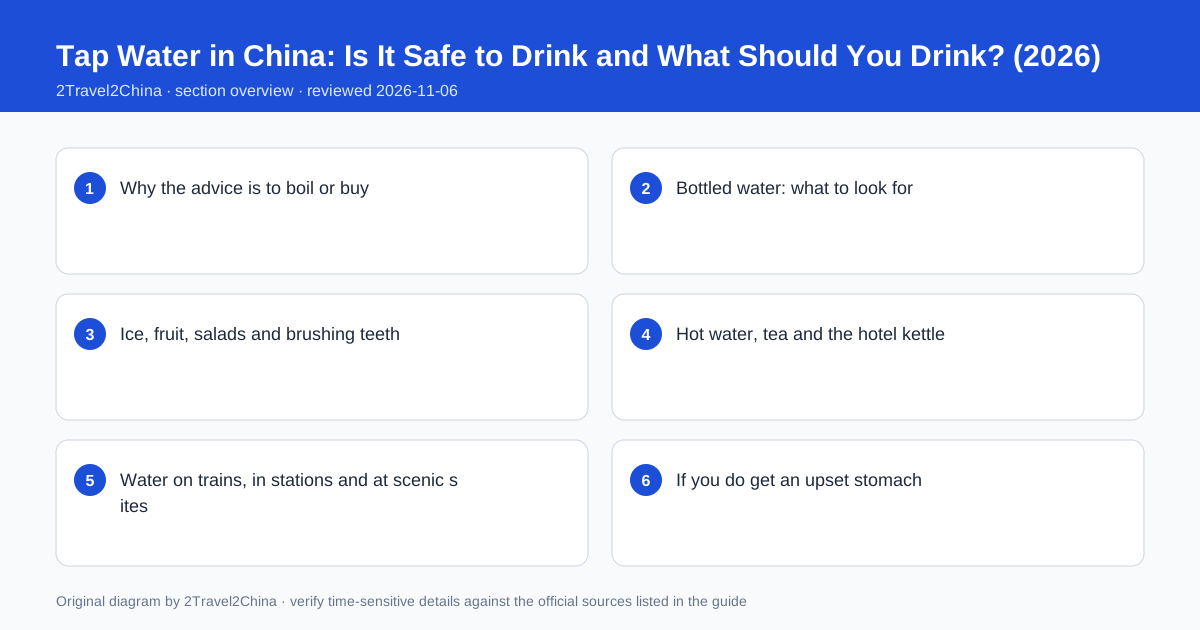
Why the advice is to boil or buy
Municipal water is treated, but the water that reaches a tap can pick up issues in older building pipes and storage tanks, and the microbial profile may differ from what a visitor’s stomach is used to. For that reason the common local practice is to boil water for drinking, or to use a filtered or bottled supply. Boiling handles the microbial concern; it does not change mineral content or address every possible contaminant, which is why a filter or bottled water is common in cities as well.
| Source | Typical use | Visitor advice |
|---|---|---|
| Tap, unboiled | Washing, cleaning, sometimes cooking | Do not drink it as-is |
| Tap, boiled | Drinking in homes and hotels | Generally the local standard |
| Filtered dispenser | Offices, hotels, stations | Usually fine when maintained |
| Bottled still water | Everywhere, inexpensive | The simplest visitor default |
| Kettle in the room | Most hotel rooms | Boil, then cool before drinking |
This is not a judgement about water quality in one country versus another; it is about a change in the local microbial environment. A traveller’s digestive system is adapted to home water, and a short trip is exactly the wrong time to test that adaptation. The low-cost, low-effort choice is to drink bottled or boiled water and not think about it again.
Bottled water: what to look for
Bottled still water is sold in convenience stores, supermarkets, stations, kiosks and hotel shops, usually in 500 ml and larger sizes. Check that the seal is intact, since a reused bottle with a broken cap is the one thing worth rejecting. Sparkling water and flavoured drinks are widely available too, but plain still water is the cheapest and most useful. Buying a large bottle for the room and a small one for the day bag covers most days.
- Check the cap seal before drinking, especially at a small kiosk
- Choose plain still water rather than a sweetened drink for hydration
- Keep a large bottle in the room and a small one in the day bag
- Recycle where bins are provided; public bins are common in cities
- Do not pay a premium at a scenic-site kiosk when a store is nearby
At a restaurant, bottled water is often offered alongside tea. It is fine to ask for it, and the charge is small. Tap water is not usually served as a complimentary table drink in the way it might be elsewhere; hot tea or boiled water is the more common default. If a place provides a jug of warm water on the table, it has generally been boiled.
Ice, fruit, salads and brushing teeth
The related questions are more about consistency than about a single rule. In international hotels, established restaurants and city cafés, ice is normally made from filtered or bottled water and washed fruit is fine. At a small stall or in a rural setting, a visitor with a sensitive stomach may prefer to skip ice, choose fruit that can be peeled, and avoid raw leafy salads. These are the same precautions a careful traveller applies in many destinations.
| Item | Usual situation | Conservative choice |
|---|---|---|
| Ice in a city café | Usually filtered or bottled | Skip it if unsure |
| Ice at a small stall | Variable | Skip it |
| Fruit you peel | Low risk | A good default |
| Raw leafy salad | Variable at small stalls | Choose cooked dishes |
| Brushing teeth | Tap water is fine for most | Use bottled if your stomach is sensitive |
Brushing teeth with tap water is generally fine because the quantity swallowed is tiny, but a traveller who is being cautious can use bottled water for the first few days. The bigger day-to-day factor is simply hydration: a full day of walking in a humid summer city needs more water than most people expect, and a refillable bottle plus a reliable source is more useful than a rule about ice.
Hot water, tea and the hotel kettle
Hot or boiled water is widely available: hotel kettles, dispensers in stations and offices, thermos flasks in homes, and tea served with meals. A hotel kettle is the simplest way to produce drinking water in the room — boil, let it cool, then fill a bottle for the next day. Check the kettle briefly before first use, as you would in any hotel, and let the water cool fully before pouring it into a plastic bottle.
Inspect the kettle
A quick visual check before the first boil is standard hotel practice.
Boil a full kettle
Let it cool completely before transferring to a bottle.
Fill a bottle for the next day
A cool supply in the morning saves a shop stop.
Use station dispensers
Filtered hot-water dispensers are common in waiting areas.
Accept tea with meals
It is boiled water by default and a normal part of the meal.
Tea is worth mentioning because it is both a cultural constant and a practical hydration source. It arrives hot, it has been boiled, and it is frequently refilled. A visitor who does not want caffeine can ask for plain hot water instead. Neither requires a phrasebook beyond a short translated request.
Water on trains, in stations and at scenic sites
Long-distance trains are easier than most visitors expect. High-speed carriages have a hot-water dispenser near the end of each carriage, intended for tea and instant noodles. The water is boiled, but the dispenser is not a chilled drinking fountain, so fill a bottle that tolerates heat and let it cool before drinking. Station waiting rooms usually have the same dispensers alongside shops selling bottled water. On a journey of several hours, buy a bottle before boarding instead of relying on the trolley, which may not pass through every carriage on a busy service.
| Setting | What is usually available | Practical move |
|---|---|---|
| High-speed train | Boiled hot-water dispenser per carriage | Bring a heat-safe bottle; buy cold water before boarding |
| Major station | Dispensers, convenience stores, kiosks | Refill before a long connection |
| Scenic site | Bottled water at kiosks, sometimes dispensers | Carry two bottles on a long walking route |
| Long-distance bus | Few stops, limited shops | Board with a full bottle |
| Hotel gym or meeting room | Filtered dispenser or water cooler | Usually fine when visibly maintained |
Scenic sites are the one setting where planning pays off. A large heritage site or a mountain trail can involve several hours of walking with only a few kiosks, and summer humidity in eastern and southern cities makes dehydration a more realistic problem than water quality. Start with two bottles, note where the dispensers or shops are on the site map, and replace what you drink at the next stop. In winter the same rule applies in dry northern cities, where thirst is less obvious but fluid loss continues. A small electrolysis or rehydration sachet in the day bag is a cheap backup on a hot full-day route.
If you do get an upset stomach
Most travel-related stomach trouble is short-lived and resolves with rest, fluids and simple food. The important step is replacing fluids with a safe source — bottled or boiled water, or an oral rehydration sachet — rather than stopping drinking. Keep a small supply of rehydration sachets and any usual medication in the day bag, and know where the hotel is relative to a pharmacy.
- Keep drinking safe fluids; dehydration is the main short-term risk
- Use oral rehydration sachets if symptoms persist
- Choose simple cooked food for a day rather than a rich banquet
- Ask the hotel front desk for the nearest pharmacy, in writing
- Seek medical attention for fever, blood, or symptoms that do not settle
A travel insurance policy with medical cover and a 24-hour assistance number is useful here, because public hospitals generally expect payment at the point of service and international departments are self-pay or billed to international commercial insurance. Save the assistance number offline. For the overwhelming majority of visitors none of this is needed, but knowing the route to care is what makes a minor problem a minor problem.
Water practice, local supplies and health guidance vary by city and property. This guide gives a conservative visitor default rather than a medical assessment. For specific health conditions or persistent symptoms, seek qualified medical advice and check current official health guidance.
Frequently asked questions
Can I drink tap water in China?
Visitors should not drink it unboiled. Municipal water is treated, but older building pipes and a different microbial profile make boiled, filtered or bottled water the sensible default for a short trip.
Is bottled water easy to find and safe?
Yes. It is inexpensive and sold in convenience stores, supermarkets, stations and kiosks. Check that the cap seal is intact, especially at a small stall.
Is the ice in Chinese restaurants safe?
In international hotels, established restaurants and city cafés it is normally made from filtered or bottled water. At a small stall or in a rural setting, a cautious traveller can simply skip the ice.
Should I brush my teeth with tap water?
Most visitors do, because the amount swallowed is tiny. If your stomach is sensitive, use bottled or boiled water for brushing for the first few days.
What is the hotel kettle for?
Boiling drinking water is a common local practice. Boil a full kettle, let it cool, and fill a bottle for the next day. Hot-water dispensers in stations and offices work on the same principle.