Travel Insurance for China: What a Policy Should Actually Cover (2026)
Travel insurance is not a Chinese visa requirement for most short tourist visits, but it is the one purchase that changes a bad day into an inconvenience rather than a financial problem. The useful question is not whether to buy a policy but whether the policy covers medical treatment in mainland China, evacuation, and the disruption that a long multi-city rail itinerary can produce. This guide explains what to look for and what standard policies quietly exclude.
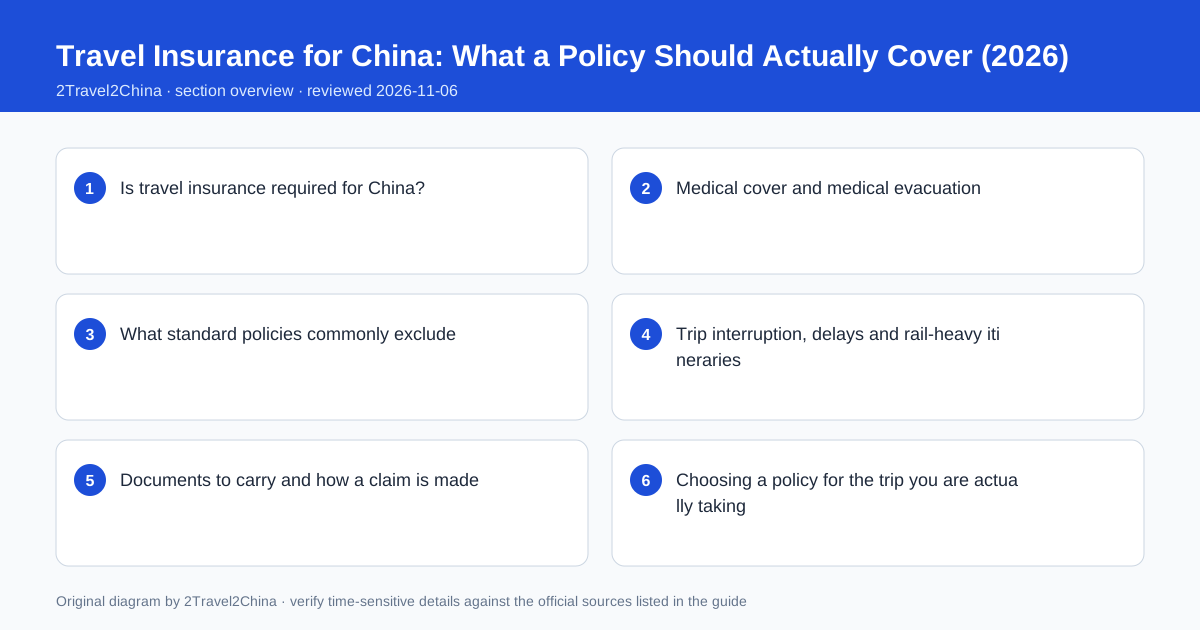
Is travel insurance required for China?
For an ordinary tourist or business visit, China does not generally require proof of travel insurance at the border, and it is not part of the standard L visa document set. That is different from some long-stay categories: students and residents may be required to hold medical insurance through a university, employer or local scheme, and those arrangements are separate from a travel policy bought at home. Some tour operators, cruise lines and visa-centre premium services also ask for cover as a commercial condition, which is not a government rule. The absence of a requirement is not a recommendation to travel uninsured.
| Traveller type | Insurance commonly required | What it is for |
|---|---|---|
| Short tourist visit | Not normally required | Optional protection against medical and trip costs |
| Long-term student | Often required by the institution | Campus or designated local medical cover |
| Employed resident | Varies by employer and local rules | Social insurance plus any commercial top-up |
| Organised tour or cruise | Often a booking condition | Operator liability and cancellation terms |
| Visa application | Not part of standard L visa documents | Some premium services bundle it anyway |
The practical reason to buy cover is that a visitor is outside their home health system. Public hospitals in China generally expect payment at the point of service, and international or VIP departments — the ones with English-language intake — are classed as special-demand services that are self-pay or billed to international commercial insurance rather than reimbursed through the basic medical insurance fund. A policy with a direct-settlement network or a straightforward reimbursement process is therefore worth more than one with a large headline limit and a difficult claims procedure.
Medical cover and medical evacuation
Look first at the medical limit, then at how the insurer pays. A policy that requires you to pay a large bill upfront and claim later is manageable for a minor consultation but painful after an inpatient stay. Ask whether the insurer has a 24-hour assistance line that can guarantee payment to a hospital in China, whether it can arrange transfer to a better-equipped facility, and whether medical evacuation to your home country or to a regional centre is included with a realistic limit. Evacuation is the expensive component, not the consultation.
- Inpatient and outpatient treatment within mainland China, with no geographic exclusion
- Medical evacuation and repatriation with a limit appropriate to a long-haul flight
- A 24-hour assistance contact that can guarantee hospital payment directly
- Cover for pre-existing conditions where declared, or at least a clear written position on them
- Reasonable cover for dental emergencies and prescribed medication
Read the definition of a medical emergency as well as the limit. Some policies exclude treatment that results from an activity they classify as hazardous, and some exclude any travel to a destination under a government advisory. If your itinerary includes high-altitude travel in Yunnan, winter sports near Harbin, or a long hiking day at Huangshan, check those specifically. A general statement that adventure activities are excluded can remove cover from exactly the day you were most likely to need it.
What standard policies commonly exclude
Exclusions are where an apparently generous policy becomes narrow. The recurring ones for China trips involve activities, timing and documentation. Winter sports, motorised vehicles, high-altitude trekking and organised competitions are frequently listed. Incidents linked to alcohol, unlicensed transport or an undisclosed pre-existing condition are also common exclusions. Cancellation cover often excludes events that were already known when the policy was bought, which matters for a trip planned around a holiday period when transport disruption is predictable.
| Exclusion | Where it bites on a China trip | What to check |
|---|---|---|
| Hazardous activities | Skiing, high-altitude trekking, via ferrata | Named activity list, not a general phrase |
| Unlicensed transport | Unmarked taxis and informal rides | Whether licensed ride-hailing is covered |
| Known events | Strikes, published schedule changes, weather warnings | The date the event became publicly known |
| Pre-existing conditions | Any ongoing treatment or medication | Declaration process and written confirmation |
| Valuables limits | Phones and cameras carried daily | Single-item cap and theft-from-bag clauses |
Two details are easy to miss. First, many policies cap a single item well below the total baggage limit, and a phone lost or damaged on a trip is often the most likely claim. Second, some require a police report within 24 hours for theft, which is obtainable but takes time out of a travel day. Keep the policy wording available offline and save the assistance number in the phone before departure. If a clause is unclear, ask the insurer in writing before you buy; a vague answer at purchase time becomes a denial at claim time.
Trip interruption, delays and rail-heavy itineraries
A China itinerary usually depends on a chain of reserved high-speed rail tickets and prepaid hotel nights. One delayed inbound flight can break the chain three days later. Trip interruption cover pays the extra cost of catching up with the itinerary or returning early, while delay cover pays a fixed benefit after a defined number of hours. Read the trigger precisely: some policies cover only the first leg, some require the delay to be caused by a named peril, and some exclude delays announced before departure.
Map the chain
List the non-refundable legs: international flights, intercity rail, prepaid hotels, booked attraction slots.
Check the delay trigger
Confirm the number of hours, whether it applies to any leg, and what causes qualify.
Check cancellation reasons
Illness, a family emergency and a missed connection are treated differently by different policies.
Keep every receipt
Rebooking fees, extra nights and replacement transport all need evidence.
Record the cause in writing
A written delay confirmation from the carrier is far stronger than a screenshot of an app.
Rail tickets in China are usually changeable or refundable under published rules, so a missed train is often a modest cost rather than a claim. The expensive scenarios are a missed international connection, a weather-driven flight cancellation that strands you away from your departure city, or a medical issue that ends the trip. Choose cover that handles those, and keep a buffer night near the departure airport rather than relying on insurance to rescue an over-tight final day.
Documents to carry and how a claim is made
A claim is a documentation exercise. Carry the policy number, the assistance phone number, a copy of the certificate and the wording — the wording matters more than the marketing summary. At a hospital, ask for an itemised bill, the medical report, proof of payment and, where relevant, a translation or an English-language summary. For a theft, obtain a police report. For a delay, ask the carrier for a written confirmation of the cause and duration. Photograph everything at the time, before the original documents disappear into a bag.
- Policy certificate, schedule of benefits and full wording, saved offline
- A 24-hour assistance number that works from outside your home country
- Passport copy and the entry stamp page, which insurers often request
- Itemised receipts, medical reports and written carrier confirmations
- A simple record of dates, places and the sequence of events
Notify the insurer as early as the policy requires, usually within a short window of the incident, even if you do not yet have every document. Most denials arise from late notification or from paying a large bill without contacting the assistance line when the policy required prior authorisation. Keep a single email thread with the claim reference and add documents as they arrive. If the policy was bought through a comparison site or a bank, the assistance line belongs to the underwriter, not the retailer, so find that number before you travel.
Choosing a policy for the trip you are actually taking
Match the cover to the shape of the trip, not to the cheapest annual premium. A seven-day Shanghai conference with one hotel needs modest medical cover and little else. A three-week route across Beijing, Xi’an, Chengdu and Guilin with prepaid rail and hotels needs stronger interruption cover. A winter trip including Harbin or a high-altitude leg in Yunnan needs the activity clauses checked explicitly. A family trip needs the pre-existing condition position for every traveller named on the policy.
- Short single-city trip: solid medical and evacuation cover, modest baggage and delay benefits
- Multi-city rail itinerary: stronger trip interruption and rebooking cover
- Winter or mountain itinerary: written confirmation that named activities are covered
- Long stay: check the maximum continuous trip length, often 30, 60 or 90 days
- Frequent traveller: annual multi-trip cover, but verify the per-trip limit and destination list
The last item is easy to overlook: an annual policy may cover any number of trips but only a limited number of days per trip, and some exclude China from a regional definition. Read the schedule, confirm that mainland China is inside the geographic area, and check whether Hong Kong and Macao are treated separately — they are distinct immigration territories and some policies treat them as distinct destinations too. Buy the policy when you book the first non-refundable element, because cancellation cover usually starts from the purchase date rather than the departure date.
Insurance products, exclusions and destination definitions differ between insurers and change over time. This guide is a checklist for reading a policy, not a recommendation of a product. Confirm cover in writing with the underwriter before purchase, and verify current entry requirements with your Chinese mission.
Frequently asked questions
Is travel insurance mandatory for a tourist visa to China?
No. Proof of travel insurance is not part of the standard L visa document set for a short tourist visit. Long-stay students and employees may have separate insurance requirements through their institution or employer.
Will my home health insurance cover treatment in China?
Usually not directly. Public hospitals generally expect payment at the point of service, and international departments are self-pay or billed to international commercial insurance rather than to China’s basic medical insurance fund.
What is the most important cover for a China trip?
Medical treatment within mainland China, medical evacuation with a realistic long-haul limit, and a 24-hour assistance line able to guarantee hospital payment directly. A large headline limit is less useful without a workable payment route.
Are high-altitude trips and winter sports covered?
Often excluded under a general hazardous-activities clause. If your itinerary includes Yunnan highlands, skiing near Harbin or serious hiking, get written confirmation that the named activity is covered before buying.
What documents do I need to make a claim?
The policy number and wording, itemised receipts, a medical report or police report, written confirmation of any delay from the carrier, and proof of payment. Notify the insurer within the window specified in the policy.