Passport Validity and Invitation Letters for a China Visa (2026)
A Chinese visa application is mostly a document exercise, and the rejections are mostly avoidable: a passport with too little remaining validity, a name that does not match across forms, a photo that fails the specification, or an invitation letter that is needed but missing. This guide gives the full checklist, explains which documents are category-dependent, and covers the two forms that appear after the visa is issued.
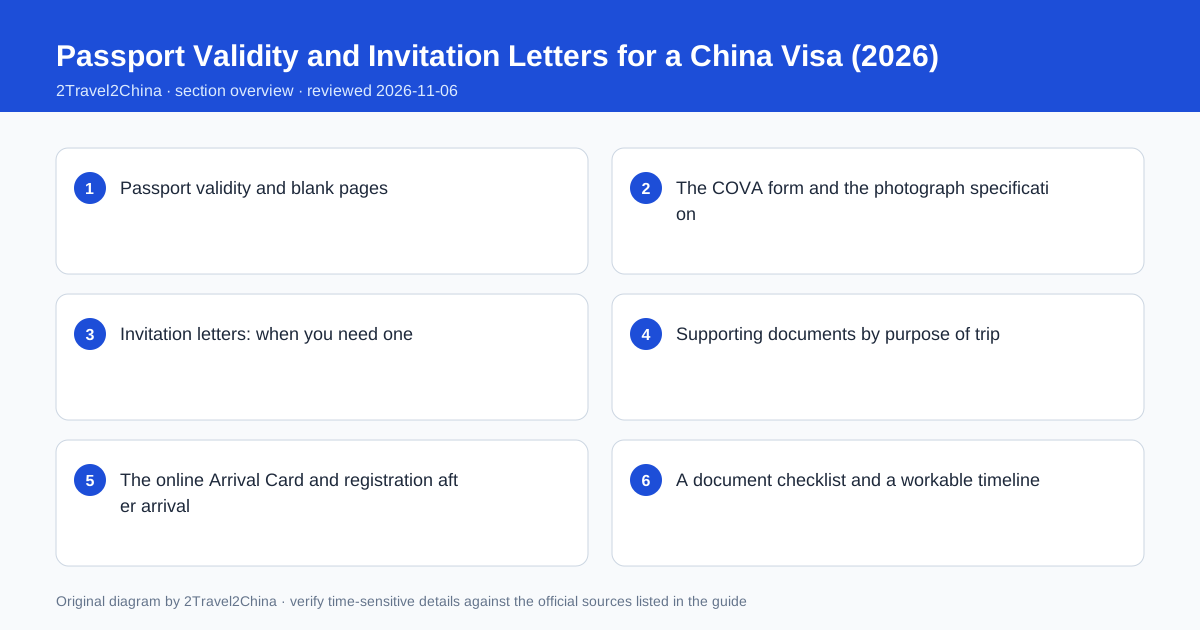
Passport validity and blank pages
Chinese missions generally expect an ordinary passport with at least six months of remaining validity at the time of application and at least one or two blank visa pages. The exact wording differs slightly by mission, and some apply the six-month rule to the intended date of entry rather than to the application date. A passport that expires in seven months is technically usable in many cases but leaves almost no room for a delayed trip or an extended stay, so renewing first is the cheaper decision. Check the physical document, not a note in a travel app: the printed expiry date and the number of genuinely blank pages are what the counter will look at.
| Item | What to check | Why it fails |
|---|---|---|
| Expiry date | At least six months beyond the planned entry | Renewal cycles collide with a fixed departure date |
| Blank pages | At least two fully blank visa pages | Endorsement pages do not count as blank |
| Name spelling | Identical to the COVA form and tickets | Transliteration differences trigger a re-submission |
| Passport condition | No damage to the biographical page | A damaged document may not be accepted at all |
| Previous visas | Old Chinese visas in a cancelled passport | Officers may ask to see travel history |
Names are a surprisingly common source of delay. Copy the machine-readable zone exactly, including hyphens, spaces and middle names, into the COVA form, the airline booking and the visa application. If a passport was renewed after a ticket was bought, update the airline record before applying. Where an applicant holds more than one nationality, use the same passport throughout the entire process — application, entry stamp, rail bookings and hotel registration all read the same document.
The COVA form and the photograph specification
The China Online Visa Application form, usually called COVA, is completed online, printed and signed, then submitted with the supporting documents at a Visa Centre or embassy. It generates a barcode and an appointment reference. The form asks for a detailed travel history, employment history, family details and the intended itinerary. Answer consistently with the supporting paperwork: the employer name, hotel address and travel dates should match the letters and bookings you attach. Inconsistency is treated as a reason to question the application, even when each individual answer is plausible.
- A recent colour photograph on a plain white background, full face and no head covering
- Neutral expression, eyes open and visible, no glasses with tinted lenses
- The printed and signed COVA form with its barcode page
- A photocopy of the passport biographical page
- Proof of legal residence if applying outside your country of nationality
The photograph is one of the most frequent technical rejections at the counter. Selfies, cropped holiday photos and images with shadows behind the head are routinely refused. A passport-photo service that knows the Chinese specification is a small cost compared with a second appointment. Bring two copies, keep the digital source file in case an online upload is required, and do not staple anything to the form. Where the mission offers an online submission route, the digital version still has to match the printed one.
Invitation letters: when you need one
An invitation letter is not a universal requirement. For a standard L visa with hotel bookings and a return ticket, many missions do not ask for one. It becomes necessary when a private individual or an organisation in China is hosting you, and it is a core document for M, F, Q, S and Z categories. The letter should identify the inviter, the invitee, the purpose and dates of the visit, who bears the costs, and the inviter’s contact details and status in China. A company invitation is normally accompanied by business registration evidence; a private host supplies a copy of their identity document and, for a foreign host, their residence permit.
| Situation | Invitation needed | What the host supplies |
|---|---|---|
| Tourist staying in hotels | Usually not | Hotel bookings and return ticket instead |
| Staying with a friend | Usually yes | Letter, ID copy, address, sometimes residence proof |
| Business meetings | Yes | Company letter plus registration details |
| Family reunion | Yes | Relationship evidence and host residence status |
| Employment | Yes, plus work authorisation | Employer work permit notification |
The letter does not need elaborate wording, but it does need to be internally consistent. If the letter says the visit is for business while the COVA form says tourism, the application has a problem. If the dates on the letter do not cover the dates on the hotel booking, the same. Ask the host to use the exact passport name, to sign and date the letter, and to send a scanned copy early enough that you can check it before the appointment. A scanned signature is widely accepted, but confirm with the handling mission.
Supporting documents by purpose of trip
Beyond the passport and the form, the supporting set depends on why you are going. A tourist supplies travel and accommodation evidence. A business visitor supplies an invitation and, sometimes, evidence of the commercial relationship. A student supplies an admission notice and the relevant JW form. A family visitor supplies relationship documents. Proof of funds is requested less often for short tourist trips than applicants expect, but it is sensible to carry a recent statement when applying for a long stay or a multiple-entry visa.
- Return or onward flight reservation with a fixed date
- Hotel bookings covering at least the first part of the stay, or a host invitation letter
- Travel itinerary sufficient to show the trip is plausible, without pre-booking every museum
- Employment letter or enrolment proof where the mission requests it
- Certified translations or legalised civil documents for family and long-stay categories
Do not buy non-refundable tickets before the visa is issued. A reservation or a refundable booking satisfies the documentary requirement without putting the fare at risk if processing takes longer than expected. For family and work categories, legalisation and translation can add weeks, so start those documents first and the visa form last. Where a document is in a language other than Chinese or English, confirm whether the specific mission requires an official translation; the answer varies.
The online Arrival Card and registration after arrival
Two administrative steps sit on either side of the border. The National Immigration Administration provides an online Arrival Card that can be completed before travel, reducing the paperwork at the immigration desk. It is not a visa and does not replace one. After arrival, accommodation registration is the step visitors most often overlook. Hotels register foreign guests themselves and transmit the record to the local public security authority. If you stay anywhere other than a hotel — a rented flat, a friend’s home, a university dormitory — the obligation falls on you.
Complete the online Arrival Card
Fill it before departure where available and keep the confirmation with your travel documents.
Keep the same passport to hand
The entry stamp, hotel registration and any rail ticket all reference the same document.
Let the hotel register you
At a hotel the property handles the record; confirm at check-in that they can register a foreign passport.
Register yourself within 24 hours
For non-hotel accommodation, file within 24 hours of moving in, online through the 12367 channel or at the local police station.
Keep proof of the filing
A screenshot or receipt is useful if a later hotel, school or employer asks for it.
Since 21 September 2026 the National Immigration Administration has allowed online accommodation registration nationwide through the 12367 app, its WeChat or Alipay mini-program, or the immigration service portal, while keeping the local police-station channel open. The 24-hour obligation comes from the Exit and Entry Administration Law. It is a genuine legal requirement rather than a hotel formality, and it is separate from the visa question. A visitor who entered without a visa is still subject to it.
A document checklist and a workable timeline
Work backwards from the departure date. Six to eight weeks out, check passport validity and renew if necessary. Four to six weeks out, request the invitation letter or admission documents, begin any legalisation, and complete the COVA form. Two to four weeks out, attend the Visa Centre appointment with the printed form, photograph and supporting set. After the visa is issued, verify every printed field before you book non-refundable tickets, then complete the online Arrival Card and save offline copies of everything.
| Timing | Action | Common failure |
|---|---|---|
| 6–8 weeks | Check passport validity and blank pages | Renewal leaves no time before departure |
| 4–6 weeks | Obtain invitation and legalised documents | Host sends the letter too late to review |
| 2–4 weeks | COVA form, photo and Visa Centre appointment | Photo or name mismatch forces a second visit |
| On issue | Verify visa label fields; book travel | Booking non-refundable fares before the visa arrives |
| Before flying | Online Arrival Card and offline document copies | No access to the booking at the border |
| After arrival | Accommodation registration within 24 hours if needed | Assuming the rule applies only to residents |
Keep one folder — physical and offline digital — containing the passport copy, visa page, return ticket, first-night address, invitation letter, insurance certificate and the 12367 registration confirmation. Border and hotel staff rarely need all of it, but having it in one place removes the two situations that actually cause problems: a phone without connectivity and a document that cannot be found. Re-check the current requirements with the Visa Centre handling your application, because mission-level practice changes more often than the national rules.
Visa document requirements differ between Chinese missions and change with policy updates. Use this checklist to organise the work, then confirm the exact list with the embassy or Visa Centre that will handle your application and check the National Immigration Administration notice in force on your travel date.
Frequently asked questions
How much passport validity do I need for a Chinese visa?
Chinese missions generally expect at least six months of validity and blank visa pages. The precise wording differs by mission, so renew a passport that expires within seven months of your planned entry rather than testing the boundary.
Do I always need an invitation letter?
No. A standard tourist application with hotel bookings and a return ticket often does not require one. It becomes essential when staying with a private host or applying for business, family, study or work categories.
What is the COVA form?
The China Online Visa Application form. You complete it online, print and sign it, and submit the barcode page with your supporting documents at the Visa Centre or embassy. Answers must match your invitation and bookings.
Is the online Arrival Card a visa?
No. It is an administrative form provided by the National Immigration Administration that can be completed before travel to reduce paperwork at the border. It does not replace a visa or a visa-free eligibility check.
What is the 24-hour accommodation registration rule?
If you stay somewhere other than a hotel, you must register your address within 24 hours under the Exit and Entry Administration Law. Since September 2026 this can be filed online nationwide through the 12367 channel, with the police-station option retained.