China Visa Types Explained: L, M, Q, S, X and Z Visas (2026)
China issues visas by purpose of entry rather than through a single tourist category. The letter printed on the visa — L, M, F, Q, S, X or Z — decides what you may do, how long you may stay and which documents support the application. Most independent travellers need the L tourist visa, and only if their passport is not on one of the 2026 visa-free lists. This guide maps the categories, explains what each permits, and shows how to avoid applying for the wrong one.
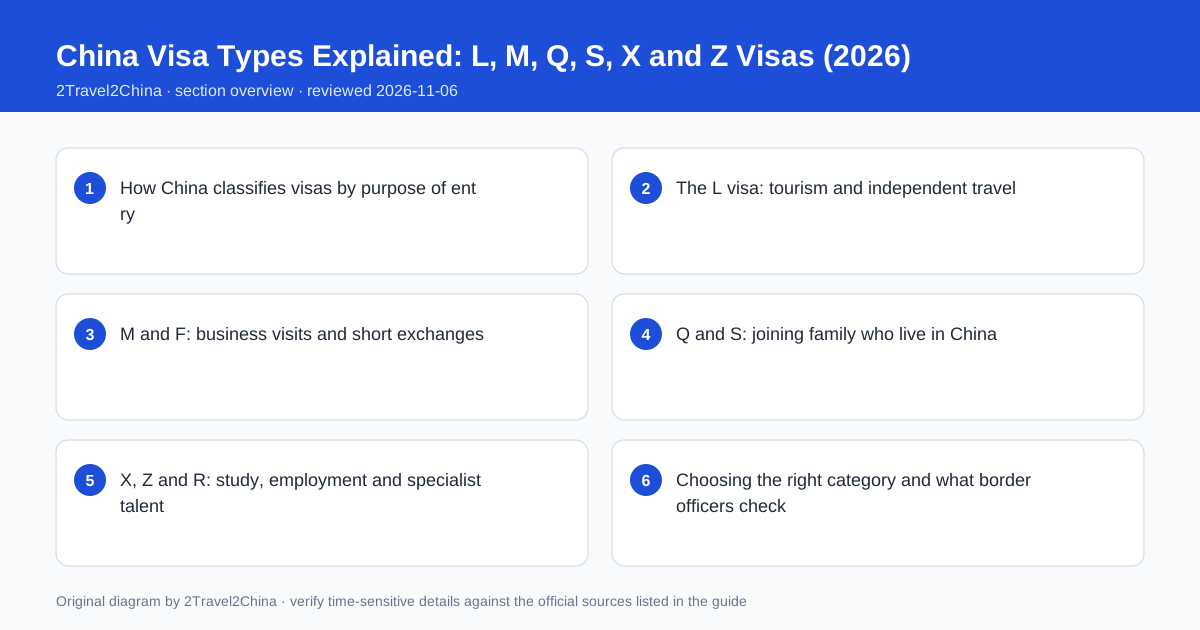
How China classifies visas by purpose of entry
A Chinese visa is an annotation in your passport that states a category, an allowed number of entries, a validity window and a permitted duration of stay for each entry. These are four separate things and confusing them causes most of the trouble people report at the border. A three-month visa validity does not mean you may remain for three months; the duration-of-stay figure, usually 30 or 60 days per entry, is the number that matters once you arrive. The category letter sits next to that figure and defines the purpose for which entry was granted. Working, studying or residing long term under a tourist category is not permitted, and changing category inside China usually means leaving and reapplying.
| Category | Purpose | Typical applicant |
|---|---|---|
| L | Tourism, sightseeing, visiting friends | Independent travellers and tour groups |
| M | Commercial and trade activity | Business visitors invited by a Chinese company |
| F | Exchanges, visits, short study or inspection | Academic and cultural visitors |
| Q / S | Joining family in China | Spouses, parents and children of residents |
| X | Study longer than six months | Degree students and long-term language students |
| Z | Employment | People with a valid work permit and a Chinese employer |
| R | High-level or specialist talent | Qualified experts under talent schemes |
Before choosing a category, check whether you need a visa at all. Ordinary passport holders from 50 countries receive 30 days visa-free, and 57 nationalities qualify for the 240-hour transit waiver with an onward ticket to a third country or region. If either covers your trip, no application and no category is needed. The categories below matter only for the remaining nationalities and for trips whose purpose falls outside tourism, because a visa-free entry is still limited to tourism, business, family visits, exchange or transit and does not authorise employment or long-term study.
The L visa: tourism and independent travel
The L visa is the standard tourist category. It covers sightseeing, independent travel, visiting friends and, in practice, most short leisure trips that do not involve paid work. Applications go through a Chinese embassy or a Visa Application Service Centre, starting with the online COVA form. A typical single-entry L visa allows a 30-day stay, though double-entry and longer-duration variants exist and the mission handling your application decides what to grant. The permitted stay is printed on the visa itself, so read the label rather than relying on what an agency promised.
- A passport with sufficient remaining validity and blank visa pages
- A completed COVA form printed and signed, with a compliant passport photograph
- Proof of onward or return travel and accommodation for at least the first nights
- Evidence of funds sufficient for the length of stay, where the mission asks for it
- An invitation letter only when you are staying with a friend or a private host
The itinerary you submit does not bind you to a fixed route. What matters is that the purpose remains tourism and that you respect the duration of stay. If you later need longer, an extension is requested at the local Public Security Bureau exit-entry office in the city where you are staying, normally at least seven days before the current stay expires. Approval is discretionary, not automatic. Overstaying, even by a day, produces fines and can affect future applications, so treat the printed date as firm.
M and F: business visits and short exchanges
An M visa covers commercial and trade activity: meetings, contract negotiation, factory visits, trade fairs and after-sales work. It does not authorise employment in China, and a business visitor should not be filling a role that a local employee would normally hold. An F visa covers non-commercial exchanges, short-term study of up to six months, academic visits, inspections and cultural or sporting exchanges. The distinction is the nature of the host and the activity, not the length of the trip, and an invitation from the inviting organisation is central to both.
| Question | M visa | F visa |
|---|---|---|
| Host | Chinese company or trade body | University, institution or cultural body |
| Typical activity | Meetings, sourcing, exhibitions | Lectures, short courses, exchanges |
| Key document | Company invitation letter | Institutional invitation or admission notice |
| Paid work in China | Not permitted | Not permitted |
Trade-fair visitors often ask whether a visa-free entry is enough. For many nationalities it is, because business is among the purposes listed under the unilateral visa-free policy, and the 240-hour transit waiver also covers a short commercial stop. Where the trip involves repeated entries over several months, an M visa with multiple entries is more practical than relying on a waiver each time. Confirm the current rules with the mission handling the application, because the visa-free country lists and transit ports were updated repeatedly between 2024 and 2026.
Q and S: joining family who live in China
Family categories are split by the status of the person you are joining. Q visas apply to family members of Chinese citizens or of foreign nationals with permanent residence in China; S visas apply to family members of foreign nationals who are working or studying in China on a long-term basis. Both are further divided into short-term and long-term subcategories, and the long-term versions are the route to a residence permit after arrival. Family relationship evidence — marriage and birth certificates, usually legalised or accompanied by a certified translation — is the core of the application.
- Q1 and S1 are for stays over 180 days and lead to a residence permit application
- Q2 and S2 are for shorter visits and normally allow a limited duration of stay
- The inviting family member supplies a letter, identity documents and residence status proof
- Relationship documents must match the names and dates on both passports exactly
The most common error is applying for an L visa for a long family stay because it appears simpler. A tourist category does not convert cleanly into a family residence permit, and the applicant can end up leaving China to reapply. If the plan is to live with family, the category should reflect that from the start. Because these are long-stay routes with document legalisation steps, begin several months ahead rather than treating the application as a routine tourist formality.
X, Z and R: study, employment and specialist talent
An X visa is for study lasting more than six months; short courses fall under F or, in some cases, a visa-free entry. An X1 visa requires an admission notice and a foreign student visa application form, and it leads to a residence permit after arrival. A Z visa is for employment and requires a valid work permit or notification letter before the visa application is made — the employer completes that stage in China. An R visa covers high-level and urgently needed specialists under national talent criteria and requires supporting recognition from the relevant authority.
- X1: study over 180 days, admission notice plus JW202 or JW201 form
- X2: study up to 180 days, admission notice normally sufficient
- Z: work permit notification from the employer, then a residence permit after arrival
- R: talent qualification evidence, with faster processing and longer stay options
- None of these categories can be entered on a tourist or visa-free basis
The sequencing matters more than the paperwork. For a Z visa the employer must obtain the work authorisation first; arriving on an M or L visa and looking for work is not a lawful shortcut and regularly leads to an exit-and-reapply cycle. Students face a similar sequencing issue because the admission documents are issued by the institution on its own timetable. In all three categories, the visa is a door into a residence-permit process, not the final status, so plan for the steps that follow arrival.
Choosing the right category and what border officers check
Start from the purpose of the trip, then work backwards to the documents the category requires. If the purpose is tourism and your passport is on a visa-free list, stop there. If you need a visa, the category letter should describe what you will actually do, because the invitation, the supporting documents and the answers given at the border should tell a consistent story. Inconsistency between the stated purpose and the supporting paperwork is a far more common refusal reason than a missing photocopy.
Check the waiver lists first
Confirm whether the 30-day unilateral visa-free policy or the 240-hour transit scheme already covers your passport and itinerary.
Match purpose to category
Tourism is L, trade is M, family reunion is Q or S, long study is X, and employment is Z.
Assemble category-specific documents
Invitation letters, admission notices and work permit notifications are category-dependent, not interchangeable.
Verify printed details on issue
Check name, passport number, entry count, validity window and permitted duration of stay before leaving the mission.
Respect the stay after arrival
Register accommodation within 24 hours where required and file any extension before the current stay expires.
Border officers primarily check that the document is valid, that the person matches it, and that the declared purpose is plausible. Carry the same supporting documents you used for the application — a return ticket, a hotel booking or an invitation letter — in a form you can show without connectivity. If your plans changed after the visa was issued, a short, factual explanation is better than an improvised story.
Visa-free country lists, transit ports and application requirements changed repeatedly between 2024 and 2026. A guide written in 2023 will give the wrong answer. Verify your own passport on the National Immigration Administration list and confirm document requirements with the Visa Centre handling your application before you pay for non-refundable travel.
Frequently asked questions
Which Chinese visa do I need for a normal holiday?
The L tourist visa, if your passport is not covered by a visa-free policy. Citizens of 50 countries receive 30 days visa-free in 2026, so check the National Immigration Administration list first — you may need no visa at all.
Can I work in China on an M business visa?
No. An M visa covers commercial activity such as meetings and trade fairs, not employment in a Chinese role. Paid work requires a Z visa backed by a work permit notification obtained by the employer before the visa application.
What is the difference between Q and S family visas?
Q visas are for family of Chinese citizens or permanent residents; S visas are for family of foreign nationals working or studying in China. Q1 and S1 cover stays over 180 days and lead to a residence permit.
Does visa validity mean I can stay that long?
No. Validity is the window in which you may enter; the permitted duration of stay, printed separately, is usually 30 or 60 days per entry. The stay figure is the one that controls how long you can remain.
Can I change visa category after arriving in China?
Sometimes, but it is discretionary and usually requires leaving and reapplying through a Chinese mission abroad. Choose the category that matches the real purpose before you apply rather than relying on a change after arrival.