240-Hour Visa-Free Transit in China: Ports, Rules and Itineraries (2026)
The 240-hour visa-free transit scheme lets eligible travellers spend up to ten days in China without a visa while passing through to a third country or region. It is not a ten-day tourist visa: it has an onward-ticket requirement, a list of eligible ports and rules about where you may travel. This guide sets out the conditions, shows how the clock is counted and gives a route that satisfies them.
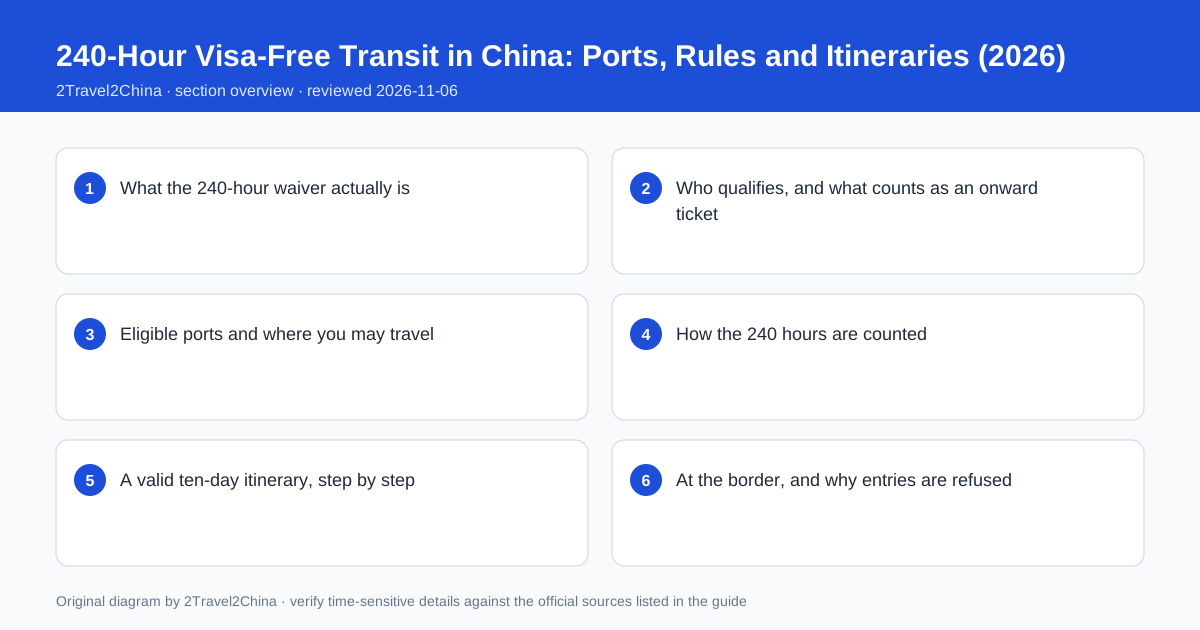
What the 240-hour waiver actually is
Visa-free transit is a border facility, not an application. Eligible nationals arriving at an approved port may be granted temporary entry for a limited period while travelling onward to a third country or region, provided they hold a confirmed onward ticket and meet the other conditions. The scheme was widened repeatedly from 72 to 144 and then to 240 hours, and the list of eligible nationalities and ports expanded at the same time. In 2026 the National Immigration Administration lists 57 countries whose citizens may use the 240-hour arrangement. Because the scheme is a transit facility, the officer at the port decides whether to grant it on arrival; it is not a document you obtain in advance.
| Element | What the rule requires | Common misunderstanding |
|---|---|---|
| Onward travel | Confirmed ticket to a third country or region | A return flight to the country you came from is often not sufficient |
| Arrival | An eligible port of entry | Any international airport or land border will do |
| Duration | Up to 240 hours, counted from a specified time | Ten full calendar days from whenever you land |
| Area | Movement within the permitted region | Unlimited travel anywhere in China |
| Documents | Passport plus onward ticket and accommodation details | A visa application or pre-approval is needed |
The most important consequence is that your itinerary must have three distinct points: the place you came from, mainland China, and a third country or region that is different from the first. A Hong Kong, Macao or Taiwan region stop can serve as that third region for immigration purposes, which is why many itineraries route in from one country and out through Hong Kong. Flying in from London and returning to London does not create a transit. Confirm the exact third-region rule for your port before booking, because the phrasing used by the National Immigration Administration is precise.
Who qualifies, and what counts as an onward ticket
Eligibility starts with nationality. The 2026 list covers 57 countries, including the United States, which is not on the 30-day unilateral visa-free list. That difference is why the transit waiver is often the only no-application route for a short American visit. Your passport must be an ordinary passport valid for the stay, and you must be admissible under ordinary border checks. Holding a passport from an eligible country does not guarantee the grant; the onward itinerary and the port still matter.
- A confirmed onward ticket with a seat and a fixed date within the 240-hour window
- A destination in a third country or region, distinct from the country or region you arrived from
- Arrival and departure through eligible ports in the permitted area
- A passport valid for the duration of the stay, with blank pages for stamps
- An address for your first night, supplied at the border if asked
A fully booked, changeable or open ticket is weaker evidence than a confirmed one. Border officers want to see that you will actually leave within the allowed window and that the onward destination is a genuinely different immigration point. If you plan to fly out of a different Chinese city from the one you entered, verify that the departure port is also on the eligible list before you buy. Where the itinerary is complex, carrying a printed copy of the ticket and a short written route summary removes most of the ambiguity at the desk.
Eligible ports and where you may travel
The scheme operates through a defined set of ports, and the permitted area of movement is tied to the region of arrival. Beijing, Shanghai, Guangzhou, Chengdu, Xi’an and a number of other major gateway cities appear on the eligible lists, with sea and land ports included alongside airports. The practical effect is that a 240-hour entry usually supports a regional itinerary built around the arrival hub rather than an unrestricted cross-country tour. Shanghai municipal guidance, for example, describes travel within the connected Yangtze River Delta region.
| Arrival region | Typical gateways | Itinerary shape that fits |
|---|---|---|
| Beijing–Tianjin–Hebei | Beijing Capital, Beijing Daxing, Tianjin | Beijing plus a day trip to Tianjin or the Great Wall |
| Yangtze Delta | Shanghai Pudong, Hongqiao, Hangzhou, Nanjing | Shanghai, Suzhou, Hangzhou by high-speed rail |
| Pearl River Delta | Guangzhou Baiyun, Shenzhen, Hong Kong links | Guangzhou with an onward exit via Hong Kong |
| Western China | Chengdu, Xi’an | Xi’an or Chengdu with nearby day trips |
Treat the permitted area as a constraint to design around, not as a detail to check later. A ten-day plan that starts in Shanghai, crosses to Xi’an and ends in Beijing may exceed what the entry allows, while a ten-day plan that stays in the Yangtze Delta is straightforward. The port officer can also annotate the permitted area on the entry stamp. If you are unsure whether a city falls inside it, ask at the desk before leaving the airport, because asking later is much harder.
How the 240 hours are counted
The clock is the rule people most often misread. The 240-hour period is counted from a specified starting point set out in the border guidance, not from the moment you happen to clear immigration, and the permitted stay is expressed in hours rather than as ten calendar days. That distinction matters for late-evening arrivals: a flight landing at 23:00 does not grant ten additional full days of sightseeing. The expiry time is recorded at entry, and it is the time you should use for every booking decision.
Note the stated start time
Record the exact time from which the 240-hour period runs, as given at the port.
Work backwards from the onward flight
Book the departure comfortably inside the window, with a buffer for delays.
Keep accommodation inside the permitted area
Hotel registration records where you stayed, so an out-of-area night creates a mismatch.
Avoid same-day tight connections
A delayed inbound flight can compress the whole window and put the onward ticket at risk.
Confirm the recorded expiry before leaving the desk
If something looks wrong, resolve it at the port rather than at the departure gate.
Overstaying a transit entry has the same consequences as overstaying a visa: fines, possible detention for the administrative process, and a mark against future entries. There is no routine extension mechanism for the transit facility. Build the itinerary with a day of slack rather than filling all 240 hours, and keep the onward ticket unchanged once the entry is granted.
A valid ten-day itinerary, step by step
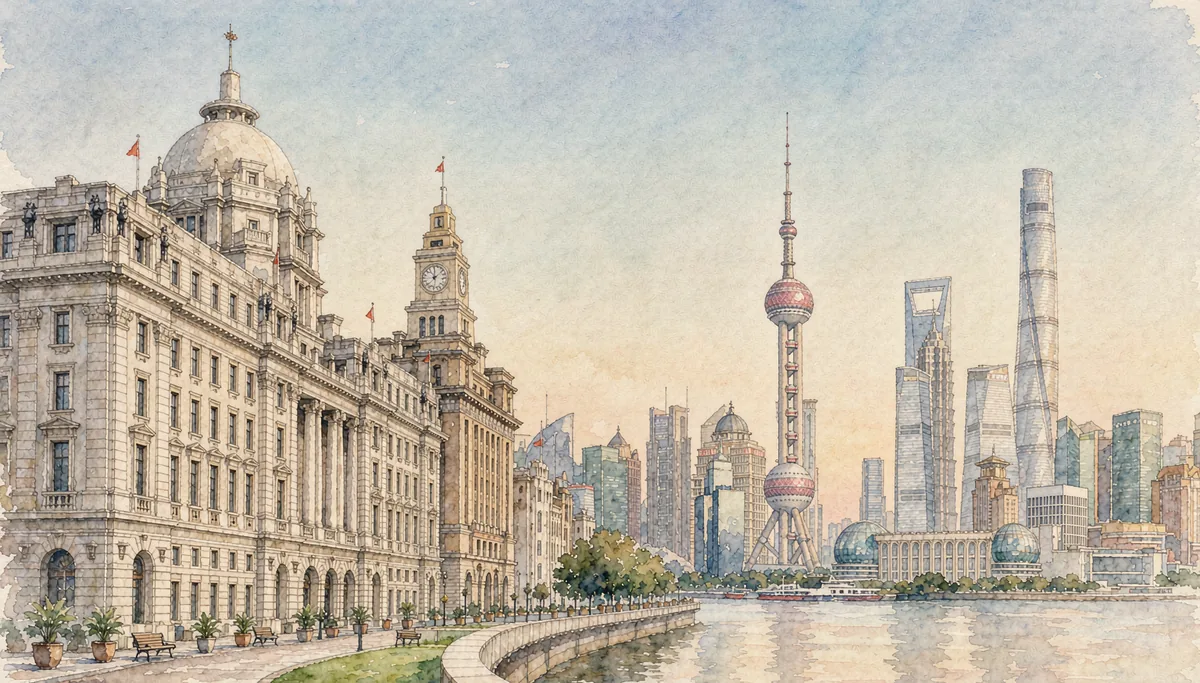
A workable plan treats Shanghai as the arrival point, Hong Kong as the third region on departure, and the Yangtze Delta as the permitted area. Day one is arrival, transfer and an early night rather than a museum. Days two to four cover Shanghai itself: the Bund, the old city, a museum and a day for the modern districts. Days five and six use high-speed rail to Suzhou for the classical gardens and canals, then Hangzhou for West Lake. Days seven and eight return to Shanghai for the remaining neighbourhoods and a day trip.
- Day 1: arrive at an eligible Shanghai port, transfer, register at the hotel
- Days 2–4: Shanghai on foot and by metro, with one pre-booked museum slot
- Days 5–6: Suzhou gardens and canals by high-speed rail, one night or a long day trip
- Day 7: Hangzhou West Lake and a tea-hills walk, returning the same evening
- Days 8–9: flexible buffer for weather, shopping or a second museum
- Day 10: depart to the third region well inside the recorded 240-hour window
The route works because it stays within one connected region, keeps the onward ticket intact and leaves a buffer at both ends. It also uses high-speed rail for short hops, where a passport-linked ticket and a five-hour journey are simpler than a flight. Substitute Beijing and Tianjin, or Guangzhou and a Hong Kong exit, using the same shape: one hub, short rail hops, one clear third-region departure. What breaks the scheme is a cross-country loop or a return to the country you arrived from.
At the border, and why entries are refused
At the port you present your passport, the confirmed onward ticket, an address for the first night and, where asked, a short itinerary. The officer checks nationality against the eligible list, verifies that the onward destination is a third country or region, confirms the arrival port is eligible, and records the permitted stay and area. The process is usually quick for a clean, well-documented case. It is discretionary, so arriving with a vague plan makes the decision slower and less predictable.
- Onward ticket returning to the same country you arrived from
- An open or unconfirmed ticket, or a departure outside the 240-hour window
- Arrival at a port that is not on the eligible list
- An itinerary that clearly leaves the permitted region
- Passport validity that does not cover the intended stay
Most refusals are documentary rather than personal. A printed ticket, a hotel address and a one-page route summary resolve nearly all of them. If the transit grant is not available at the desk, the fallback is a visa obtained in advance, which is why travellers with a complex itinerary should apply rather than rely on the waiver. Check the current National Immigration Administration notice and the local port guidance before departure; both the country list and the port list changed more than once between 2024 and 2026.
A 240-hour transit entry is not a substitute for a visa on a return trip to the same country, and it is not valid for employment or long-term study. Verify the eligible nationality list, the onward-ticket rule and the eligible ports against the National Immigration Administration notice in force on your travel date.
Frequently asked questions
Is the 240-hour waiver the same as a 10-day tourist visa?
No. It is a transit facility granted at the border, requiring a confirmed onward ticket to a third country or region, arrival at an eligible port and movement within a permitted area. It is not an application you make in advance.
Can I fly in from London and return to London?
Generally no. The onward destination must be a third country or region distinct from the one you arrived from. Many itineraries therefore exit through Hong Kong, Macao or another country to satisfy the rule.
Which countries qualify for 240-hour transit in 2026?
The National Immigration Administration lists 57 eligible nationalities, including the United States, which is not on the 30-day unilateral visa-free list. Check the current notice for your own passport before booking.
Can I travel anywhere in China during the 240 hours?
No. Movement is limited to the permitted area associated with the arrival region. A Yangtze Delta entry suits Shanghai, Suzhou and Hangzhou; a cross-country Beijing-to-Xi’an loop would normally exceed it.
Can I extend a 240-hour transit entry?
There is no routine extension for the transit facility. Plan to depart comfortably inside the recorded window and keep the onward ticket unchanged; overstaying carries fines and affects future entries.