China Permanent Residence (Green Card): Eligibility and Application (2026)
China grants permanent residence to foreigners under the Exit and Entry Administration Law and the Measures for the Administration of Examination and Approval of Foreigners' Permanent Residence. There is no general points-based route for ordinary workers. Instead the law lists seven specific categories — investment, senior employment, outstanding contribution, and four family-reunification paths — and every applicant must be law-abiding, in good health and free of a criminal record.
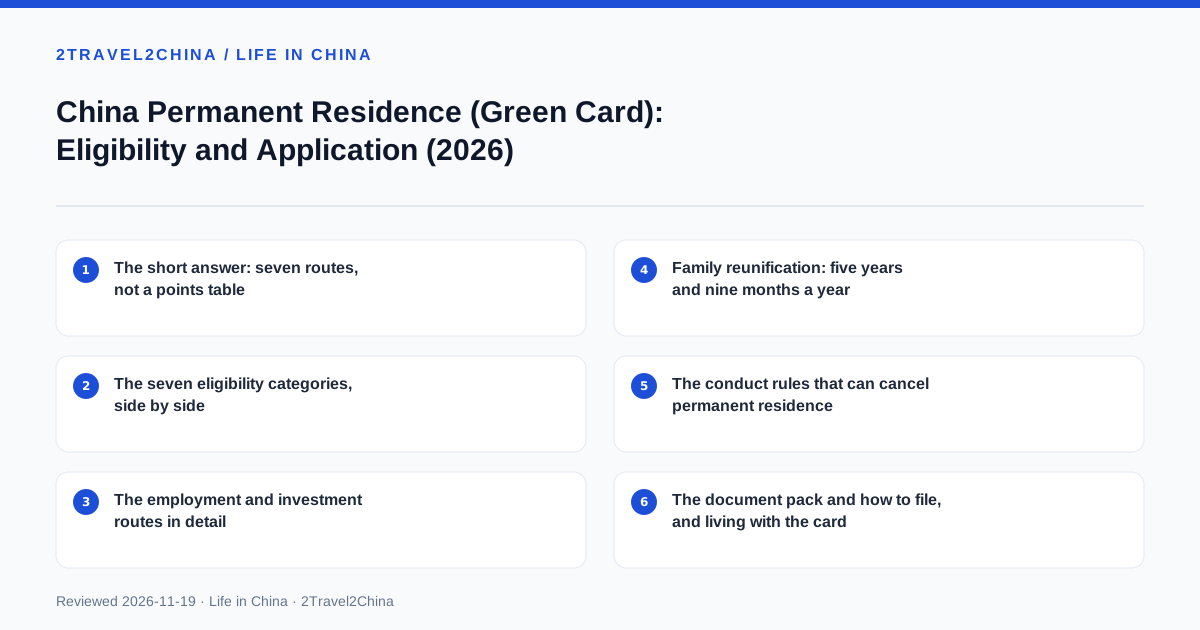
The short answer: seven routes, not a points table
China's permanent residence system is a closed list, not an open competition. Under the governing measures, a foreign national qualifies by meeting one of seven conditions, and every applicant must also abide by Chinese law, be in good health and have no criminal record. There is no route converting years of ordinary employment on an average salary into permanent residence by itself. Understanding which of the seven boxes you fit is the decisive first step.
The seven conditions fall into three investment and employment routes, one outstanding-contribution route, and four family or dependent routes. The first three are aimed at people whose work or capital is judged valuable to China. The family routes depend on an existing relationship with a Chinese citizen or a foreign permanent resident, or on being a dependent child or an elderly parent. Applications are accepted by public security organs at municipal level, or by the sub-bureaus of a direct-controlled municipality.
Permanent residence keeps your foreign nationality. It is not naturalisation and it does not confer voting rights. The Foreign Permanent Resident ID Card lets you live and work in China without a separate work permit or residence permit.
The seven eligibility categories, side by side
The official service guides published by provincial and municipal governments reproduce the same seven categories. The table below condenses them into the test each applicant must pass. Note how often a clean tax record and a minimum number of years of actual residence appear together — the authorities look at presence and contribution at the same time, not one or the other.
| Route | Core test | Residence requirement |
|---|---|---|
| Direct investment | Stable direct investment with good tax records for three consecutive years | Sustained presence tied to the investment |
| Senior employment | Deputy general manager or above, or associate senior title such as associate professor, with good tax records | At least four consecutive years in post and at least three years resident within those four |
| Outstanding contribution | Significant, outstanding contribution and a special national need | Determined by the recommending authority |
| Family of the above | Spouse and unmarried children under 18 of a qualifying investor, senior employee or contributor | Follows the qualifying applicant |
| Spouse of a resident | Married at least five years with stable income and a home | Five consecutive years, at least nine months in China each year |
| Dependent child | Unmarried child under 18 joining a parent | Follows the parent's status |
| Elderly parent | Age 60 or over, no direct relatives abroad, joining a direct relative in China | Five consecutive years, at least nine months in China each year |
The employment and investment routes in detail
The senior employment route is often misunderstood. The post must be at deputy general manager level or above, or carry an associate senior professional title such as associate professor or associate researcher, or enjoy equivalent treatment. You must have held that position for four consecutive years, have resided in China for at least three years within those four, and have a good tax record. A long career in China below that level does not qualify on its own.
Provincial hotlines have also published a talent-oriented employment path for foreign nationals working in China. Its conditions include holding a doctorate, or working continuously in a national key development zone for at least four years with at least six months of actual residence each year. A separate published condition requires four consecutive years of work with annual wage income of at least six times the local average and annual individual income tax of at least twenty percent of that wage income. These are discretionary talent policies, so confirm the current wording with the accepting authority before you rely on them.
The investment route asks for direct, stable investment in China with good tax records for three consecutive years. The supporting file is correspondingly detailed: a business licence copy, proof of the enterprise's annual report disclosure, a confirmation letter for the foreign-invested project, a capital verification report, and, for encouraged foreign investment, a national or provincial confirmation of that status plus personal tax certificates. Real estate held purely as an asset is not the same as an operating foreign-invested enterprise.
Family reunification: five years and nine months a year
Four of the seven categories are family based. The spouse route is the most widely used: you must be married to a Chinese citizen or to a foreign permanent resident, the marriage must have subsisted for five years, and you must have resided in China for five consecutive years with at least nine months in China each year. Stable income and a fixed residence are required. Short trips abroad are tolerable; one long absence is not.
The dependent-child route covers an unmarried child under 18 whose parent qualifies. The elderly-parent route is narrower: you must be 60 or older, have no direct relatives living abroad, be joining a direct relative in China, and meet the same five-year and nine-month residence test. The spouse and unmarried children under 18 of an investor, senior employee or outstanding contributor can apply alongside that person, which means one qualifying senior hire can bring a family through the same case.
Holding a family reunion residence permit is not the same as permanent residence, and it does not by itself authorise work. To work you still need a work permit and a work-type residence permit unless you already hold permanent residence.
The conduct rules that can cancel permanent residence
Permanent residence can be lost. Article 24 of the governing measures lists four grounds on which the National Immigration Administration may cancel an existing status and confiscate or invalidate the Foreign Permanent Resident ID Card: a threat to national security or interests, a court sentence of deportation, obtaining the status through false materials or other unlawful means, and failing to meet the residence requirement.
That last ground matters in practice. A permanent resident who, without approval, spends less than three months in China in a year, or less than one year in China across a five-year period, can lose the status. This is why permanent residence is not a card you can simply leave in a drawer while living elsewhere. If your work or family requires long periods abroad, keep documented approval and keep a record of your entry and exit dates.
The document pack and how to file
Every applicant submits a valid foreign passport, a health certificate and a certificate of no criminal record from abroad. Each route then adds its own proof. Employees provide an employment certificate, a copy of the Foreigner's Work Permit, the employer's registration certificate, proof of annual report disclosure and personal tax certificates. Outstanding-contribution applicants provide a recommendation letter and copies of awards. Family applicants provide marriage, birth or parent-child relationship certificates.
Identify the exact category you fit
Match your record against the seven conditions before collecting documents. Applying under the wrong category is the most common reason a file is not accepted.
Assemble the base and category documents
Passport, health certificate, overseas criminal record certificate, then the route-specific proof. Check whether foreign documents need notarisation or translation.
File with the competent public security authority
Submit to the municipal public security organ or the sub-bureau of a direct-controlled municipality where you meet the conditions. Expect an interview and a genuine-record check.
Keep the residence record after approval
Once approved, track your entry and exit dates. The three-month annual and one-year five-year thresholds are conditions of keeping the status.
Living with the card: what changes and what does not
A Foreign Permanent Resident ID Card removes the need for a separate work permit and residence permit, and it simplifies opening accounts, buying property and accessing public services. It does not change your nationality, and it is not a passport. You still travel with your national passport, and you still need to meet the residence conditions that keep the status alive. For most long-term residents the practical gain is administrative freedom rather than a change of legal identity.
The honest assessment is that permanent residence is difficult for ordinary employees and relatively accessible through the family and senior-talent routes. If you do not fit one of the seven conditions, the productive path is to build the years, tax record or qualification that a route requires, and to verify the current rules against a government service guide before you spend money on applications.
Frequently asked questions
Does working in China for five years automatically qualify me for permanent residence?
No. There is no automatic conversion from employment to permanent residence. Employment qualifies only under the senior route, which requires a deputy general manager level post or associate senior title, at least four consecutive years in post and good tax records, or under a published talent policy. Ordinary employment alone does not qualify.
What are the residence conditions for the spouse route?
You must be married to a Chinese citizen or a foreign permanent resident for at least five years, have resided in China for five consecutive years with at least nine months in the country each year, and have stable income and a home. Missing the nine-month threshold in a year can break the continuous-residence calculation.
Can China permanent residence be taken away?
Yes. Under Article 24 of the governing measures, status can be cancelled for threatening national security, being sentenced to deportation, obtaining it by false materials, or residing less than three months in a year or less than one year over five years without approval.
Do I need a work permit after I get permanent residence?
No. A Foreign Permanent Resident ID Card replaces the separate work permit and residence permit, so you can work without applying for them again. You still travel internationally on your national passport, and permanent residence does not change your citizenship.
Which authority accepts a permanent residence application?
Applications are accepted by the public security organs of municipal people's governments in cities with subordinate districts, and by the public security sub-bureaus or county-level sub-bureaus of direct-controlled municipalities. The accepting office will verify the authenticity of your employment, relationship and residence record.