Exit-Entry Records and the 183-Day Tax Residency Rule in China (2026)
Your passport stamps and your tax bill are connected. Under a 2019 State Taxation Administration rule, a foreigner without a Chinese domicile becomes a resident individual after 183 days in a tax year, and after six consecutive qualifying years the exemption on overseas income falls away. The evidence that decides the count is your official exit-entry record, which you can now check yourself through the National Immigration Administration's 12367 service.
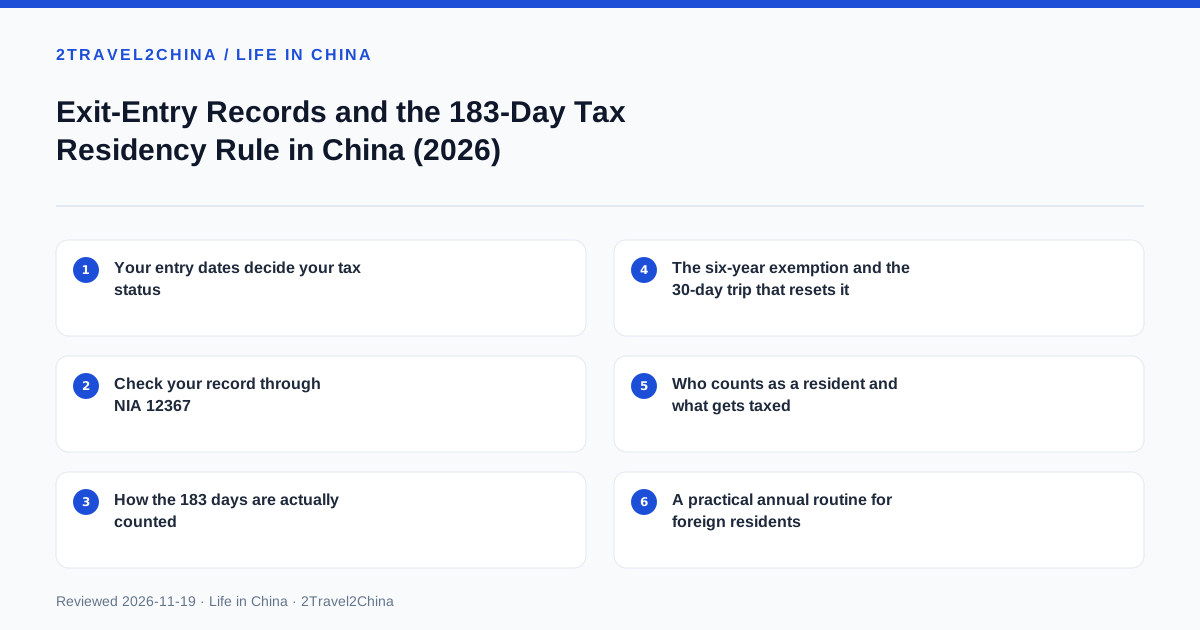
The short answer: your entry dates decide your tax status
China taxes residents on worldwide income and non-residents only on China-source income. If you have no Chinese domicile, the dividing line is physical presence: 183 days or more in a tax year makes you a resident individual for that year. A second, quieter rule matters over the longer term. Once you have reached 183 days in each of six consecutive years without any single trip abroad lasting more than 30 days, overseas income paid by overseas employers stops being exempt.
Both tests are counted from your official entry and exit record, not from your visa validity or your lease agreement. That record is held by the National Immigration Administration and can be checked through its 12367 government service platform. Reconciling it once a year is the cheapest tax advice available, because it tells you exactly where you stand before the numbers turn against you.
This guide explains the rules and how to read the official data. It is not tax advice. For a binding position, use a qualified tax adviser and confirm details with the competent tax authority.
How to check your exit-entry record through 12367
The National Immigration Administration runs a national online government service platform, launched in 2019 and renamed the 12367 immigration service in 2023. It is available as a website, a mobile app and WeChat and Alipay mini-programmes, with English-language online responses around the clock. Access requires real-name authentication and a face verification step, so set it up while you are in China and can complete the checks.
- Register and complete real-name and face authentication on the NIA 12367 website, app or mini-programme.
- Open the exit-entry record query function and request the date range you want to review.
- Save or download the record and check that every entry and exit stamp matches your travel.
- Reconcile the dates against your passport and your own travel calendar before using them for tax purposes.
- Use the 12367 hotline, which offers English and several other languages, to query a discrepancy you cannot resolve online.
The platform also handles appointment booking, document status checks and, since November 2025, online arrival card filing for foreign visitors. It served 185 million query and service requests in 2025, which is a fair indication that the record it returns is the authoritative one. Treat any discrepancy between your own notes and the official record as something to fix at the source rather than assume your notes are right.
How the 183 days are actually counted
The counting rule is more precise than most summaries suggest. A day counts as a day of residence in China only if you are present for a full 24 hours. If you are in China for less than 24 hours on a given day, that day is not counted. The rule comes from Ministry of Finance and State Taxation Administration Announcement No. 34 of 2019, which sets the standard for people without a Chinese domicile.
That detail changes behaviour at the margins. A same-day border run does not add a day, but a late arrival followed by an early departure can cost you two days you assumed you had. Plan the calendar on the 24-hour standard, and verify the result against the exit-entry record rather than counting nights in a hotel. The tax year is the calendar year, so the count resets every 1 January.
| Situation | Residency result | Income taxed in China |
|---|---|---|
| No Chinese domicile and under 183 days in the year | Non-resident individual | China-source income only |
| 183 days or more, within the six-year window | Resident individual | China-source income, plus overseas income paid by Chinese entities |
| 183 days or more in each of six consecutive qualifying years | Resident individual | Worldwide income, including overseas employer payments |
| One year under 183 days, or one trip abroad over 30 days | Six-year sequence restarts | Overseas income from overseas employers stays exempt for the new sequence |
The six-year exemption and the 30-day trip that resets it
Most expatriates discover the six-year rule too late. If you reside 183 days or more in a tax year, overseas income paid by an overseas entity or individual is exempt from Chinese tax only if one of the previous six years had fewer than 183 days, or you made a single departure longer than 30 days in any of those years. If all six years reached 183 days with no trip over 30 days, worldwide income becomes taxable.
The six years are counted backwards from the year before the tax year in question, and the sequence can only begin in 2019 or a later year. The practical consequence is that a single long summer trip abroad can restart the clock, while a series of short weekend trips cannot. The Implementation Regulations of the Individual Income Tax Law, issued as State Council Decree 707, confirm that a departure of more than 30 days in any qualifying year restarts the consecutive count.
A single departure of more than 30 days in any of the six years breaks the sequence. This is a lawful feature of the rules, not a loophole, but it must reflect genuine travel and it must be supported by the official record.
Who counts as a resident and what gets taxed
The Individual Income Tax Law defines a resident individual as someone who has a domicile in China, or who has no domicile but resides in China for a cumulative 183 days in a tax year. A person without a domicile who stays under 183 days is a non-resident. The distinction determines the tax base: residents are taxed on income from both inside and outside China, while non-residents are taxed only on China-source income.
For a non-domiciled resident within the six-year window, the exemption applies narrowly to income that is both sourced overseas and paid by an overseas entity. Overseas income paid by a Chinese employer, and China-source income paid from overseas, remain taxable. For a non-resident who stays no more than 90 days, the part of China-source employment income paid by an overseas employer and not borne by a Chinese establishment is exempt. These four combinations are where most disputes arise, and they are set out in the regulations rather than in general guidance.
Resident individuals with more than one source of income may also have an annual reconciliation obligation, generally filed between 1 March and 30 June of the following year. Whether you have one depends on your income mix and withholding history, so check with the competent tax authority or a qualified adviser rather than assuming a salary paid through payroll settles everything.
A practical annual routine for foreign residents
Start each January by pulling the previous year's exit-entry record from 12367 and counting the qualifying days on the 24-hour standard. Note the longest single trip abroad and whether it exceeded 30 days. Then compare the result with your income sources: where the money was earned, and who paid it. That single comparison tells you whether you are a resident, and whether the overseas-income exemption is still available to you.
Pull the record
Download the full-year exit-entry record from the NIA 12367 platform after real-name and face verification.
Count qualifying days
Count only days with a full 24 hours of presence in China, and record the longest single absence.
Classify your income
Separate China-source from overseas-source income, and note whether each payment came from a Chinese or overseas payer.
Check the filing obligation
If you are a resident with multiple income sources, confirm whether annual reconciliation between March and June applies to you.
Tax rules, thresholds and platform features change, and the consequence of getting the count wrong can be a tax assessment rather than a warning. Confirm the current rules with the State Taxation Administration and keep your own copy of every official record you rely on. The point of the routine is not to avoid tax but to know your status before a deadline, when there is still time to act.
Frequently asked questions
How can I check my own entry and exit record in China?
Use the National Immigration Administration's 12367 government service platform, available as a website, app and WeChat or Alipay mini-programme. After real-name and face authentication, open the exit-entry record query and select your date range. The English-language hotline can help with discrepancies.
Does a same-day trip out of China count as a day of residence?
No. Under Announcement No. 34 of 2019, a day counts only if you are present in China for a full 24 hours. If you are in China for less than 24 hours on that day, it is not counted toward the 183-day residency test. Use the official record to verify.
What is the six-year tax exemption for foreigners in China?
A non-domiciled resident is exempt from Chinese tax on overseas income paid by overseas entities if, in one of the previous six years, they had fewer than 183 days in China or made a single trip abroad longer than 30 days. If all six years qualify, worldwide income becomes taxable.
Am I a Chinese tax resident if I stay more than 183 days?
If you have no Chinese domicile and reside in China for 183 days or more in a calendar year, you are a resident individual for that year and are in principle taxed on worldwide income. A person with a Chinese domicile is a resident regardless of the day count.
Can a long holiday abroad reset the six-year sequence?
Yes. A single departure from China lasting more than 30 days in any of the six preceding years restarts the consecutive-year count, according to the Individual Income Tax Law Implementation Regulations. Short trips do not have this effect, and the record must support the actual dates.