Registering Your Address and Extending a Residence Permit in China (2026)
If you live anywhere other than a hotel, Chinese law requires your accommodation to be registered within 24 hours of moving in. Since 21 September 2026 the National Immigration Administration has allowed that filing to be completed online nationwide, with the local police-station channel kept open. A separate clock governs your residence permit: an extension must be requested at least 30 days before it expires. This guide separates the two obligations, gives the exact filing channels, and lists the other deadlines that follow from the Exit and Entry Administration Law.
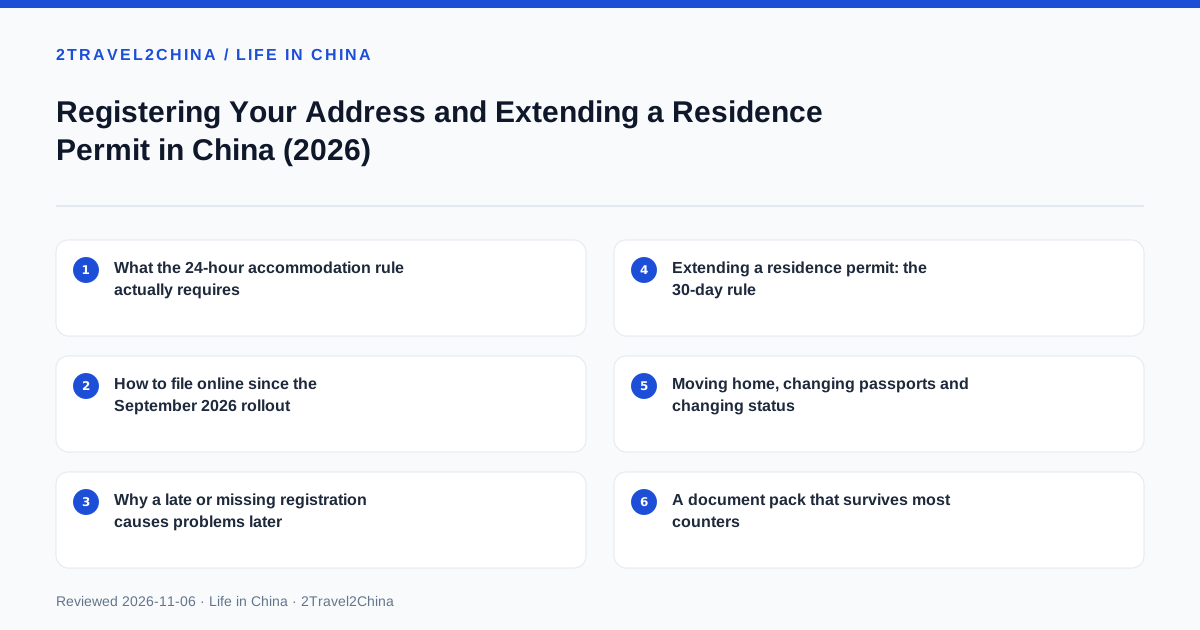
What the 24-hour accommodation rule actually requires
Article 39 of the Exit and Entry Administration Law splits accommodation into two cases. When you stay in a hotel, the hotel registers you under hotel-industry public security rules and sends the record to the local public security authority; you do not file anything yourself. When you live or stay in any other kind of residence, you or the person hosting you must register with the public security authority at your place of residence within 24 hours of moving in. The obligation follows the address, not your visa type, so it applies to long-term residents, students, visiting relatives and short-stay tenants alike.
The distinction matters because most English-language advice compresses it into register at the police station within 24 hours, which is wrong for hotel guests and incomplete for renters. A hotel registration is automatic and ends when you check out. A private-address registration is a record tied to a specific dwelling, and it has to be renewed or refiled when you move. Local authorities treat a missing or late record as a compliance problem that can affect later visa extension and residence permit applications.
| Where you stay | Who registers | Your deadline | What you keep |
|---|---|---|---|
| Hotel or guesthouse | The hotel front desk | None for you | Nothing; the hotel holds the record |
| Rented flat | You or the host / landlord | Within 24 hours of moving in | The electronic or paper registration receipt |
| Friend or relative home | You or the person hosting you | Within 24 hours of arrival | The electronic or paper registration receipt |
| Employer-provided housing | Usually you, sometimes the employer | Within 24 hours of moving in | Receipt plus your lease or assignment letter |
How to file online since the September 2026 rollout
Online filing is now available nationwide. The National Immigration Administration announced on 21 September 2026 that it would extend its online accommodation registration service across the country after a pilot that began on 20 March 2026 in Hebei, Liaoning, Zhejiang, Hubei, Guangxi, Chongqing and Sichuan. The channels are the NIA government service portal, the 12367 immigration app, its WeChat mini-program and its Alipay mini-program. An online filing has the same legal effect as registering in person at the local public security authority.
Prepare your identity documents
Have your passport or other international travel document to hand, together with the full address of the dwelling. If someone else is hosting you, that person may file on your behalf.
Choose a channel
Open the NIA service portal, the 12367 app, or the WeChat or Alipay mini-program. Hotel guests do not use this channel; the hotel has already filed the record.
Submit the address and arrival date
Enter the residential address and the date you moved in. The 24-hour clock runs from arrival at the dwelling, not from the date you signed a lease.
Save the receipt
Keep the electronic registration confirmation. It is the document you will be asked for when applying for a residence permit, a driving licence conversion, school enrolment or a visa extension.
Refile when you move
A change of address creates a new 24-hour obligation. Do not assume the previous record transfers with you.
The in-person channel at the local police station or public security office remains open. Online and offline registrations carry equal legal effect, so choose whichever you can actually complete within the 24-hour window.
Why a late or missing registration causes problems later
A registration receipt is an upstream document for several downstream applications. Local guidance published alongside the online filing service states plainly that overdue registration affects visa extension and residence permit handling. Vehicle administration offices ask for an accommodation registration certificate when a foreign national applies to convert an overseas driving licence, and schools ask for it when assessing a child of a foreign national for enrolment. Missing the first step therefore shows up weeks or months later as a rejected application.
- Carry your passport or residence document if you are 16 or older; Article 38 requires it to be available for inspection by public security authorities.
- Report a change to the registered particulars of a residence document within 10 days, as required by Article 33.
- If a residence document is lost, damaged or stolen, apply for a replacement at the exit-entry administration of the county-level authority at your place of stay or residence.
- A foreign baby born in China must be registered for stay or residence within 60 days of birth under Article 40.
These are separate clocks with separate authorities. A practical way to keep them straight is to treat the address record as the anchor: it is the shortest deadline, it is the one most often requested as evidence, and it is the one you will repeat every time you change home. Put a reminder in your calendar for the day you move in rather than trying to reconstruct the date later.
Extending a residence permit: the 30-day rule
Article 32 sets the extension deadline at 30 days before the residence permit expires. The application goes to the exit-entry administration of the county-level or higher people government public security authority at your place of residence, and you submit material supporting the reason for the extension. If the authority considers the reason reasonable and sufficient it grants an extension; if it refuses, you are expected to leave on time. Article 36 makes refusals of extensions, renewals and replacements final administrative decisions.
Check the expiry date first
Count back 30 days from the printed expiry date and treat that as the real deadline, not the expiry date itself.
Confirm your reason for staying
Work, study, family reunion and other categories have different supporting material. Your employer, university or sponsor usually issues the key document.
Make sure your address record is current
A stale or missing accommodation registration is a common reason an application is returned for correction.
File at the local exit-entry administration
Bring your passport, current residence permit, the supporting letter and the accommodation registration receipt.
Keep the old permit until the new one is issued
You still need a valid document for hotel check-in, train ticket collection and banking while the application is processed.
Do not confuse a residence permit with a stay permit. Article 34 caps the validity of a stay permit at 180 days and covers cases such as a visa-free entrant who needs to remain beyond the visa-free period. Work itself requires both a work permit and a work-category residence document under Article 41, so a change of employer is not a purely contractual matter; it has immigration consequences.
Moving home, changing passports and changing status
Three events reliably break paperwork. Moving house starts a fresh 24-hour registration clock and may also require a change to the registered particulars of your residence document within 10 days. Replacing a passport changes the travel document number linked to your residence record, bank account and registered address. Changing from study to work, or from one employer to another, changes the category and supporting institution behind your residence document. In each case the earlier filings do not update themselves.
| Event | Immediate action | Follow-up |
|---|---|---|
| New address | File accommodation registration within 24 hours | Update the address held by your bank, employer and school |
| New passport | Carry both the old and new passport during the transition | Update residence document particulars and bank KYC records |
| New job or sponsor | Confirm the work permit and residence category before starting | Refile supporting documents with the exit-entry administration |
| New family member | Register the birth within 60 days if the baby was born in China | Apply for the child stay or residence document |
For anyone on a short visa-free or transit stay, most of this section does not apply. But if your 10-day transit becomes a work contract or a degree programme, the gap between visitor and resident closes quickly, and the address registration is usually the first document somebody asks you for.
A document pack that survives most counters
The fastest way through any Chinese administrative counter is a consistent set of documents. Inconsistent spellings between a passport, a lease, a bank record and a registration receipt are a common source of delay. Use the same romanised name everywhere, keep digital and paper copies, and store the electronic accommodation registration receipt somewhere you can find it a year later.
- Passport with at least six months of remaining validity and blank visa pages, plus a scan of the identity page.
- Current visa, stay permit or residence permit, and a scan of both sides of the card.
- Accommodation registration receipt for your current address, with the address written exactly as it appears on the lease.
- Lease or employer housing letter, and the landlord identity or property document if it was used for registration.
- Work permit, university enrolment letter or sponsor letter, depending on your residence category.
Rules for registration and residence are issued by the National Immigration Administration and implemented locally. Each source linked at the end of this guide is the place to confirm a requirement before you rely on it, especially when a local office asks for additional material.
Frequently asked questions
Do hotel guests have to register at a police station?
No. Under Article 39, hotels register foreign guests themselves and send the information to the local public security authority. The 24-hour personal obligation applies only when you live or stay somewhere other than a hotel, such as a rented flat, employer housing or a friend home.
Can I register my address online?
Yes, nationwide since 21 September 2026. Use the National Immigration Administration service portal, the 12367 app, or its WeChat or Alipay mini-program. Online filing has the same legal effect as registering in person, and the police-station channel remains available.
How early should I apply to extend a residence permit?
At least 30 days before the current permit expires, under Article 32 of the Exit and Entry Administration Law. Apply at the exit-entry administration at your place of residence with documents supporting your reason for staying, and keep your address registration current first.
What happens if I registered late?
Local guidance says overdue registration can affect visa extension and residence permit applications. File as soon as you notice, keep the receipt, and be prepared to explain the delay at the local public security office rather than assuming the record can be ignored.
Do I need to register again after moving within the same city?
Yes. The registration is tied to a specific address, and moving in starts a new 24-hour window. Article 33 also requires changes to registered residence particulars to be reported within 10 days, so treat a move as two separate updates.