Golden Week in China Explained: Why a Week Off Moves a Billion People (2026)
Golden Week is the Chinese habit of joining a statutory holiday to nearby weekends, using designated make-up working days, to create a single block of seven or eight days off. Two such weeks survive today: Spring Festival and National Day. The scale is hard to overstate. The Ministry of Culture and Tourism recorded 888 million domestic trips during the eight-day 2025 National Day and Mid-Autumn holiday. This guide explains how the system works and what it means for a visitor in 2026.
What Golden Week is, in one paragraph
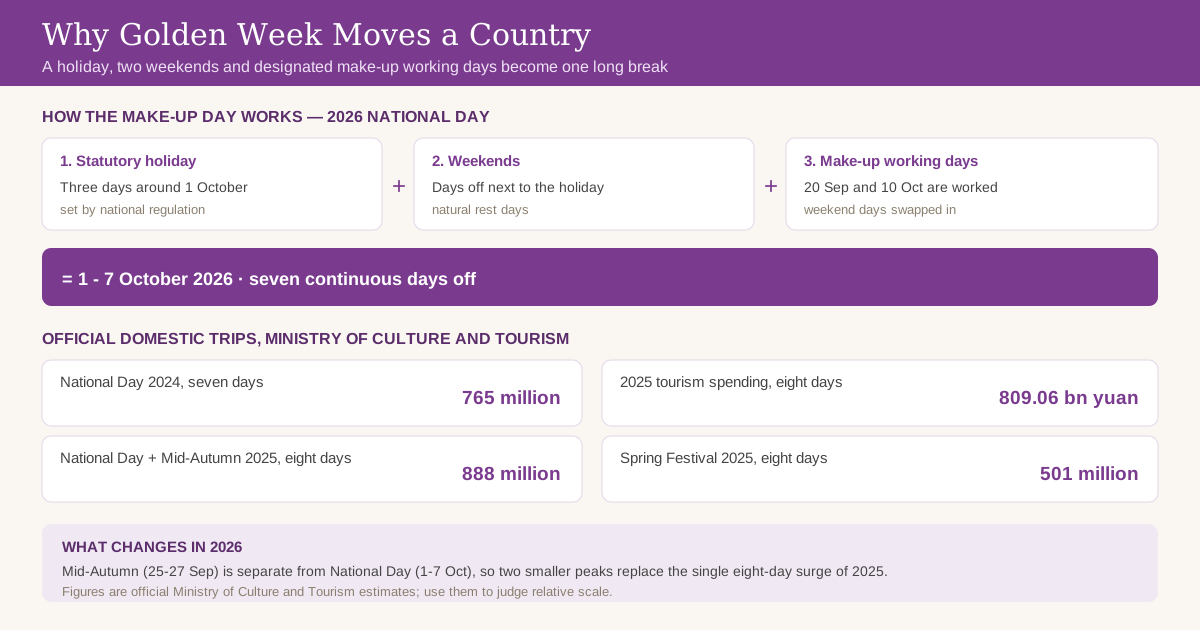
Golden Week is a long public holiday assembled from a statutory holiday, adjoining weekends and one or more designated make-up working days. China has two today: Spring Festival and National Day. The name comes from the consumer spending these breaks generate. In 2026 National Day runs 1 to 7 October, seven days, with 20 September and 10 October designated as working days to extend the break. Understanding that trade is the key to understanding why the week is so crowded.
| Element | How it works | 2026 National Day example |
|---|---|---|
| Statutory holiday | Set by national regulation | Three days around 1 October |
| Adjoining weekend | Natural days off next to the holiday | Weekend adjacent to the break |
| Make-up working days | Weekend days designated as work | 20 September and 10 October |
| Resulting break | One continuous block off | 1 to 7 October, seven days |
Where Golden Week came from
Golden Week began in 1999, when the State Council revised the national holiday rules and concluded that longer blocks of leave would stimulate domestic consumption after the Asian financial crisis. The first seven-day National Day holiday was in 1999, and official figures from that year record about 28 million domestic trips and 14.1 billion yuan in tourism revenue. The idea was borrowed in part from Japan's concentration of public holidays into a single week.
Until 2008 there were three Golden Weeks: Spring Festival, Labour Day and National Day. That year the Labour Day holiday was cut from three statutory days to one, removing the May Golden Week, and Qingming, Dragon Boat and Mid-Autumn were added as three-day breaks. The stated aim was to spread holidays across the year and reduce the concentration of travel. Two Golden Weeks survived, and they remain the two heaviest travel periods in the country.
The 1999 decision was made against a specific economic background. After the Asian financial crisis, policymakers looked for domestic demand to offset weak exports, and extending holidays was a direct way to encourage spending on travel, retail and restaurants. The first National Day Golden Week in 1999 is reported to have generated about 28 million domestic trips and 14.1 billion yuan in tourism revenue, a striking result when total annual domestic tourism revenue was only about 283 billion yuan. That comparison explains why the policy was kept and why the week still carries the name Golden.
The official numbers that show the scale
The Ministry of Culture and Tourism publishes tourism totals after each major holiday, and the figures make the scale concrete rather than anecdotal. The eight-day 2025 National Day and Mid-Autumn combined holiday produced 888 million domestic trips and 809.06 billion yuan in domestic tourism spending. That was an increase of 123 million trips and 108.19 billion yuan over the seven-day 2024 National Day holiday.
| Holiday | Days | Domestic trips | Tourism spending |
|---|---|---|---|
| National Day 2024 | 7 | 765 million | 700.8 billion yuan |
| National Day plus Mid-Autumn 2025 | 8 | 888 million | 809.06 billion yuan |
| Spring Festival 2025 | 8 | 501 million | 677 billion yuan |
| Qingming 2025 | 3 | 126 million | 57.5 billion yuan |
| Labour Day 2025 | 5 | 314 million | 180.3 billion yuan |
These are official Ministry of Culture and Tourism estimates derived from its data centre, not precise headcounts. Use them to judge relative scale, not as exact visitor counts for a single attraction.
The table shows two useful comparisons. First, the three-day Qingming holiday generated 126 million trips and 57.5 billion yuan in 2025, while the five-day Labour Day holiday reached 314 million trips and 180.3 billion yuan. Adding two days to a break more than doubles the travel, because a three-day break mostly supports local outings while five days permits an intercity trip. Second, the eight-day 2025 holiday added 123 million trips over the seven-day 2024 one, showing that even a single extra day produces a measurable surge.
Why the crowds concentrate the way they do
A week of leave does not spread demand evenly. Travel peaks on the evening before the first day off and on the final day of the break, because that is when people leave home and return. Inside the week, the most famous sites reach their daily caps early, while second-tier cities and rural destinations are comparatively quieter. The rail network is large, but popular corridors sell out first.
The make-up days matter too. Because the working weekends around a Golden Week are shifted rather than simply added, the two or three days before and after the break have an unusual rhythm. In 2026, 20 September is a working Sunday and 10 October is a working Saturday. Domestic travellers often leave on the evening of the last working day, so the effective peak starts earlier than the official first day.
- Treat the evening before the break and the last day as part of the peak.
- Reserve high-speed rail as soon as the sales window opens.
- Book timed attraction slots at the same time as trains and hotels.
- Expect the highest queues at the most famous sites, not across the whole country.
- Keep one flexible day in case a ticket or a connection fails.
What the 2026 calendar does differently
The 2026 arrangement separates two holidays that merged in 2025. The State Council set Mid-Autumn as 25 to 27 September and National Day as 1 to 7 October, with make-up working days on 20 September and 10 October. In 2025, by contrast, Mid-Autumn and National Day combined into an eight-day block, which is why the tourism total reached 888 million trips. Splitting them in 2026 should produce two smaller peaks rather than one eight-day surge.
Spring Festival in 2026 is also longer than usual at nine days, from 15 to 23 February, with 14 and 28 February as make-up working days. That means the year's two Golden Weeks are unequal in length: a nine-day February break and a seven-day October break. A visitor choosing between them should expect family-oriented closures in February and tourist-oriented crowding in October.
How to travel well during a Golden Week
The most reliable strategy is to reduce the number of fixed commitments. Fewer cities, longer stays and one anchor sight per day survive disruption better than a tight multi-city route. Rail seats and timed attraction entries are the two scarce resources, so secure them first and treat everything else as flexible. A backup attraction that needs no reservation protects the day if a slot is unavailable.
The second tactic is to use the shoulder days. The days immediately after a break are often quieter at major attractions, because domestic travellers have returned to work. Shifting a visit by three or four days can change the experience more than changing the city. Where dates are fixed, choose a second-tier city or a neighbourhood-level experience over the single most famous site in the country.
Timing within the day helps as well. Famous sites that cap daily entries tend to fill their morning slots first, so an afternoon or early-evening entry is often easier to obtain at the same price. Restaurants near major attractions are busiest at standard meal hours; eating slightly early or late removes much of the wait. None of these tactics removes the crowds, but together they turn a week dominated by queues into a workable itinerary.
Frequently asked questions
What is a Golden Week in China?
Golden Week is a long public holiday created by joining a statutory holiday to nearby weekends with designated make-up working days. China has two, Spring Festival and National Day. The term refers to the consumer spending generated. In 2026 National Day runs 1 to 7 October, with 20 September and 10 October as working days.
Why is Golden Week so crowded?
Because a large country gets the same days off at once, and demand concentrates on the evening before and the final day of the break. The Ministry of Culture and Tourism recorded 888 million domestic trips during the 2025 National Day and Mid-Autumn holiday. Popular rail corridors and famous attractions reach capacity first, while smaller destinations stay quieter.
What are make-up working days?
They are weekend days that the State Council designates as working days in exchange for an extra day off during a holiday block. For the 2026 National Day break, 20 September and 10 October are make-up working days. The arrangement is published in the annual holiday notice, usually in early November for the following year.
When did Golden Week start in China?
The first National Day Golden Week was in 1999, after the State Council revised holiday rules to stimulate domestic consumption following the Asian financial crisis. Official figures recorded about 28 million domestic trips that year. Until 2008 there were three Golden Weeks; Labour Day's was removed and Qingming, Dragon Boat and Mid-Autumn were added as shorter breaks.
Is 2026 National Day a single long holiday with Mid-Autumn?
No. In 2026 the State Council set Mid-Autumn as 25 to 27 September and National Day as 1 to 7 October, leaving a three-day gap. They merged into an eight-day holiday in 2025 but are separate in 2026, so expect two smaller travel peaks rather than one continuous week.