Food Allergies in China: How to Communicate Risk and Eat Safely
Eating in China with a serious food allergy is manageable, but it demands clearer communication than most destinations because the cuisine relies on a small set of base ingredients — soy, wheat, sesame, shellfish and peanut — that reappear in sauces, stocks and garnishes you cannot see. The single most useful tool is a written allergy card in Chinese that names your trigger and says it can cause shock, shown to the kitchen before you order. This guide covers the phrases that carry weight, the places allergens hide, why a cheerful 'no problem' is not a guarantee, the highest-risk settings, and the emergency numbers you hope never to need.
The core phrase that can save a trip
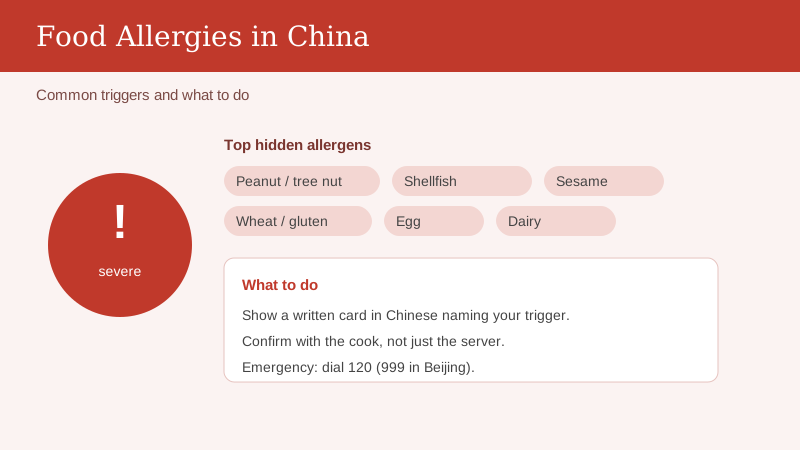
The phrase that matters most is 'wo dui X guomin' — 'I am allergic to X' — spoken for each trigger and backed by a written card. For a life-threatening reaction add 'yanzhong guomin hui xiuk', meaning 'a severe allergy can cause shock', because 'allergy' alone is heard as a mild dislike. Name the food in Chinese: peanut 'huasheng', shellfish 'haixian', egg 'jidan', milk 'niunai', wheat 'mianjin'.
If you carry an epinephrine auto-injector, bring it in your carry-on, keep it on you at the table, and confirm before travel that China permits personal use (it does, with the device in original packaging). Do not rely on a restaurant to have any emergency medication.
Why 'mei wenti' is not a guarantee
A common trap is the cheerful 'mei wenti' — 'no problem' — from a server who wants to please and may not fully grasp cross-contamination. In a busy wok kitchen, the same surface cooks your dish and the shrimp minutes apart, and a brush of water does not remove allergen protein. Treat any verbal reassurance as a starting point, confirm it in writing with the kitchen, and choose simpler cooked-to-order dishes over buffets where you cannot see the preparation.
The safest ordering pattern is: show the card, ask the kitchen directly (not just the server), choose plainly cooked plates with few ingredients, and avoid anything described as 'house special' or 'mixed'. Chain restaurants with picture menus and central kitchens are often easier to manage than tiny family stalls, because the recipe is fixed and the staff can check an ingredient list.
High-risk settings: hotpot, buffets, street food
Three settings deserve extra caution. Hotpot is the highest risk: a shared broth and shared dipping sauces mean one person's shellfish contaminates everything, and the sesame-peanut dip is almost universal. Buffets and salad bars hide cross-contact in shared tongs and mixed dishes. Street food often uses a single oil for everything and cannot tell you the contents. If your allergy is severe, skip these entirely or eat only sealed, packaged items you can read.
- Shared hotpot broth and the standard sesame-peanut dipping sauce
- Buffet tongs and pre-mixed dishes where ingredients are unclear
- Deep-fried street snacks cooked in reused, mixed-oil batches
- Any dish the server cannot name ingredient by ingredient
Long journeys add their own risk. Train dining cars and flight meals are hard to customise, and a 'special meal' request filed through an airline may not reach the Chinese cabin crew reliably. For a severe allergy, bring sealed snacks and a packed meal you control, tell the crew in writing, and avoid sharing food on a train where neighbours' lunches surround you. Control the food you carry rather than betting on a kitchen you cannot see.
Safer ways to order at the table
Some cooking methods are intrinsically lower risk than others. Plainly steamed (qing zheng) or quickly stir-fried to order (qiang chao) dishes with one or two visible ingredients are easier to keep allergen-free than long-simmered braises, which sit for hours in soy- and stock-based liquids. Ask for 'qing zheng' or 'shao chao, bu yao jiang' — lightly cooked, sauce on the side — and prefer a single protein with a single vegetable so you can verify each component yourself.
Use your phone as a translator at the table. Point the camera at a menu and read the ingredient list, not just the dish name; modern apps render Chinese characters into English well enough to catch 'peanut' or 'sesame' in the small print. Save the Chinese allergy card as the first photo in a dedicated album so it opens instantly, and keep a printed paper copy in case the battery dies. The aim is to make the kitchen's job — cooking around your trigger — as simple as possible.
Prepare before you leave home
Most allergy safety in China is set up before departure. Tell your travel insurer about the allergy in writing and confirm it covers emergency evacuation, because a severe reaction in a remote city can mean an air transfer to a major hospital. Register with your embassy so consular staff know a citizen with a medical condition is in the country, and carry a doctor's note in Chinese naming the allergen and your medication in generic terms a local pharmacist can read.
Pack more medication than you think you need. Chinese pharmacies stock antihistamines and some inhalers, but your specific auto-injector may not be sold over the counter and brand names differ. Bring the device in original packaging with the prescription, keep one in your carry-on and one in your hotel room, and learn the Chinese for 'I need a hospital now' before you are in a hurry. Travellers who prepare fully eat across the country with confidence; those who improvise discover the limits at the worst moment.
A printable allergy card in Chinese
Write the card once, save it as a phone image, and show it at every meal. Keep it short and specific so a busy cook can act on it in seconds. Translate the trigger list into the Chinese words from the table above, and state plainly that the reaction can be severe. Hand it to the person cooking, not just the person taking the order.
I have a serious food allergy. I cannot eat: peanut, tree nuts, shellfish (shrimp, crab), sesame, wheat, egg, or dairy. Even a small amount can cause dangerous shock. Please use clean utensils and a separate pan. What can I safely eat? Thank you.
If something goes wrong: emergency numbers
Memorise two numbers before you need them. Dial 120 for ambulance service across mainland China; in Beijing you can also use 999 for the Red Cross emergency line. Major city hospitals run international departments (guojiji) with English-speaking staff and are the right place for an allergic reaction once stabilised. If you carry epinephrine, use it at the first sign of a systemic reaction and call emergency services immediately — do not wait to see if it passes.
For non-emergency preparation, check the travel health advisories from your home country and the Chinese Center for Disease Control and Prevention before departure, and carry a written plan in both English and Chinese naming your allergen, your medication and the nearest international hospital. Travellers who do this preparation eat widely and safely; those who rely on hope and a smile are the ones who end up in a Beijing emergency room.
Frequently asked questions
How do I say I have a food allergy in Chinese?
Say 'wo dui X guomin' for each trigger, then add 'yanzhong guomin hui xiuk' to mean a severe allergy can cause shock. Back it with a written card naming the allergen, because 'allergy' alone is often heard as a mild dislike and may not change how the kitchen cooks.
What allergens are most common in Chinese food?
Soy and wheat hide in nearly every braised dish and noodle through soy sauce and pastes; sesame appears in dips and dressings; peanut and tree nuts turn up in gongbao dishes and satay sauces; shellfish seasons many stocks; and egg binds dumplings and fried rice. None of these show clearly on a menu.
Is it safe to eat at a Chinese hotpot restaurant with allergies?
Hotpot is the highest-risk setting: a shared broth and the near-universal sesame-peanut dipping sauce mean one person's shellfish contaminates everything. If your allergy is severe, skip hotpot or use a fully personal pot with your own sealed sauce. For mild allergies, a personal pot still carries cross-contact risk from shared ingredients.
What should I do if I have an allergic reaction in China?
Use your epinephrine auto-injector at the first systemic sign and call 120 for an ambulance; in Beijing 999 also reaches emergency services. Go to a hospital international department for follow-up care. Prepare a Chinese-English card naming your allergen and nearest international hospital before you travel, and keep the injector in your carry-on.
Can restaurant staff in China guarantee no cross-contamination?
Not reliably. A busy wok kitchen cooks your dish and shellfish on the same surface minutes apart, and a verbal 'no problem' often reflects politeness rather than certainty. Show a written card to the cook, choose simply cooked dishes, prefer chain restaurants with fixed recipes, and avoid buffets and shared hotpot where you cannot see preparation.