Chinese Dining Etiquette: What Actually Matters at a Shared Table
Most Chinese meal etiquette is not a list of prohibitions. It is a set of signals about who is hosting: the host usually orders, the host usually pays, dishes are shared from the centre of a round table, and guests are expected to wait for a cue before reaching for the lazy Susan. Knowing those few things removes far more awkwardness than memorising taboos, and it makes a first dinner invitation much easier to enjoy.
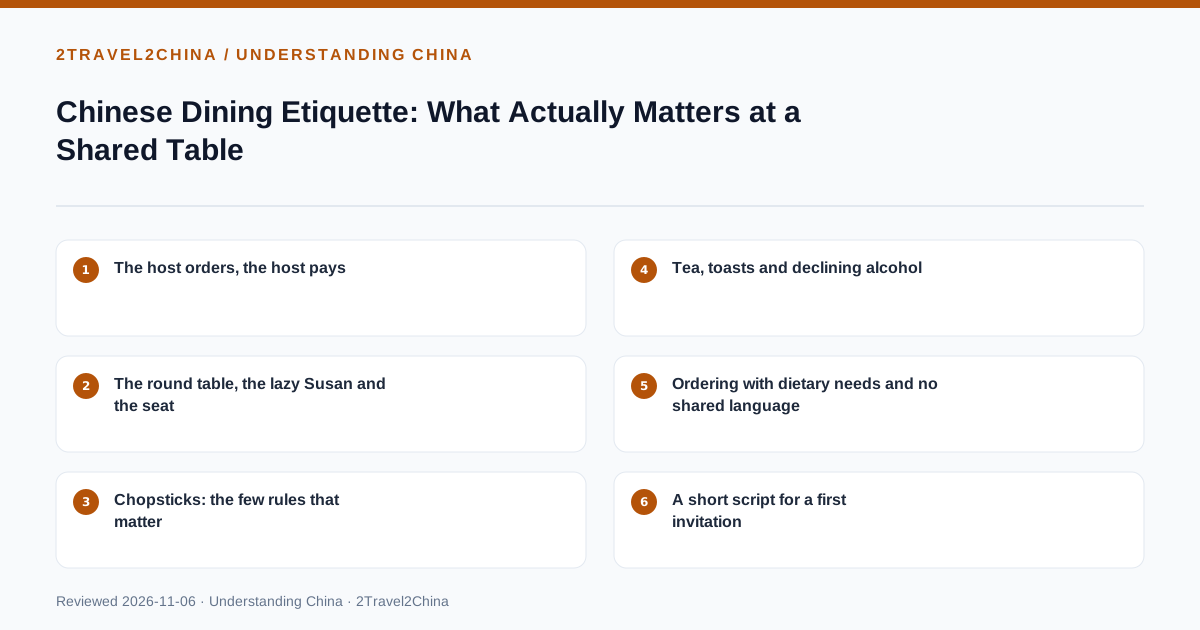
The host orders, the host pays
At a meal with a clear host, the host chooses the dishes and settles the bill. This is the single most useful rule because it settles several questions at once: do not rush to order your own plate, do not insist on splitting the bill, and do not assume silence means nobody has decided. A guest who wants to contribute can offer to order one dish, praise a specific dish, or reciprocate with an invitation another time rather than reaching for the bill.
The logic is generosity rather than formality. A host typically orders more food than the table can finish, because leaving nothing on the plates can imply that too little was provided. Among friends of the same generation, splitting the cost is common and unremarkable, especially in casual settings. Context decides: a business dinner or a first invitation to someone's home follows the host rule; a quick lunch between classmates follows whatever the group agreed.
| Setting | Who orders | Who pays | Guest move |
|---|---|---|---|
| Business or formal invitation | The host | The host | Thank the host, offer a return invitation |
| Family dinner at a home | The cook or host | Not discussed | Bring a small gift, help clear the table |
| Casual meal with friends | The group, often one person for speed | Often split | Offer to transfer your share |
| Solo traveller at a small restaurant | You | You | Point, use a picture menu, pay by QR code |
The round table, the lazy Susan and the seat
A group meal is normally served on a round table with a rotating tray in the middle. Sharing is the default: dishes arrive at the centre and everyone takes a portion into their own bowl. On larger tables the tray is a lazy Susan, and the small courtesies around it are what people actually notice. Wait for the host to start, rotate the tray slowly in one direction, take a modest portion, and do not spin it back immediately to hunt for one specific ingredient.
Seating has a pattern but visitors are rarely expected to work it out. The seat facing the door is generally treated as the host seat, with the most honoured guest placed near the host. If nobody directs you, wait rather than choosing a chair; someone will usually gesture. Once seated, the practical detail is the bowl: keep it close, use the serving spoon or the shared chopsticks when provided, and avoid reaching across another person for a distant dish.
- Wait for the host or the eldest person to begin before taking food.
- Use serving chopsticks or a serving spoon when they are on the table.
- Rotate the lazy Susan in one direction and pause while someone else is serving themselves.
- Take a small first portion; dishes are usually replenished or followed by more courses.
- If invited to choose a seat, wait for the host to indicate one.
Chopsticks: the few rules that matter
Chopstick etiquette is mostly about not pointing, not stabbing and not leaving them in a position associated with funerary offerings. Sticking chopsticks upright into a bowl of rice is the one visitors most often hear about, because it resembles incense placed for the dead. Tapping a bowl with chopsticks, waving them at a person, or using a single chopstick to spear food are the other gestures that reliably draw a comment.
Everything else is ordinary table manners. Rest chopsticks on the rest or across the bowl when you pause, do not use your own chopsticks to turn food over on a shared platter, and avoid crossing them in a way that suggests an argument. Children and foreign guests are rarely corrected directly; a smile and a quiet adjustment is the usual response, so there is no need to be anxious about a minor slip.
| Gesture | Why it is avoided | Do instead |
|---|---|---|
| Chopsticks standing upright in rice | Resembles incense offered to the dead | Lay them flat on the rest or bowl |
| Pointing with chopsticks | Reads as directing the utensil at a person | Gesture with an open hand |
| Tapping the bowl | Associated with begging | Set the bowl down quietly |
| Spearing food with one stick | Not how the utensil is used | Lift with both sticks or ask for a spoon |
| Turning shared food with personal chopsticks | Hygiene at a shared table | Use the serving utensil |
Tea, toasts and declining alcohol
Tea often arrives before the food, and the small courtesies are about other people rather than your own cup. Pour for the people near you before topping up your own, hold the pot or cup with both hands when offering it to an older person, and a light tap of two fingers on the table is a common quiet way to say thank you when someone refills your cup. None of this is a test; it is a set of low-key signals that the table is looking after each other.
Alcohol follows a similar pattern. At a formal dinner the host may propose a toast, and glasses are often raised together with a word such as ganbei. A guest who does not drink can say so plainly and raise a glass of tea, water or a soft drink; refusing a drink is far more acceptable than it once was, and nobody should be pressed. If you do join a toast, holding your glass slightly lower than an elder person is a traditional sign of respect.
- Pour tea for others before refilling your own cup.
- A polite no to alcohol is acceptable; keep a non-alcoholic glass for toasts.
- Wait for the host to propose the first toast at a formal meal.
- Do not feel obliged to match every round; pacing yourself is normal.
A short script for a first invitation
If you remember nothing else, remember the order: wait to be seated, wait for the host to order, wait for the host to start, take small portions from shared dishes, pour tea for others, and thank the host rather than reaching for the bill. That sequence covers a business banquet, a family dinner and most of the situations a visitor will actually encounter.
It also leaves room for the more useful part of the evening, which is asking about the food. Chinese hosts are usually happy to explain a local dish, a regional ingredient or why a particular restaurant was chosen. A specific question about the meal is a better contribution than a perfectly executed gesture, and it turns an intimidating etiquette exercise into a conversation.
Frequently asked questions
Who pays at a Chinese dinner?
When there is a clear host, the host normally orders and pays. A guest should thank the host and can offer a return invitation rather than insisting on splitting the bill. Among friends in casual settings, splitting the cost is common and unremarkable.
Is tipping expected in Chinese restaurants?
No. Tipping is not customary in ordinary restaurants in China. Pay the bill by QR code, by card where accepted, or with cash. Some higher-end venues may add a service charge, which appears on the bill itself.
What are the chopstick rules I should actually remember?
Do not stand chopsticks upright in a bowl of rice, do not point with them, do not tap the bowl, and use the serving utensil for shared dishes when one is provided. Minor slips by foreign guests are rarely commented on directly.
Can I refuse alcohol at a formal dinner?
Yes. Say so plainly and keep a glass of tea, water or a soft drink for toasts. Refusing alcohol is widely accepted. At a formal meal, wait for the host to propose the first toast before raising your glass.
How do I communicate a food allergy without speaking Chinese?
Prepare a card with the requirement written in Chinese characters and show it before ordering. Use picture menus or point to ingredients, confirm spice levels explicitly, and check whether the table uses QR-code ordering inside Alipay or WeChat.