Chinese Food for Beginners: How to Order, What to Eat and Where to Start
Chinese food is not one cuisine but a map of regional kitchens, and the fastest way to enjoy it is to stop expecting a single 'Chinese restaurant' and start ordering by dish. This guide walks a first-time visitor through how a meal actually works in China: scanning a QR code to order, sharing plates family-style, paying through Alipay or WeChat, and recognising the ten dishes that define a first trip. It also covers how to read a menu when you do not read Chinese, how spice levels differ by region, and the street-food and night-market scenes that are safe and rewarding when you follow a few simple rules.
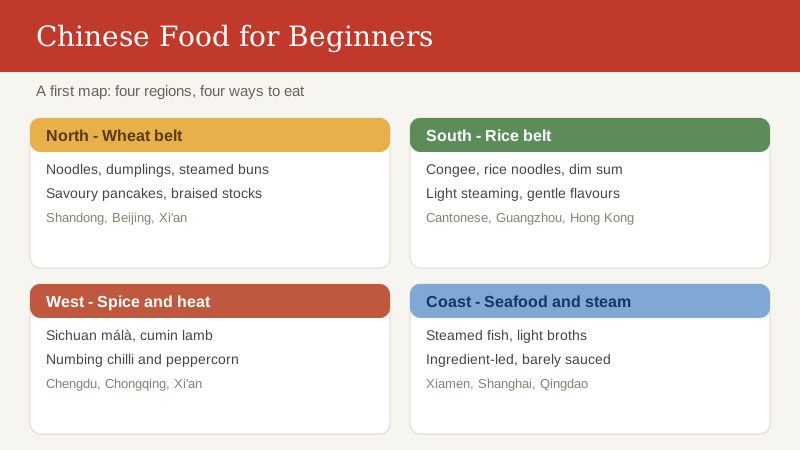
The big picture: regional, not uniform
China has at least eight long-established regional kitchens, and the food in Harbin is as different from the food in Guangzhou as Italian is from Swedish. The practical takeaway for a visitor is simple: do not judge all Chinese food by one restaurant. A bowl of hand-pulled noodles in Lanzhou, a plate of dim sum in Guangzhou and a numb-and-hot hotpot in Chengdu are all 'Chinese food', but they share almost nothing except rice and a mastery of the wok. Planning what to eat by city is more useful than planning by cuisine name.
Two broad strokes help at first. The south leans toward rice, steaming and a lighter hand with oil; the north leans toward wheat, noodles, dumplings and bolder savoury sauces built on scallion and garlic. Within those halves sit the famous regional styles — Sichuan and Hunan in the spicy interior, Cantonese and Fujian along the southeastern coast, Shandong and Jiangsu around the eastern plains, and Anhui in the mountains. You do not need to memorise the list; you only need to know that the speciality changes every few hundred kilometres.
How ordering works in a Chinese restaurant
Most sit-down restaurants in cities now use a QR-code ordering system: scan the code on the table with Alipay or WeChat, browse a menu that often has photos, pick dishes, and pay in the same app when you are done. In smaller or older restaurants a paper menu and a call of 'fuwuyuan' (waiter) still works. Either way, dishes arrive as they are cooked and are placed in the centre for everyone to share — there is rarely an individual plate per person.
Scan or signal
Scan the table QR with Alipay or WeChat, or catch the server's eye and ask for a menu. Many apps translate the menu into English on screen.
Order several shared dishes
Order roughly one dish per person plus one, including a vegetable and a soup, rather than one plate each. Rice or noodles come last.
Pay through the app
When finished, settle the bill in Alipay or WeChat by scanning the exit QR or the code on the table. Cash is accepted but slower.
Tipping is not expected anywhere in ordinary restaurants, and a service charge is rare outside luxury hotels. Leaving loose change on the table confuses staff more than it pleases them.
Dishes every first-timer should try
If you only eat ten dishes in China, make them the ones below. They are famous for a reason, they appear in most major cities, and each one teaches you something about how Chinese cooking builds flavour. Order the English-friendly names and you will almost always get the right plate.
| Dish (English) | Region of origin | What you get |
|---|---|---|
| Gongbao chicken (kung pao) | Sichuan | Diced chicken with peanuts, dried chili and Sichuan pepper in a sweet-sour-spicy sauce |
| Peking duck | Beijing | Crisp roasted duck sliced at the table, wrapped in thin pancakes with scallion and sauce |
| Xiaolongbao | Shanghai / Jiangsu | Steamed soup dumplings with a hot, savoury broth locked inside the wrapper |
| Dim sum | Cantonese (Guangdong) | Bite-size steamed and fried parcels served in roving trolleys or from a menu |
| Hot pot | Sichuan / Chongqing | A simmering broth at your table where you cook meat, tofu and vegetables |
| Mapo tofu | Sichuan | Silken tofu in a red chili-and-bean sauce with the tingle of Sichuan pepper |
| Jianbing | Northern street food | A savoury breakfast crepe with egg, crispy cracker, scallion and sauce |
| Lanzhou hand-pulled noodles (lamian) | Gansu / northwest | Wheat noodles pulled to order, served in clear beef broth with chili oil |
How spice and flavour actually work
The single most misunderstood word is 'spicy'. In Sichuan it means 'mala' — the numbing tingle of Sichuan pepper paired with chili heat, not just burn. In Hunan it means straight dried-chili fire with no numbing. Elsewhere 'spicy' might mean a gentle warmth from white pepper or ginger. Telling a server 'wo bu chi la' (I don't eat spicy) is the safest ask, then dial up with 'wei la' if you want a little.
Beyond heat, Chinese cooking organises taste into a handful of registers: salty, sweet, sour, bitter and the prized 'umami' (xian), often built from stock, fermented bean paste, dried seafood or cured ham. A great meal balances these so no single note dominates. When a dish tastes 'strange' to a Western palate, it is usually the umami or fermented-sour register doing work you do not expect — give it a second bite before judging.
Street food and night markets
Night markets and street stalls are where regional snacking comes alive, from grilled skewers in the north to rice noodle rolls in the south. The safety rule is simple and reliable: eat where there is a queue of locals and a high turnover of food. High turnover means ingredients are fresh and cooked moments ago; a quiet stall with flies is the one to skip. Watch the food cooked in front of you, and favour things that are boiled, grilled or fried to order over pre-cut salads sitting in the open air.
Bottled and canned drinks are safe everywhere; unsealed juices from unknown stalls are a calculated risk. Tap water should be boiled before drinking, so order beer, tea, bottled water or a sealed soft drink rather than a glass of tap water. With those two habits — busy stall, cooked-to-order, sealed drink — street food becomes one of the cheapest and most memorable parts of a China trip.
Tipping, sharing and paying the bill
A Chinese meal is built around sharing, so the bill is settled one way for the whole table, not split item by item. Whoever invited usually pays, and arguing to split is possible through the payment app but culturally odd at a casual meal. Because payment is digital, the 'who gets the bill' moment is just a scan, which removes the awkwardness that cash and cards create in other countries. Refusing to let a host pay is polite once, then accept.
Restaurants rarely add a service charge, and there is no tipping custom to navigate. If you enjoyed the meal, a simple thank-you in person and a good review on Dianping do more than a tip would. Save your cash questions for the rare tourist-trap venue that quotes a separate tea or towel fee — in ordinary places water and tea are complimentary and the price on the menu is the price you pay.
Frequently asked questions
How do I order food in China if I don't speak Chinese?
Scan the table's QR code with Alipay or WeChat and use the in-app translate button to read the menu in English, or shortlist places with photos on the Dianping app before you go. Pointing at a photo on a neighbouring table also works. Pay through the same app when you finish the meal.
What are the must-try dishes for a first trip to China?
Start with gongbao chicken and mapo tofu from Sichuan, Peking duck in Beijing, xiaolongbao soup dumplings in Shanghai, Cantonese dim sum in Guangdong, and a Sichuan or Chongqing hot pot. Add jianbing crepes for breakfast and Lanzhou hand-pulled noodles for a northern staple.
Is Chinese street food safe to eat?
Yes, if you follow two rules: eat at busy stalls with a clear queue of locals and high turnover, and choose food cooked to order over pre-cut items left in the open. Drink sealed bottled water, beer, tea or soft drinks rather than tap water, and you will avoid almost all common stomach trouble.
Do I need to tip in Chinese restaurants?
No. Tipping is not a custom in ordinary Chinese restaurants, and a service charge is rare outside luxury hotels. The bill is paid digitally through Alipay or WeChat, often for the whole table at once. A thank-you and a good review are the expected ways to show appreciation.
How spicy is Sichuan food, and can I ask for less?
Sichuan heat is 'mala' — chili combined with the numbing tingle of Sichuan pepper, which is different from the straight burn of Hunan food. You can control it: say 'wo bu chi la' for none, 'wei la' for mild, or 'hen la' for hot. Most kitchens will adjust the chili to your comfort.