The Eight Great Cuisines of China: A Regional Food Map for Travellers
China does not have one cuisine; it has many, and the standard map travellers meet is the 'eight great cuisines', a shorthand for eight regional traditions each tied to a province and a distinct way with heat, oil, fermentation and starch. Knowing the eight turns a menu from a lottery into a map: you can predict that Sichuan food will be numbing and hot, that Cantonese food will be light and steamed, and that Jiangsu food will be gently sweet. This guide walks the eight by region and flavour, explains how they differ in the kitchen, and gives a first-timer a sensible order to taste them.
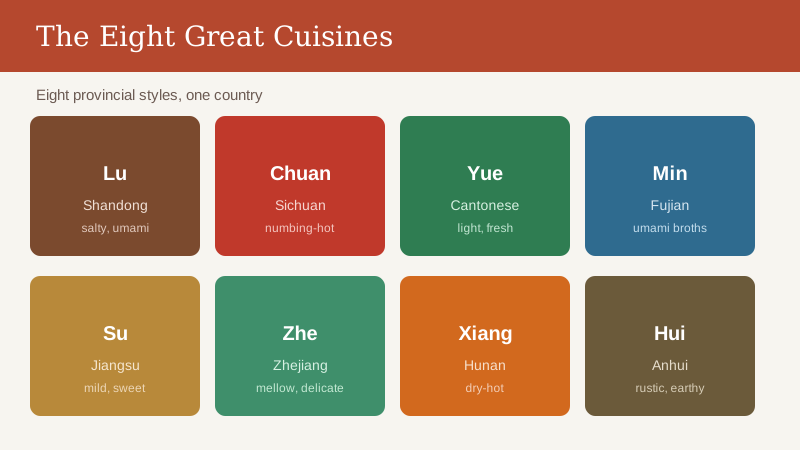
What 'eight great cuisines' actually means
The phrase is a 20th-century teaching tool rather than an ancient law. Regional cooking in China is older than any list, but culinary schools and state culture bodies settled on eight provincial styles — Shandong, Sichuan, Cantonese, Fujian, Jiangsu, Zhejiang, Hunan and Anhui — as the representative set. Each grew from local climate, crops and trade: coastal provinces lean on seafood and light cooking, interior provinces use more preserved and fermented flavour, and the north builds on wheat while the south builds on rice. Treat the eight as a starting frame, not a complete census of Chinese food.
The practical value for a visitor is prediction. When a menu says 'Sichuan-style' you can expect the málà numbing-and-hot combination of chilli and Sichuan peppercorn; 'Cantonese' signals quick cooking that respects the ingredient; 'Jiangsu' hints at careful knife work and a sweet-savoury balance. You will still find fusion and local twists everywhere, but the eight give you a vocabulary to order with intent instead of guessing.
The eight at a glance
| Cuisine (province) | Signature dishes | Defining flavour | Best city to try it |
|---|---|---|---|
| Lu / Shandong | Sweet and sour carp, braised sea cucumber | Salty, umami, crisp-fried | Jinan, Qingdao |
| Chuan / Sichuan | Mapo tofu, gongbao chicken, hotpot | Numbing-hot (málà), oily | Chengdu, Chongqing |
| Yue / Cantonese | Dim sum, steamed fish, roast duck | Light, fresh, ingredient-led | Guangzhou, Hong Kong |
| Min / Fujian | Buddha jumps over wall, seafood soups | Umami broths, sour-sweet | Xiamen, Fuzhou |
| Su / Jiangsu | Lion's head meatballs, mandarin fish | Mild, slightly sweet, refined | Nanjing, Suzhou |
| Zhe / Zhejiang | West Lake vinegar fish, longjing shrimp | Mellow, sweet-sour, delicate | Hangzhou, Ningbo |
| Xiang / Hunan | Chairman's pork, smoked cured meats | Dry-hot, pure chilli heat | Changsha |
| Hui / Anhui | Braised turtle, wild herb stews | Heavy, preserved, earthy | Huangshan |
Northern roots: Lu (Shandong)
Shandong cuisine is the oldest and most influential of the eight, the foundation of much northern cooking and of imperial court food. It prizes clear, salty umami from stocks and seafood, and techniques like quick-frying and braising that keep texture. Famous dishes include sweet and sour carp and braised sea cucumber. Because it spreads through Beijing and the northeast, you meet Lu influences in the pancakes, noodles and savoury cold platters far beyond Shandong itself.
For a visitor, Shandong style is the safe, crowd-pleasing entry point: less chilli, more familiarity, and a clear respect for the main ingredient. Order a whole steamed fish or a crisp-fried vegetable and you get the Chinese kitchen at its most classical, before the regional fireworks of the south and west begin.
Sichuan and Hunan: two kinds of heat
The two 'hot' cuisines are often confused, but they differ in mechanism. Sichuan uses the málà pair — chilli for heat and Sichuan peppercorn for a tingling numbness — plus broad bean paste and oil, so the heat is layered and mouth-coating. Hunan (Xiang) uses fresh and dried chillies with almost no numbing, producing a drier, sharper, purer burn, often with smoked and cured meats. Both are addictive; Sichuan is rounder, Hunan is more direct.
If you only try one, let your tolerance decide. Sichuan hotpot is a social event built around a divided or full spicy broth and a dipping sauce you control, so you can moderate the heat. Hunan food is less adjustable once cooked, so ask for 'wei la' (mildly spicy) if you are unsure. Either way, keep plain rice and a cold drink handy.
The south coast: Cantonese and Fujian
Cantonese (Yue) is the style foreigners know best, and the one most likely to please a cautious eater. It favours steaming, light stir-frying and poaching so the ingredient speaks, with dim sum — small steamed and fried bites — as its social centrepiece. Fujian (Min) sits beside it with a seafood-and-broth focus, famous for complex soups like 'Buddha jumps over the wall' and a gentle sour-sweet note from pickled ingredients. Both coastal provinces keep things fresh rather than heavy.
Eating Cantonese well is about restraint and freshness: a simply steamed fish with scallion and oil, a plate of greens, a bowl of congee. Fujian rewards a good soup stop, especially in Xiamen where seafood broth cultures thrive. These are the regions to choose when travelling with children, older relatives or anyone wary of chilli.
The Yangtze delta: Jiangsu and Zhejiang
Jiangsu (Su) and Zhejiang (Zhe) form the refined, slightly sweet heart of eastern China, built around the lakes and rivers near Shanghai, Nanjing, Suzhou and Hangzhou. Su cooking is meticulous — lion's head meatballs, sweet and sour mandarin fish, careful knife work — while Zhe is lighter and more aromatic, famous for West Lake vinegar fish and longjing shrimp cooked with local green tea. Both use sugar to round savoury dishes, which surprises visitors expecting Chinese food to be either hot or salty.
This is the cuisine of the grand canal cities, best eaten slowly in a seated restaurant rather than grabbed on the street. Order two or three shared plates and a staple, and notice how the sweetness is balanced, not dessert-like. Hangzhou in particular pairs these dishes with tea culture, making it a natural stop on a food-and-scenery route.
Anhui and the mountainous interior
Anhui (Hui) is the least known abroad and the most rustic of the eight, rooted in the hills around Huangshan. It relies on wild herbs, braised and stewed dishes, and preserved ingredients like cured bamboo and ham, with little oil showiness and a deep, earthy colour. Signature dishes include braised turtle and various mountain-vegetable stews. It is less about spectacle than about substance, and it pairs naturally with a visit to the Huizhou villages of Hongcun and Xidi.
Try Anhui food where it is made, near Huangshan, rather than chasing it in big cities where it is rare. The flavour profile — savoury, herbal, slightly smoky — is a good contrast to the sweetness of the nearby Yangtze delta and shows how much China's 'cuisine map' still follows its geography.
A sensible tasting order for first-timers
Start mild
Begin with Cantonese or Hangzhou (Zhejiang) dishes — steamed fish, plain vegetables — so your palate learns the baseline before chilli arrives.
Add the north
Move to Shandong and Jiangsu for savoury, slightly sweet classics that build confidence with braised and fried textures and clean stocks.
Turn up the heat
Introduce Sichuan hotpot or gongbao chicken next, then Hunan, so the numbing and the dry heat read as distinct experiences rather than one big burn.
Finish rustic
Close with Anhui or Fujian broths and mountain dishes for a slower, umami-rich end that contrasts the earlier fireworks and rounds out the map.
Where to eat each style on a China trip
You do not need a special trip for most of these. Cantonese is unavoidable in Guangzhou and Hong Kong; Sichuan defines Chengdu and Chongqing; Hunan centres on Changsha; Hangzhou and Suzhou deliver the delta styles; Shandong shows up across the north; Fujian belongs to Xiamen and Fuzhou; Anhui waits near Huangshan. Build your eating plan from your route: pick one signature dish per region you visit, and let the eight be a checklist rather than a burden.
A practical tip: in any big city, dedicated regional restaurants advertise their province in the name, and review apps list 'caixi' (cuisine style) as a filter. Choose a restaurant that only does one regional style — the focus usually means better execution than a 'Chinese food' menu that tries to do all eight at once.
Frequently asked questions
What are the eight great cuisines of China?
The eight are Shandong, Sichuan, Cantonese, Fujian, Jiangsu, Zhejiang, Hunan and Anhui — eight provincial styles chosen as representative regional traditions. Each reflects its local climate and crops: coastlines lean on seafood, interiors on preserved flavour, the north on wheat and the south on rice.
Which Chinese cuisine is best for someone who dislikes spice?
Cantonese (Yue) and the eastern delta styles of Jiangsu and Zhejiang are the mildest, favouring steaming, gentle stir-frying and a light, slightly sweet balance that respects the ingredient. Shandong is also low on chilli. Save Sichuan and Hunan for when you want heat, and ask for a mild version if unsure.
What is the difference between Sichuan and Hunan food?
Sichuan pairs chilli with Sichuan peppercorn for a numbing, oily málà heat that is layered and mouth-coating, while Hunan uses fresh and dried chillies with almost no numbing for a drier, sharper pure burn. Sichuan hotpot lets you control the spice; Hunan dishes are less adjustable once cooked.
Where can I try each cuisine on a China trip?
Cantonese is everywhere in Guangzhou, Sichuan defines Chengdu and Chongqing, Hunan centres on Changsha, Hangzhou and Suzhou serve the delta styles, Shandong spans the north, Fujian belongs to Xiamen, and Anhui waits near Huangshan. Let your route decide which signatures you tick off.
Is Chinese food all the same across the country?
No. China has many regional cuisines, and the eight great cuisines are only the standard teaching set. Flavour, cooking method and staple change sharply by province — rice in the south, wheat in the north, seafood on the coast, fermented and preserved flavours inland. A menu in Chengdu and one in Guangzhou barely overlap.