Vegetarian and Vegan Food in China: How to Eat Plant-Based Without the Guesswork
China is easier for plant-based eating than its meat-heavy reputation suggests, but only if you understand one trap: the Chinese word for vegetarian, 'sushi', usually means 'no visible meat', not 'no animal product'. Egg is common in meat-free dishes, strict Buddhist kitchens avoid the pungent alliums (garlic, onion, leeks) that many Western vegans eat freely, and dairy is rare because traditional Chinese cooking simply does not use much of it. This guide explains the words that actually get you fed, where to find fully plant-based Buddhist temple kitchens, what hides inside seemingly vegetable dishes, and how to turn a phone screen into a vegan card staff can read.
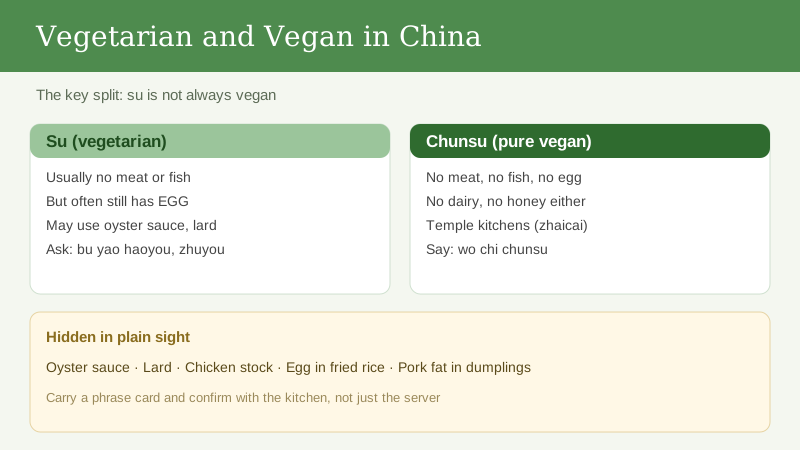
Why 'vegetarian' in China is not what you expect
The first surprise for plant-based travellers is that a dish labelled vegetarian in an ordinary restaurant may still contain egg, and in some regions even meat stock or oyster sauce. Chinese 'sushi' (vegetarian food) means the absence of meat and fish, not all animal derivatives. Because dairy is barely used, a vegetarian plate is often accidentally vegan except for the egg — but never assume the egg is out.
The second surprise is the opposite: strict Buddhist temple kitchens, called 'zhaicai', are fully plant-based and also skip the 'five pungent vegetables' — garlic, onion, leek, chive and shallot — on religious grounds. So a temple meal can be more vegan than a Western 'vegan' label, while a city restaurant's 'vegetarian' stir-fry may not be vegan at all. The distinction is the whole game, and the words below are how you signal which one you mean.
The words that actually get you fed
Learn four written words and you can navigate almost any menu. 'Sushi' means vegetarian food; 'sucai' means vegetarian dishes; 'zhaicai' means Buddhist vegetarian; and 'chunsu' means pure vegan, with no egg and no dairy. Showing the characters on your phone removes the ambiguity of pronunciation. The spoken phrase most staff understand is 'wo chi su' — 'I eat vegetarian' — which at least steers you to the right section of the menu.
- 'wo chi su' — I eat vegetarian (proper nouns only, spoken)
- 'wo chi chunsu' — I eat pure vegan, no egg and no dairy
- 'wo bu chi rou' — I do not eat meat
- 'bu yao cong suan' — no garlic and no onion, if you avoid alliums
Buddhist vegetarian restaurants (zhaicai)
Buddhist vegetarian restaurants are the most reliable plant-based option in China, and they often cluster near temples. They serve creative 'mock meats' made from gluten, tofu, mushroom and konjac that mimic duck, pork and fish in texture alone — no animal involved. Famous examples include the vegetarian hall at Wenshu Yuan monastery in Chengdu, the Nanputuo Temple banquet in Xiamen praised as one of the country's finest vegetarian experiences, and temple kitchens in Hangzhou and Shanghai that serve quiet, restorative set meals.
Temple kitchens are typically busy at weekends and festival days, and many close by early evening. Arrive before 7pm, expect a simple fixed menu, and treat the meal as part of the temple visit rather than a restaurant booking.
Finding a temple kitchen is easier than it sounds. Search map apps for 'su shi' or 'zhaicai guan', and look for restaurants physically attached to or beside a monastery, where the kitchen supplies the monks. In Chengdu, Wenshu Yuan's vegetarian hall is a destination in its own right; in Hangzhou, temples by West Lake serve set lunches; in Xiamen, Nanputuo's banquet is famous enough that visitors book ahead on holidays.
What hides in 'vegetable' dishes
Even when a dish is all plants on the menu, animal products sneak in through the cooking. Oyster sauce is the most common — it appears in everything from gai lan to 'vegetable' fried rice. Lard (zhuyou) is used to stir-fry greens for shine and flavour. Chicken or pork stock seasons many soups and braised vegetables. Egg binds dumpling fillings and appears in fried rice and noodles even when no meat is listed. None of these show up under 'vegetable'.
| Dish you might order | Hidden risk | What to ask |
|---|---|---|
| Stir-fried greens | Oyster sauce, lard | 'bu yao haoyou, bu yong zhuyou' — no oyster sauce, no lard |
| Fried rice or noodles | Egg, lard, chicken stock | 'qing chao, bu yao dan' — plain fry, no egg |
| Vegetable dumplings | Pork fat in wrapper | Confirm a fully vegetable filling and wrapper |
| Mapo tofu (veg version) | Still may use meat stock | Ask for the declared vegetarian version |
Cities and apps that make it easy
The easiest plant-based cities are the big, international ones: Shanghai, Beijing, Chengdu and Hangzhou all have dedicated vegan restaurants, import supermarkets with vegan sections such as Ole, and a young dining scene that understands the term. The discovery app Dianping lets you filter by 'sushi' and read reviews; the global community app HappyCow works in major Chinese cities and is the fastest way to find a verified vegan kitchen near you.
Outside the top tier, plan a little more. Smaller cities still have Buddhist temple kitchens and plenty of tofu, but few labelled vegan restaurants, so the phrase card and Dianping's photo reviews carry the load. Supermarkets in any city sell firm tofu, fresh greens and mantou (steamed buns) that are almost always vegan, so a self-catered breakfast is never hard.
Self-catering and markets: the easy backup
Supermarkets and wet markets are a plant-based traveller's safety net when a restaurant cannot guarantee a vegan plate. Every city has a chain supermarket, such as Hema, Yonghui or Ole, and a morning wet market where you can buy firm tofu, fresh leafy greens, tomatoes, sweet potatoes, mantou steamed buns, rice and seasonal fruit. These staples are almost universally vegan and let you build a hotel-room breakfast or a park picnic without depending on a kitchen understanding your card. A small rice cooker or even a hotel kettle can cook grains and steam vegetables for almost nothing.
The one catch is packaged snacks. Domestic biscuits, instant noodles and 'vegetable' crackers often contain egg powder or milk powder even when the picture shows only plants. Scan labels for the characters 'nai' (milk), 'dan' (egg) and 'huangyou' (butter), and prefer products with an allergen statement. Big-city import sections stock certified vegan items and plant milks that remove the guesswork entirely, so a short supermarket run can cover several meals and lower the daily pressure on restaurants.
Regional differences worth knowing
Plant-based eating gets easier as you cross regions, and knowing the pattern helps you choose. Sichuan and Hunan carry deep Buddhist and tofu traditions, so Chengdu and its neighbours offer the richest temple-kitchen and tofu repertoire in the country. Fujian and Zhejiang, around Xiamen and Hangzhou, blend temple cuisine with a lighter coastal style but still anchor strong vegetarian restaurants to their monasteries. The further south toward Guangdong, the more dim sum leans on pork and lard, so the phrase card carries more weight there.
Northern China is noodle and bread country, which cuts both ways. Hand-pulled lamian broth is meat-based, and many wheat noodles and dumpling wrappers contain egg, so ask 'bu yao dan' (no egg) before ordering. The compensation is mantou, laobing flatbreads and steamed buns that are usually egg- and dairy-free, plus endless cabbage, potato and tomato dishes that need only a lard-free wok. Reading the regional pattern lets you pick cities and dishes that fit instead of fighting the local default every meal.
A simple phrase card to show staff
When words fail, a phone screen succeeds. Save the line below as an image or note and show it when you order. It states the rule in plain terms a kitchen can act on, which is far more reliable than repeating 'I am vegan' to someone who hears it as a vague preference. Pair it with pointing at the menu photo you want, and confirm with 'zhe ge you rou ma?' — 'does this have meat?'
I am a strict vegan. I do not eat: any meat (pork, beef, chicken, fish, seafood), egg, dairy, honey, animal fats (lard), or oyster sauce. What vegetable dishes can I eat? Thank you.
Frequently asked questions
Is vegetarian food in China actually vegan?
Usually not. The Chinese word for vegetarian, 'sushi', generally means no visible meat but often still includes egg, and ordinary restaurants may use oyster sauce or lard. Strict Buddhist temple kitchens are fully plant-based and also skip garlic and onion. Always confirm egg and hidden animal products unless you are in a temple kitchen.
How do I say I am vegan in Chinese?
Learn 'wo chi chunsu' for 'I eat pure vegan', and show a short written note listing what you avoid: meat, egg, dairy, honey, lard and oyster sauce. Spoken 'wo chi su' means only 'I eat vegetarian', which is weaker. A phone screen with the list is more reliable than pronunciation alone.
Where can I find reliable vegan restaurants in China?
Buddhist temple kitchens (zhaicai) are the safest fully plant-based option and often sit near monasteries. In cities use the HappyCow app and Dianping's 'sushi' filter; Shanghai, Beijing, Chengdu and Hangzhou have the most dedicated vegan venues and import supermarkets with vegan sections.
What hidden animal products should I watch for?
Oyster sauce in greens, lard in stir-fries, chicken or pork stock in soups, and egg in fried rice, noodles and dumpling fillings are the common ones. None appear under 'vegetable' on a menu. Ask 'bu yao haoyou, bu yong zhuyou' to drop oyster sauce and lard before you order.
Is China a good destination for vegan travellers?
Yes, with preparation. Tofu, fresh vegetables, steamed buns and rice are everywhere, temple kitchens are genuinely vegan, and major cities have dedicated restaurants. The challenge is communication, not availability — a phrase card and the right apps turn a difficult trip into an easy one.