Chinese Tea: A Traveller's Guide to Types, Regions, Ceremony and Buying
Tea is China's oldest export and its daily ritual, and for a visitor it is the easiest 'cultural experience' to actually join rather than just observe. The country grows six broad families of tea — green, black (called red tea locally), oolong, white, yellow and dark (including pu-erh) — each tied to a specific region and a different way of brewing. This guide maps the families to the places they come from, explains the gongfu tea ceremony you will meet in teahouses, shows where to drink and how to buy tea without overpaying, and covers the small etiquette of cups and saucers that makes you look like you belong.
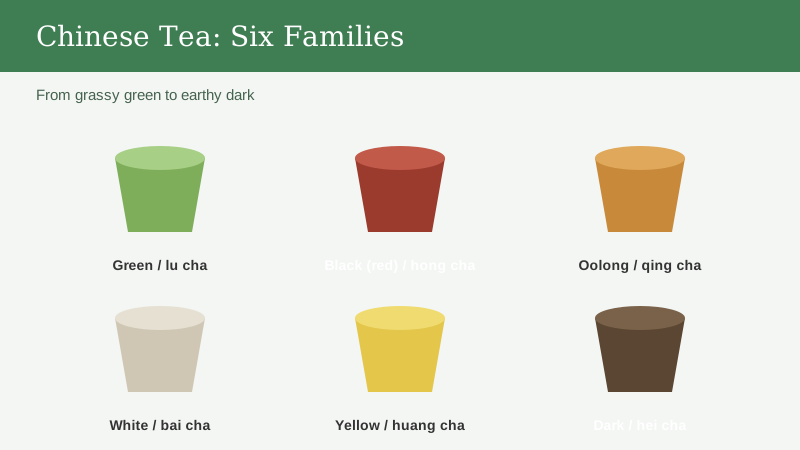
Six families of Chinese tea
All tea comes from the same plant; what changes is oxidation and processing, which Chinese tradition splits into six families. Green tea is unoxidised and grassy; black tea (hong cha, 'red tea') is fully oxidised and malty; oolong sits between, partially oxidised and floral; white tea is barely processed and delicate; yellow tea is a rare, gently smoothed green; and dark tea (hei cha), including pu-erh, is post-fermented and earthy, often aged like wine. Knowing the family tells you how the cup will taste before you order.
| Family | Flavour | Brew temperature |
|---|---|---|
| Green (lu cha) | Fresh, grassy, light | 75-80 C, not boiling |
| Black / red (hong cha) | Malty, sweet, full | 90-95 C |
| Oolong (qing cha) | Floral to roasted | 90-100 C |
| White (bai cha) | Soft, honeyed, subtle | 80-85 C |
| Dark / pu-erh (hei cha) | Earthy, aged, deep | 95-100 C |
Where each famous tea comes from
Terroir matters as much in tea as in wine, and most famous Chinese teas are named for their mountain or town. West Lake Longjing (Longjing) is a pan-fired green from Hangzhou in Zhejiang. Tieguanyin is a floral oolong from Anxi in Fujian. Wuyi rock tea (yan cha) grows on the cliffs of Fujian's Wuyi Mountains. Pu-erh comes from Yunnan's Xishuangbanna. Huangshan Maofeng is a green from Anhui's Yellow Mountain, and Baihao Yinzhen silver-needle white tea comes from Fujian's Fuding. Buy the tea in or near its home region and you get both freshness and a fair price.
- Hangzhou, Zhejiang — West Lake Longjing green tea
- Anxi / Wuyi, Fujian — Tieguanyin and rock oolong
- Xishuangbanna, Yunnan — aged pu-erh dark tea
- Huangshan, Anhui — Maofeng green and nearby keemun black
- Fuding, Fujian — silver-needle white tea
How tea is served: gongfu cha
In teahouses and southern homes you will meet gongfu cha, the 'skilled tea' ritual: a small clay or porcelain pot, tiny cups, and several short steepings of the same leaves. The point is to extract the tea in stages so each infusion reveals a different layer, rather than one big mug. It looks formal but is welcoming — you are invited to watch, smell the lid, and sip from the small cup. Joining a gongfu session is the most authentic tea experience a visitor can have, and it costs little in a neighbourhood teahouse.
Warm the vessels
Pour hot water over the pot and cups, then discard, to heat the clay and wake the leaves.
Short steeps
Add leaves and steep for only 10-20 seconds, pouring the first infusion away to rinse, then serve small cups in turn.
Resteep many times
Quality leaves yield six to ten infusions; lengthen each steep slightly as the flavour fades.
Where to drink: teahouses and temples
Every city has teahouses, from grand riverside rooms in Hangzhou to quiet side-street shops elsewhere, where you pay by the pot and can sit for an hour. Temple tea is a special case: many monasteries, including sites around Hangzhou and Chengdu, serve simple tea in a calm courtyard as part of a visit. In tourist districts a 'tea ceremony' pitched at visitors can drift toward a sales pitch, so prefer a normal teahouse where locals are drinking, and treat any invitation to 'just look at our rare tea' with mild caution.
A standard teahouse pot for two usually costs a fraction of a Western cafe session and includes refills. Ask the price before sitting down in scenic spots, where a riverside view can multiply the bill.
How to buy tea without getting scammed
Tea is easy to overpay for, especially near temples and airports where 'famous' tins can be mostly stems and dust at triple price. The reliable route is a proper tea market (cha cheng) in a big city, where dozens of shops compete and you can smell and taste before buying, or a reputable brand shop with clear pricing ('mingma biaojia'). Top-grade West Lake Longjing can legitimately cost hundreds of yuan per 50 grams, but ordinary everyday Longjing is a tenth of that — so a 'bargain' premium tin is the red flag, not the cheap one.
- Buy in a tea market or a brand shop with visible prices, not at a temple stall or airport kiosk.
- Ask for the producing area and look for sealed, dated packages from a named garden or factory.
- Taste before you buy; a shop that refuses a sample is one to leave.
- Expect to pay more for the true origin name, and accept that 'Longjing-style' is not Longjing.
Seasonality and freshness
Tea is seasonal in a way coffee is not, and freshness drives both price and flavour. The most prized green teas, such as pre-Qingming Longjing (mingqian), are picked before the Qingming festival in early April, when young buds are tender and the cup is sweet rather than bitter. Summer and autumn produce later, stronger leaves used for everyday drinking and for oolong and black teas that actually prefer mature leaf. Buying within the harvest year matters far more for green and white teas than for aged pu-erh, which is valued precisely because it develops with time.
Storage protects the investment. Tea absorbs surrounding smells, so keep it away from the spice drawer, the fridge door and anything aromatic, sealed in a tin or foil bag. Green and white teas lose their edge within a year if exposed to air and light; oolong and black keep longer; and pu-erh is traditionally stored in a ventilated, odour-free space to age. A shop that cannot tell you the harvest year of a 'premium' green is one to avoid, because you may be paying new-tea prices for old leaf.
Tea, caffeine and everyday drinking
Chinese tea contains caffeine, but the amount depends heavily on the family and the brew. Green and white teas are relatively low, oolong and black higher, and the first short gongfu infusion pulls the most caffeine into the cup while later steeps grow milder. Most travellers tolerate an afternoon pot well, but if you are sensitive, choose green or white, avoid the first strong infusion, and skip tea on an empty stomach, which can feel acidic for some people.
One myth worth setting aside: tea is not a detox or a medicine, and the health claims attached to specific famous teas are mostly marketing. What is true is gentle and modest — tea is a calorie-free, hydrating alternative to sugary drinks, and the ritual of slowing down for a pot is genuinely restful after a busy travel day. Treat it as a pleasure and a cultural practice rather than a supplement, and you will enjoy it more.
Tea etiquette you can use
A few small gestures go a long way. When someone fills your cup, tap two fingers on the table — the 'finger thank-you' said to originate with an emperor who poured for his disguised subjects. Do not drain your cup and immediately demand more; in gongfu style, let the host pour. Offer the first cup to the eldest or most senior person present. None of this is strict, but it signals respect and makes a shared pot more enjoyable for everyone at the table.
One practical note: Chinese tea is almost always served without milk or sugar, and adding either marks you as a tourist — which is fine, but the host may quietly assume you dislike the tea's real flavour. Try it plain first; the point of a good green or oolong is exactly the taste you would be masking. If you truly prefer it sweet, ask for a separate saucer of rock sugar rather than reaching for the sugar bowl.
Frequently asked questions
What are the main types of Chinese tea?
China classifies tea into six families by how it is processed: green (unoxidised, grassy), black or 'red' tea (malty), oolong (partially oxidised, floral to roasted), white (delicate), yellow (a rare smoothed green) and dark tea including pu-erh (earthy, often aged). The family tells you the flavour before you brew.
Where does famous Chinese tea come from?
West Lake Longjing green tea comes from Hangzhou in Zhejiang; Tieguanyin and Wuyi rock oolong from Fujian; pu-erh dark tea from Yunnan; Huangshan Maofeng green from Anhui; and silver-needle white tea from Fuding in Fujian. Buying in or near the home region gives fresher tea at a fairer price.
What is gongfu tea ceremony?
Gongfu cha is the southern 'skilled tea' ritual using a small pot and tiny cups, with many short steeps of the same leaves so each infusion reveals a new layer. It is welcoming rather than strict — you watch, smell the lid and sip. A neighbourhood teahouse offers it cheaply and authentically.
How do I buy Chinese tea without overpaying?
Shop in a tea market or a brand store with visible pricing rather than temple stalls or airports, taste before buying, and look for sealed, dated packs from a named garden. True West Lake Longjing can cost hundreds of yuan per 50 grams, so a 'bargain' premium tin is the warning sign, not the cheap one.
Do Chinese people add milk or sugar to tea?
Almost never. Chinese tea is served plain so you taste the leaf, and adding milk or sugar marks you as a visitor. Try it unsweetened first; if you truly prefer it sweet, ask for a separate saucer of rock sugar rather than reaching for the sugar bowl at the table.