How to Plan Your First Trip to China: A Complete Framework (2026)
A first trip to China is mostly a sequencing problem. The country is large enough that the number of days decides how many regions you can combine, and the high-speed rail network is good enough that a well-shaped route needs very few flights. This guide gives the framework before the routes: how to choose bases, how to count travel days, and the order in which to settle the paperwork, payments and bookings.
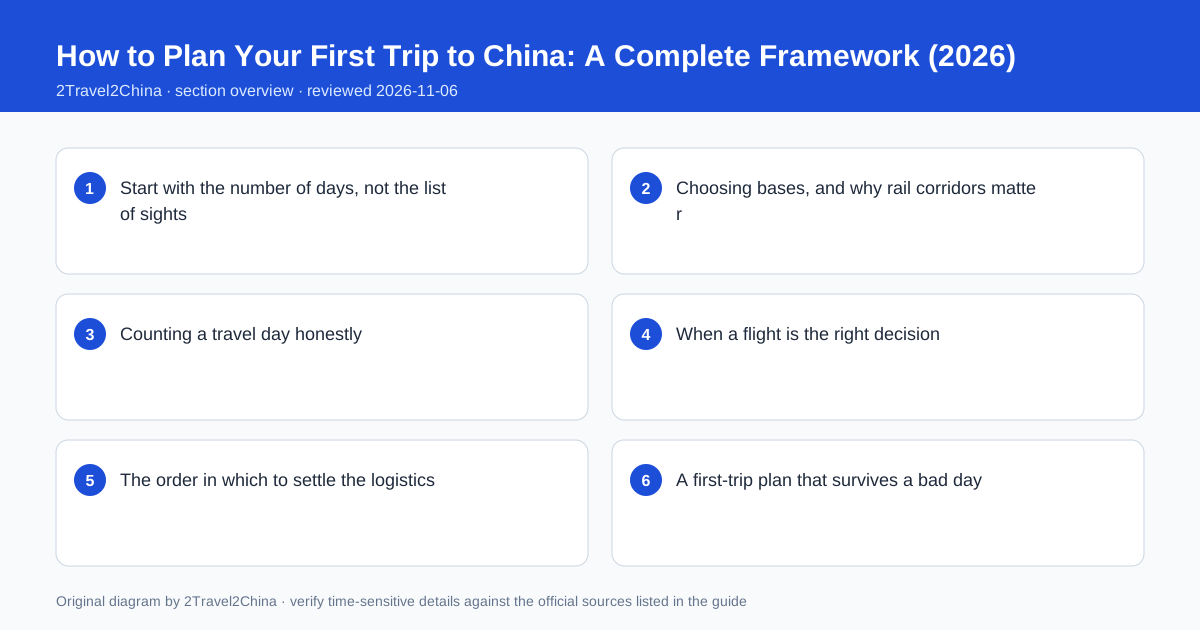
Start with the number of days, not the list of sights
The most common first-trip mistake is starting from a bucket list and trying to fit it into the available time. Beijing, Xi’an, Shanghai, Guilin, Chengdu and the Great Wall can all appear on a two-week plan on paper, but each transfer consumes most of a day once check-out, the trip to the station, the journey and check-in are counted. A better starting point is the number of nights on the ground, minus the first day and the last day, which are rarely full sightseeing days.
| Nights | Realistic bases | Shape |
|---|---|---|
| 5–6 | One city and nearby day trips | Beijing with the Great Wall, or Shanghai with Suzhou |
| 7–8 | Two connected cities | Beijing and Xi’an, or Shanghai and Hangzhou |
| 10–11 | Three cities on one rail corridor | Beijing, Xi’an, Shanghai |
| 14 | Three or four with one flight | Add Chengdu or Guilin to the classic route |
| Under 5 | One city, no intercity travel | A deep single-city trip beats a rushed loop |
A ten-day trip has perhaps eight usable days. Two intercity transfers take two of them. That leaves six days split across three cities — two days each — which is workable if the sites are chosen carefully and disastrous if each day contains three major attractions. Work from the usable days, then assign two nights minimum to each base. One-night stops look efficient on a spreadsheet and feel like living out of a suitcase.
Choosing bases, and why rail corridors matter
China operates 165,000 km of railway, of which more than 50,000 km is high-speed line, and 97 percent of cities with over 500,000 residents are connected to the high-speed network. The practical consequence is that certain city pairs are natural neighbours while others are not. Beijing, Xi’an and Shanghai sit on a well-served corridor; Shanghai, Suzhou and Hangzhou are close enough for day trips; Chengdu and Guilin are better added with a flight or a longer rail leg.
| Pair | Connection | Suits |
|---|---|---|
| Beijing → Xi’an | Direct high-speed rail, roughly a half-day journey | Classic first route |
| Xi’an → Shanghai | Long high-speed rail leg or a flight | A full travel day |
| Shanghai → Suzhou / Hangzhou | Very short high-speed rail hops | Day trips from one base |
| Beijing → Shanghai | Frequent high-speed services | A comfortable single leg |
| Any city → Chengdu / Guilin | Longer rail journey or a flight | Adds a region, costs a day |
Group bases into regions rather than drawing a loop across the whole map. A first trip that stays in the north and the Yangtze Delta can be almost entirely rail-based, with central stations, no airport security and a passport read at the gate. Adding a far south-west region usually means one flight and one extra travel day. That is a legitimate trade, but it should be a deliberate one.
Counting a travel day honestly
A four-hour train is not a four-hour commitment. Check-out, the trip to the station, arriving early enough for the gate, the journey itself, the trip from the arrival station and hotel check-in routinely turn it into six or seven hours. Add a meal and a buffer for a delayed departure and most of the day is gone. Treat an intercity move as a travel day with one light activity at each end, not as a sightseeing day with a train in the middle.
Morning
Check out, reach the station early, board with the passport used for the booking.
Midday
The journey itself; keep a booked seat and a plan for luggage.
Afternoon
Transfer from the arrival station and check in.
Late afternoon
One light activity: a neighbourhood walk, a market, an early dinner.
Next day
The first full sightseeing day in the new base.
This is why a one-night stop is so expensive in practice. You arrive in the afternoon, sleep, and leave the next morning having seen almost nothing while paying for two transfers. Two nights is the minimum that makes a base worthwhile. If the arithmetic does not allow two nights somewhere, drop the city rather than compressing the stay.
When a flight is the right decision
Rail is usually better for journeys up to roughly five or six hours because stations are central, services are frequent and the boarding process is simpler. A flight wins on genuinely long cross-country legs, on a tight connection with a fixed arrival time, or when a route is not served by a direct high-speed service. Compare door-to-door time: a two-hour flight plus two hours of airport process, security and transfers is not obviously faster than a five-hour train.
| Situation | Prefer | Reason |
|---|---|---|
| Under ~5 hours between city centres | Rail | Central stations, simpler boarding |
| Cross-country, 1,500 km or more | Flight | Rail would consume a full day or more |
| Fixed same-day commitment | Whichever has more slack | A buffer protects the commitment |
| Peak holiday week | Book either very early | Availability, not mode, is the constraint |
| Heavy luggage or a group | Rail | Fewer handling steps |
If a flight is necessary, do not place it immediately after an international arrival or immediately before an international departure. Keep the long-haul flights and the domestic flight separated by at least a night, so a delay does not cascade into a missed intercontinental connection. That single rule prevents more ruined itineraries than any booking trick.
The order in which to settle the logistics
The planning sequence matters as much as the route. First, establish whether your passport needs a visa or is covered by the 2026 visa-free or 240-hour transit rules. Second, set up Alipay and WeChat Pay with a verified passport record and linked foreign cards, at home where bank verification codes arrive. Third, book the international flights and the first-night hotel. Fourth, register 12306 with the exact passport name. Fifth, book intercity rail when tickets are released.
- Entry route: visa-free list, 240-hour transit, or an L visa application
- Payments: two wallets verified, two linked cards, one small test transaction
- Connectivity: eSIM or SIM plan, offline maps, Chinese addresses, translation pack
- Accommodation: confirm the property can register a foreign passport
- Rail: 12306 account with the exact passport name, then tickets at release
- Attractions: timed-entry slots for the headline sites
The two items that cause the most downstream trouble are the passport name in 12306 and the hotel’s ability to register a foreign guest. Both are cheap to confirm early and expensive to discover at a station gate or a check-in desk. Keep offline copies of every confirmation, because an arrivals hall with an unactivated SIM is the worst possible place to search an inbox.
A first-trip plan that survives a bad day
Build slack into three places: the first day, the day after each intercity transfer, and the day before flying home. The first day absorbs immigration, transfer and jet lag. The day after a transfer absorbs a delayed train or a slow check-in. The final buffer protects the flight home from a last-minute disruption. A plan that only works when everything arrives on time is not a usable plan.
| Day type | What to schedule | What not to schedule |
|---|---|---|
| Arrival day | Transfer, check-in, a neighbourhood walk, an early night | A timed museum slot |
| Full days | One major site plus one lighter activity | Three headline attractions |
| Transfer days | The journey and one easy evening activity | A fixed-time booking |
| Buffer day | A flexible list of second-choice sites | An intercity move |
| Pre-departure day | Packing, a short local outing, an airport plan | A day trip far from the airport |
Keep a short list of second-choice activities for each city — a smaller museum, a park, a historic neighbourhood — that need no advance booking. When rain closes a cableway or a timed slot is lost, swapping in one of those keeps the day intact. The framework is not about seeing fewer things; it is about making the things you planned actually happen.
Entry rules, ticket-release windows, venue booking systems and transport timetables change. Use this framework to shape the trip, then verify current dates and official sources before booking non-refundable travel.
Frequently asked questions
How many days do I need for a first trip to China?
Ten to fourteen days supports three cities on the classic Beijing–Xi’an–Shanghai corridor. Under a week is better spent in one city with day trips. Count usable days after removing arrival, departure and transfer days.
How many cities should a first trip include?
Two or three bases in ten to fourteen days. Each intercity transfer consumes most of a day, and a one-night stop rarely delivers enough sightseeing to justify the two transfers it creates.
Should I travel between Chinese cities by train or plane?
Rail usually wins up to roughly five or six hours because stations are central and boarding is simple. A flight wins on long cross-country legs and on routes without a direct high-speed service. Compare door-to-door time.
What should I set up before booking anything?
Confirm the entry route for your passport, verify Alipay and WeChat Pay with linked foreign cards at home, then book flights and hotels. Register 12306 with the exact passport name before ticket release.
Where should I build slack into the itinerary?
The arrival day, the day after each intercity transfer, and the day before the flight home. Avoid timed-entry bookings on arrival and transfer days, and keep a short list of no-booking backup activities.