7 Days in China: The Best One-Week Itinerary (2026)
Seven days is enough for a genuinely good first trip if the route stays in one region. It is not enough for a Beijing–Xi’an–Shanghai–Guilin loop. This guide gives two workable shapes — a deep single-base week in Beijing, and a two-city week joining Beijing and Xi’an — with the travel days counted honestly.
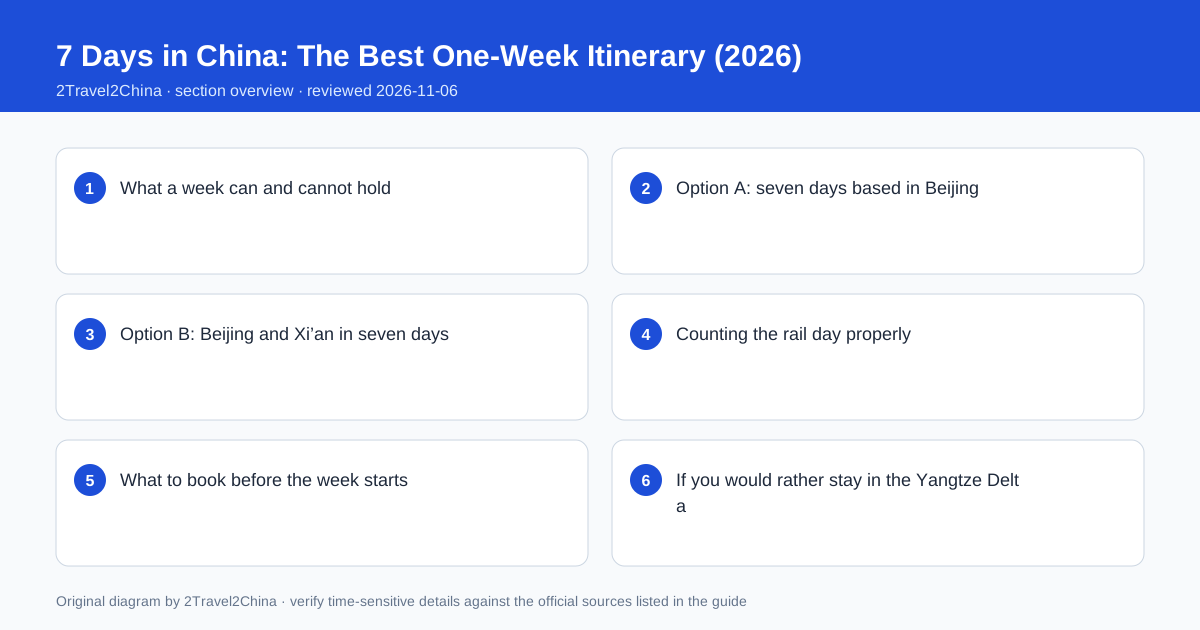
What a week can and cannot hold
A seven-day trip with two long-haul travel days at either end has roughly five full days on the ground. That is enough for one city in depth plus two day trips, or for two cities with one transfer. It is not enough for three bases, because two transfers would consume two of the five days and leave one day per city. The most common one-week mistake is not choosing the wrong sights but choosing too many beds.
| Plan | Bases | Best for |
|---|---|---|
| Deep Beijing | One hotel, 6 nights | First-timers who want heritage without packing |
| Beijing + Xi’an | Two hotels, one rail leg | The classic imperial-capital pairing |
| Shanghai + delta day trips | One hotel, 6 nights | Modern city, gardens, water towns |
| Three cities | Not recommended | Two transfers consume most of the week |
| Beijing + Shanghai | Possible but thin | Better with ten days |
The deep single-base option is underrated. One hotel means one check-in, one neighbourhood to learn, no luggage days and the freedom to return to a site you liked. For a traveller arriving after a long intercontinental flight, that simplicity is worth more than an extra city name on the itinerary.
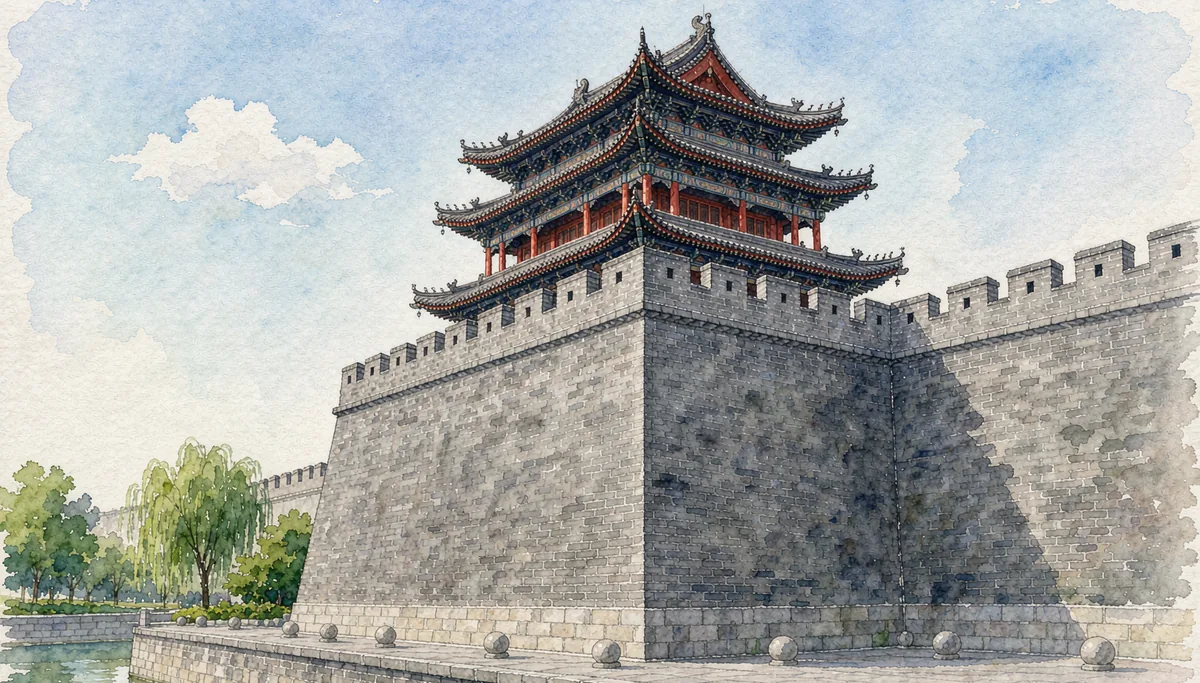
Option A: seven days based in Beijing
Beijing rewards a week because its major sites are spread across the city and each deserves half a day or more. Staying in one hotel near a metro line removes a transfer entirely and lets the days be organised by geography rather than by a checklist. Book timed-entry slots for the Forbidden City and any popular museum well in advance, and keep one flexible day for the Great Wall, whose best day depends on the weather.
- Day 1: arrival, check-in, a short walk near the hotel, early night
- Day 2: Forbidden City and Jingshan Park, then the hutong lanes to the east
- Day 3: Temple of Heaven in the morning, an afternoon museum or gallery
- Day 4: a Great Wall section as a full day trip, chosen by weather
- Day 5: Summer Palace and the university district
- Day 6: flexible — a second museum, a market, or a return to a favourite area
- Day 7: a slow morning, then the airport transfer
The flexible day is not wasted capacity. It absorbs a delayed Great Wall day, a timed-entry slot that could only be booked on a particular date, or simple fatigue after several long walking days. In a week with no intercity travel, that slack is a luxury you can afford; in a rushed multi-city week it is the first thing to be cut, which is exactly when it is most needed.
Option B: Beijing and Xi’an in seven days
The classic two-city week works because Beijing and Xi’an are connected by direct high-speed rail and each has a compact set of headline sites. Give Beijing three nights and Xi’an three, with the transfer occupying one of the middle days. Book the rail ticket with the exact passport name and treat the transfer day as a travel day with a light evening activity, not as a sightseeing day.
| Day | Base | Plan |
|---|---|---|
| 1 | Beijing | Arrival, check-in, neighbourhood walk |
| 2 | Beijing | Forbidden City, Jingshan, hutong lanes |
| 3 | Beijing | Great Wall day trip, weather-dependent |
| 4 | Travel → Xi’an | Morning or midday train; evening on the city wall |
| 5 | Xi’an | Terracotta Army as a half-day trip, Muslim Quarter in the evening |
| 6 | Xi’an | Shaanxi History Museum, city wall cycle or walk, a flexible afternoon |
| 7 | Xi’an | Slow morning, then departure |
An alternative is to fly home from Xi’an or via a connecting hub rather than returning to Beijing, which saves the return rail leg. If the international ticket is fixed to a Beijing round trip, add a return train on day 7 and drop one Xi’an activity. Either shape works; what does not work is trying to add Shanghai to the same week.
Counting the rail day properly
A direct high-speed train between Beijing and Xi’an takes roughly half a day on the timetable, but the whole day is consumed by check-out, the trip to the station, arriving early for the gate, the journey, the arrival transfer and check-in. Plan one light activity in the evening — a city-wall walk, a neighbourhood dinner — and nothing with a fixed entry time at either end.
Before departure
Confirm the passport name in 12306 matches the ticket and keep the booking offline.
At the origin station
Arrive with time for the gate; the travel document is read directly.
On the train
Keep luggage close and note the arrival station, which may not be the city centre.
On arrival
Transfer to the hotel and check in before planning anything else.
Evening
One easy activity near the hotel, with no timed entry.
The same arithmetic applies in reverse: an international flight the morning after a domestic rail leg is a fragile plan. If the week ends with a long-haul departure from a different city, either add a buffer night near the departure airport or move the rail leg earlier in the week. A single delayed train should not be able to cancel an intercontinental flight.
What to book before the week starts
Four bookings matter for a one-week trip: the entry route for your passport, the first-night hotel, any timed-entry attraction slots and the intercity rail ticket if you are using option B. Two wallets verified at home, offline maps and Chinese addresses are the supporting setup. Almost everything else — restaurants, neighbourhood walks, smaller museums — can be decided on the day.
- Check whether the 30-day visa-free list, 240-hour transit or an L visa covers the trip
- Verify Alipay and WeChat Pay with linked foreign cards while at home
- Confirm the hotel can register a foreign passport
- Book Forbidden City and other timed-entry slots in advance
- Register 12306 with the exact passport name and buy the rail ticket at release
Resist pre-booking every museum and restaurant before arrival. A week with one or two fixed slots per day has room to respond to weather, jet lag and a site that turns out to be more interesting than expected. A week with four fixed slots per day is a schedule, not a holiday.
If you would rather stay in the Yangtze Delta
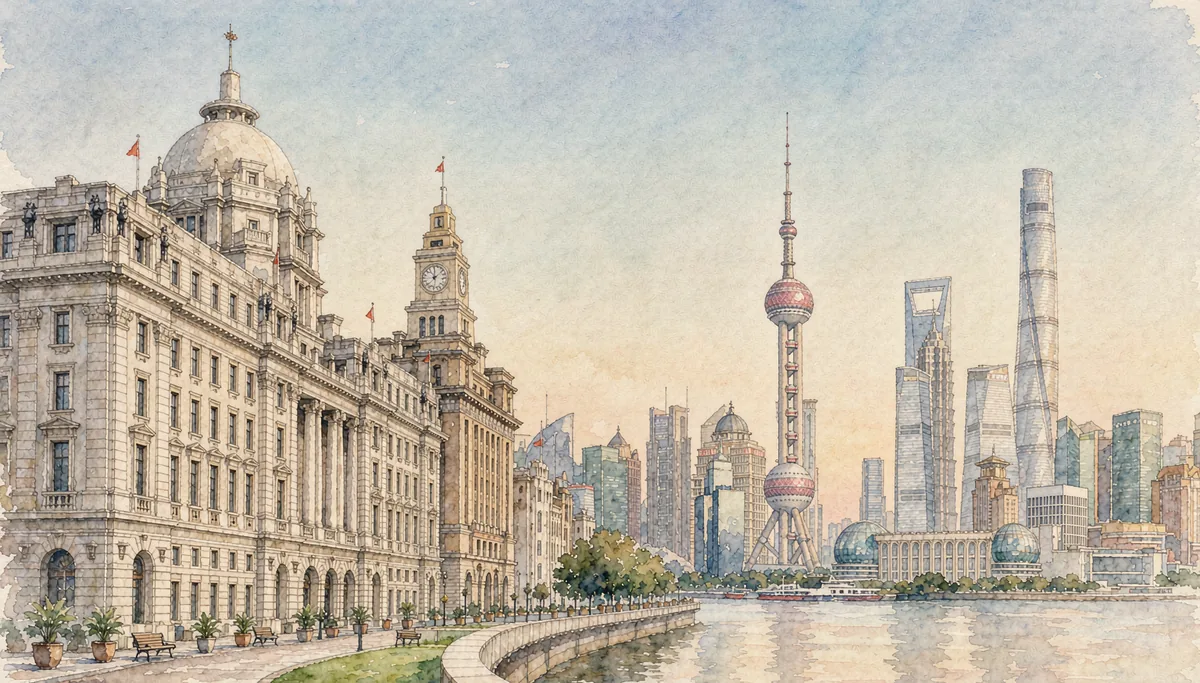
A Shanghai-based week is the strongest alternative for a traveller more interested in a modern city, gardens and water towns than in imperial history. Use one hotel near a metro line, take short high-speed rail hops to Suzhou and Hangzhou as day trips, and keep the remaining days for Shanghai’s museums, the Bund and its older neighbourhoods. The travel is short enough that no hotel change is needed.
- Day 1: arrival and a Bund walk in the evening
- Day 2: old city, a museum, and the modern districts across the river
- Day 3: Suzhou classical gardens and canals as a day trip
- Day 4: Hangzhou West Lake and tea hills as a day trip
- Day 5: Shanghai museums and a longer neighbourhood walk
- Day 6: flexible day — a water town, a second museum, or a return to Suzhou
- Day 7: slow morning and airport transfer
The delta option has the same structural advantage as the deep Beijing week: one bed, short journeys and a flexible day. It is also the shape that fits a 240-hour transit entry best, because movement stays within one connected region and the onward ticket can be routed through a third region at the end of the week.
Rail schedules, ticket-release windows and timed-entry systems change seasonally. Confirm current timetables on 12306 and the venue booking system before fixing the days, and verify entry rules against the National Immigration Administration notice in force on your travel date.
Frequently asked questions
Is seven days enough for a first trip to China?
Yes, if you stay in one region. One deep base with day trips, or two connected cities such as Beijing and Xi’an, works well. A three- or four-city loop does not fit a week.
Can I do Beijing, Xi’an and Shanghai in seven days?
Not usefully. Two intercity transfers would consume two of roughly five usable days, leaving about one day per city. Ten to fourteen days is the realistic minimum for that route.
Should I move hotels during a one-week trip?
Once at most. A single base removes luggage days and lets you organise by geography. If you do move, treat the transfer as a travel day with only a light evening activity.
What must be booked in advance for a week in Beijing?
Timed-entry slots for the Forbidden City and popular museums, the first-night hotel, and the intercity rail ticket if you are adding Xi’an. Restaurants and smaller sites can be decided on the day.
Which one-week route fits 240-hour visa-free transit?
A single-region itinerary such as Shanghai with Suzhou and Hangzhou day trips, with an onward ticket to a third country or region. Movement stays inside the permitted area and the week fits the 240-hour window.