Chinese Names and Forms of Address: Surname First, Title Last
A Chinese name carries the family name first and the given name second, so someone introduced as Wang Wei is Mr Wang, not Mr Wei. Around 100 surnames cover close to 90 percent of the population, with Li, Wang and Zhang shared by hundreds of millions of people. Add a professional title after the surname and you have the form of address that works in almost every visitor situation. This guide explains how names are built, which titles to use, and the small taboos that are easy to avoid once you know them.
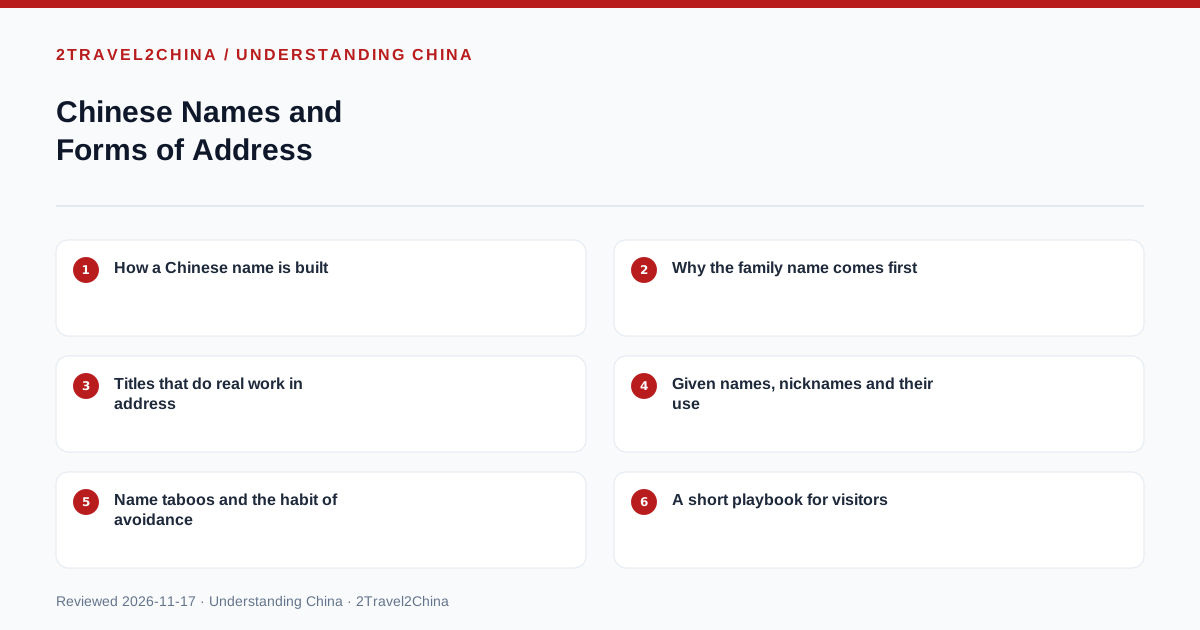
How a Chinese name is built
A Chinese name has two parts: a family name followed by a given name of one or two characters. In Wang Wei, Wang is the family name and Wei is the given name; in Ouyang Ming, Ouyang is a two-character family name. There is no middle name in the Western sense, and the family name comes first. That order is the most useful fact for a visitor, because it determines which part to use with a title.
The pool of family names is surprisingly concentrated. Historically more than 20,000 have been recorded, but roughly 3,500 are in common use today and about 100 account for close to 90 percent of the population. Li, Wang and Zhang are the three largest, each shared by tens of millions of people. This is why a surname alone is rarely enough to identify someone in a large city, and why adding a title or a full name is the polite default rather than a formality.
| Name as written | Family name | Given name | Safe address |
|---|---|---|---|
| Wang Wei | Wang | Wei | Mr Wang, or Wang jingli if he is a manager |
| Li Xiaoming | Li | Xiaoming | Mr Li, or Li laoshi if he is a teacher |
| Ouyang Ming | Ouyang | Ming | Mr Ouyang, keeping the two-character surname intact |
| Chen Jing | Chen | Jing | Ms Chen, or her stated professional title |
Why the family name comes first
Placing the family name first reflects the weight Chinese naming tradition gives to family and ancestry. The given name is chosen for meaning, often drawing on virtues or good wishes, and each character carries its own sense. A visitor who uses the family name with a title acknowledges both the individual and the family context. It is a small gesture that reads as respect in a way a first name does not.
One custom that often surprises visitors is that Chinese women keep their family name after marriage. A married couple may therefore have different surnames, and children traditionally took the father's name, though modern law allows parents to choose either parent's surname. Do not assume a woman has changed her name, and do not infer relationships from shared or different surnames. A small number of people also have compound surnames such as Ouyang, Sima or Zhuge, which must be kept whole rather than treated as a given name plus surname.
Many Chinese professionals also use an English name in international settings, and some present their Chinese name in Western order with the given name first. Verify which name a person wants you to use rather than assuming the last written word is the family name.
Titles that do real work in address
In Mandarin the normal pattern is family name followed by a title, not a Western-style title first. The general forms are xiansheng, roughly Mr, and nvshi, a respectful form for a woman that does not require knowing her marital status. Professional titles are more common than in English: laoshi for a teacher, jiaoshou for a professor, jingli for a manager, yisheng for a doctor and shifu for a driver or technician. In English you reverse the order, saying Manager Wang.
Laoshi deserves special attention because it has widened well beyond schools. It is used as a respectful form for people whose work involves knowledge or skill, including guides and instructors, and it is safe in many encounters where you do not know a specific title. Shifu works similarly for drivers, mechanics and craftspeople; calling a taxi driver shifu is ordinary and friendly. If you are genuinely unsure, a polite xiansheng or nvshi with the confirmed family name is the safe fallback.
| Mandarin title | Approximate meaning | Use it for |
|---|---|---|
| xiansheng | Mr, sir | A man when no specific title is known |
| nvshi | Ms, madam | A woman, regardless of marital status |
| laoshi | Teacher | Teachers, guides and knowledge workers |
| jiaoshou | Professor | A university professor |
| jingli | Manager | A business manager |
| shifu | Master, skilled worker | Drivers, technicians and craftspeople |
Given names, nicknames and when to use them
A given name is normally reserved for family, close friends and classmates. As a visitor or new business contact, do not switch to someone's given name until invited; using it early can feel presumptuous. Chinese nicknames are common in childhood and among close friends, but are not appropriate in formal settings. If someone offers an English name, using it signals the relationship is informal enough for it.
A related habit is lao plus surname, meaning old or senior, as in Lao Wang. Despite sounding casual, it is used among friends and colleagues who know each other well, and it is not a safe opener for a visitor. The same goes for xiao plus surname for a younger person. The reliable rule is to start formal, with a family name and title, and let the other person relax the form. When you are unsure, a short question such as how should I address you is completely acceptable and shows respect.
Translating the pattern into English trips up many first-time visitors. In Chinese you say Wang jingli, with the title after the name; in English you say Manager Wang, with the title before it. Both are correct in their own language. Mixing them, or treating Wei in Wang Wei as a Western first name, is the error to avoid. Listening to how a person introduces themselves settles the question faster than any rule.
Name taboos and the habit of avoidance
A traditional practice called bi hui, or name avoidance, means avoiding the given names of elders and superiors. In its stronger historical form it shaped naming choices and discouraged writing an elder's characters casually. Today it is softer, but its echo survives: many people still use a kinship term or title for an older relative. A visitor need not know every family detail, but the instinct to avoid over-familiarity with names is worth understanding.
Practical tokens of respect are simpler. Accept a business card with both hands, read the name and title, and place it neatly on the table or in a card holder rather than pocketing it at once. Where a card is printed in both languages, note which form the person uses. Avoid writing on someone's card, and avoid joking about a name's characters or meaning until you know the person well. These gestures cost nothing and are noticed.
- Do not treat the second part of a Chinese name as a Western first name.
- Do not assume a married woman has changed her family name.
- Do not call someone by their given name or a nickname until invited.
- Do not split a two-character family name such as Ouyang into two parts.
- Do not joke about the meaning of a person's name in a first meeting.
A short playbook for visitors
Most visitor interactions need only a few forms. For a hotel check-in, give your full name and show the passport; staff will usually address you by a translated surname. For a taxi, shifu plus the address in characters is enough. In a business meeting, present and receive cards with both hands, use the family name with the stated title, and follow the host's lead on seating and introductions.
When a name is hard to pronounce, ask rather than guess, and be willing to practise once. A foreigner attempting a tone is generally met with patience, and the effort reads as respect. If a person uses an English name, use it; if they switch back to a Chinese name in a formal setting, follow them. The underlying principle is simple: start with the more respectful form and let the other person signal when a less formal one is welcome.
Names and titles are only one layer of everyday courtesy. The related guides in this section cover greetings, gift giving and business meetings, so you can read a name correctly and handle the situation around it with confidence.
Frequently asked questions
Which part of a Chinese name is the family name?
The family name comes first. In Wang Wei, Wang is the family name and Wei is the given name, so the person is Mr Wang. A few family names have two characters, such as Ouyang or Sima, and must be kept whole. If someone presents a name in Western order, follow the form they use.
How should I address a Chinese colleague or business contact?
Use the family name plus a title, such as Manager Wang or Professor Chen. If no professional title is known, xiansheng for a man or nvshi for a woman is polite. In Chinese the order is reversed, with the title after the name. Wait to be invited before using a given name or nickname.
Do Chinese women change their name when they marry?
No. Chinese women traditionally keep their family name after marriage, so a married couple often has different surnames. Modern law lets parents choose either parent's surname for a child. Do not infer relationships from shared or different family names, and continue to address a woman by the name she uses.
What does laoshi mean and when can I use it?
Laoshi literally means teacher but is used more broadly as a respectful address for people whose work involves knowledge or skill, including guides and instructors. It is safe in many first encounters where you do not know a specific title. Shifu is the parallel respectful form for drivers, technicians and skilled workers.
Is it rude to use someone's given name in China?
In a first meeting or formal setting, yes, it can feel over-familiar. Given names and nicknames are normally reserved for family, close friends and classmates. Start with a family name and title, accept the other person's preferred form if they offer one, and a simple question about how to address them is always acceptable.