Chinese Etiquette: The Do's and Don'ts Visitors Actually Need
Most etiquette in China is ordinary politeness with a few culture-specific accents, not a minefield of forbidden acts. The habits that actually matter are greeting people by their surname and title, arriving on time, protecting everyone's dignity in public, queuing calmly, and showing respect at temples and photo spots. This guide separates the rules worth learning from the ones visitors can relax about.
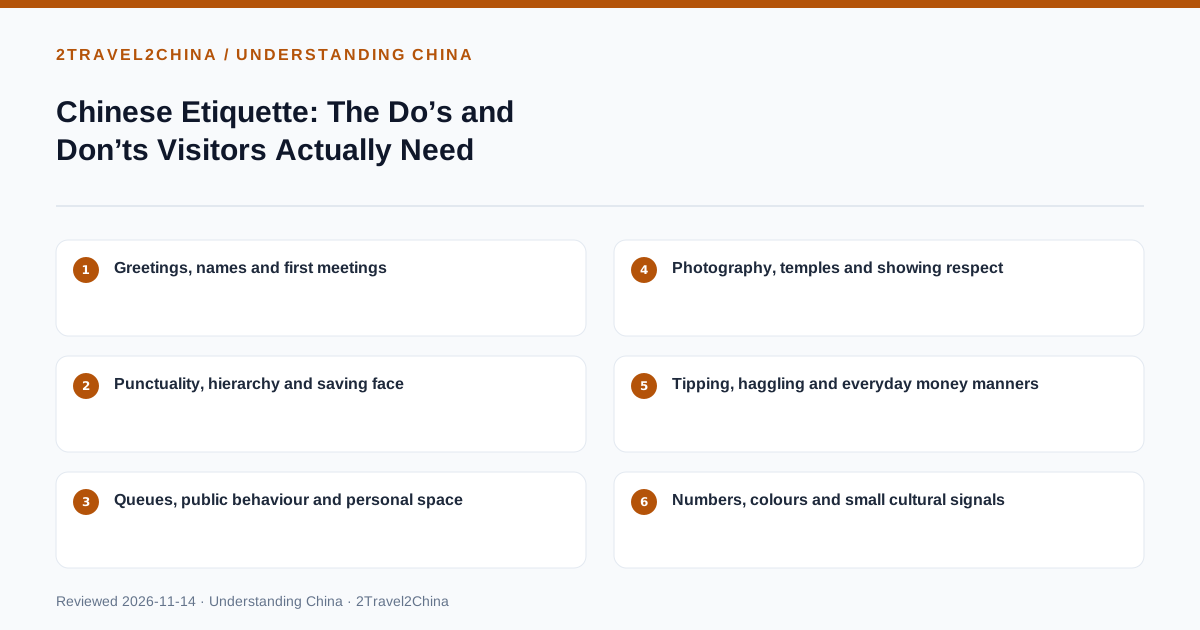
Greetings, names and first meetings
A handshake is the standard greeting in business and tourist settings, and a small nod works everywhere else. Address people by their family name followed by a title such as manager, professor or doctor, because titles signal respect more than first names do. When someone offers a business card, accept it with both hands and read it briefly before putting it away.
Names follow a different order from English. The family name comes first, so a person introduced as Li Wei is Mr Li, not Mr Wei, and using the surname with a title is the safe default until invited to do otherwise. Trying a simple ni hao, meaning hello, is appreciated even if the pronunciation is imperfect, because the effort signals goodwill rather than fluency.
Smiling and a relaxed posture go further than perfect grammar, and a slight bow of the head with a handshake is a safe, neutral greeting across ages. Younger people and students are often addressed as tongxue, while a teacher or older expert is respectfully called laoshi, a term that also extends to guides and instructors. When in doubt, mirror the warmth of the person you are meeting rather than over-thinking the form.
Punctuality, hierarchy and saving face
Being on time matters in China, and for a business meeting or a guided tour it is expected rather than optional. Arriving a little early is the polite extreme; arriving late without notice is the clear mistake. The reason is partly respect for others and partly a deeper habit called mianzi, often translated as face, which protects a person's dignity and standing in front of others.
Face is why public criticism, blunt refusals and openly correcting someone are softened. A request may be answered with a vague maybe or we will see rather than a direct no, because a flat refusal can cause both people to lose face. As a visitor, the useful habit is to disagree gently, praise in public and raise problems privately, which keeps interactions smooth without requiring you to read every unspoken signal.
Seniority shows in small ways: the most senior person sits furthest from the door or at the head of a table, speaks first in toasts, and is the one others defer to when a decision is needed. You are not expected to orchestrate this, only to notice it and let the host lead. If you are the guest of honour, a short thank-you toast near the start of a meal is the polite move, and letting others top up your glass is normal.
Queues, public behaviour and personal space
Queuing is expected and increasingly well observed at metro gates, ticket counters and boarding lines, so join the back of a line rather than pushing to the front. Public spaces are busy and voices are often loud, but deliberate cutting, aggressive shoving or angry confrontations draw attention you do not want. Step aside to take a call, and lower your voice in temples, museums and quiet train carriages.
China's high-speed trains have quiet carriages and clearly signed priority seating for elderly, pregnant and mobility-limited passengers. Offer those seats even if no one asks, and keep phone calls brief in marked quiet areas.
On escalators, stand on the right and pass on the left, and step clear of train and lift doors the moment they open so others can exit. Public spaces are crowded but not lawless, and small courtesies like holding a door or not blocking a pavement are noticed and returned. Littering and spitting draw disapproval more than fines, so use the bins and the countless public ashtrays and spittoons you will see in older areas.
Photography, temples and showing respect
Photography is permitted in most public places, but always ask before photographing people, especially in rural areas and at religious sites, and never use a drone without checking local rules. Inside temples, monasteries and mosques, follow posted signs, dress modestly, keep your voice down and avoid pointing your feet at statues or sitting on sacred thresholds.
Some sites charge separately for cameras or ban flash, and military zones, border areas and certain government buildings are off-limits to photography entirely. When in doubt, look for a no-photo symbol or imitate what local visitors do. Showing the same restraint you would at a church or cemetery reads as respect and avoids the awkward moment of being asked to delete a photo.
In active places of worship, remove your hat, step out of the flow of worshippers, and never walk in front of someone mid-prayer or mid-bow. If incense is offered, light it from a shared flame, hold it with both hands and bow toward the altar before placing it in the burner, and do not touch offerings left by others. These are participation customs, not spectator rules, so watching what regulars do is the best guide.
Tipping, haggling and everyday money manners
Tipping is not a custom in ordinary Chinese restaurants, taxis or hotels, so you should not add a tip to a bill or hand cash to a waiter. Service charges, where they exist, appear on the bill itself. Haggling, by contrast, is normal in markets and with street vendors, but do it with a smile, settle on a price before the item is wrapped, and walk away cheerfully if you cannot agree.
Paying is frictionless for visitors through Alipay and WeChat with a linked foreign card, and splitting a bill among friends is common and unremarkable. What feels unusual is the host who insists on paying for everyone at a group meal; refusing repeatedly and then accepting, or offering to pay next time, is the expected dance rather than a real argument about money.
Markets, silk stalls and tourist bazaars expect bargaining, while malls, supermarket chains and restaurant chains show fixed prices on labels and screens, so read the tag before negotiating. Carry a little cash for small temples, toilets and roadside stalls, but expect most payments, including the 1-yuan surprises, to happen by scanning a code. When a price feels unfair rather than negotiable, a calm walk-away is more effective than an argument.
Numbers, colours and small cultural signals
A few symbols appear often enough to notice. The number eight is lucky because it sounds like the word for prosperity, while four is avoided because it sounds like the word for death, so you may see buildings skip a fourth floor. Red is the colour of celebration and is used at weddings and festivals, while white and black are associated with mourning and are best avoided as gift wrap.
None of this is a rule you can break; it is context that helps you read a situation. If a host serves you tea, pouring for others before yourself is a small courtesy, and a light tap of two fingers on the table is the common quiet way to say thank you. These gestures are low-stakes, and a friendly attempt is worth more than perfect execution.
Florists and gift shops quietly follow the same logic, so avoid giving four of anything and steer clear of white or yellow chrysanthemums, which are funeral flowers. A bouquet of an even, non-four count in bright wrapping suits a celebration, while red packets, hongbao, carry cash at festivals and weddings rather than a wrapped present. None of these conventions will trap you, but reading them correctly signals that you are paying attention.
Frequently asked questions
Is tipping expected in China?
No. Tipping is not customary in ordinary restaurants, taxis, hotels or salons, and the bill is paid by QR code, card or cash. A few high-end venues add a service charge that appears on the receipt. Rounding up or leaving small change is appreciated but never required, so do not feel obliged to tip.
What does saving face mean, and why does it matter?
Face, or mianzi, is a person's dignity and standing in front of others. People avoid open criticism, blunt refusals and public embarrassment to protect it. As a visitor, praise in public, raise problems privately, and soften disagreement. You are not expected to decode every unspoken signal, only to avoid causing someone public discomfort.
How should I greet people and use names?
Offer a handshake in business and tourist settings, or a nod elsewhere, and address people by their family name plus a title such as manager or professor. The family name comes first in Chinese, so Li Wei is Mr Li. Accept any business card with both hands, read it briefly, and avoid pocketing it at once.
Is it rude to take photos of people or temples?
Ask before photographing people, especially in rural areas and at religious sites, and follow posted no-photo signs in temples, museums and monasteries. Avoid flash, dress modestly, and do not point your feet at statues or sit on sacred thresholds. Drone photography is restricted, so check local rules before flying.
What numbers and colours should I be aware of?
The number eight is lucky because it sounds like prosperity, while four is avoided as it resembles the word for death, so some buildings skip a fourth floor. Red signals celebration and weddings; white and black are linked to mourning and are poor gift-wrap choices. These are cultural cues, not rules you can break.