Museums in China: Passport Booking Rules and the Collections Worth Planning Around
China's best museums are among the cheapest cultural experiences in the world, but entry is usually controlled by a real-name reservation system rather than a ticket queue. Foreign passports work, provided the name matches and you book through the right channel at the right time. This guide sets out the published rules for the National Museum of China and the Palace Museum, then gives you a shortlist of collections that justify rearranging a city itinerary. Rules can change around holidays, so every practical detail is tied to an official source.
The short answer: free does not mean walk-in
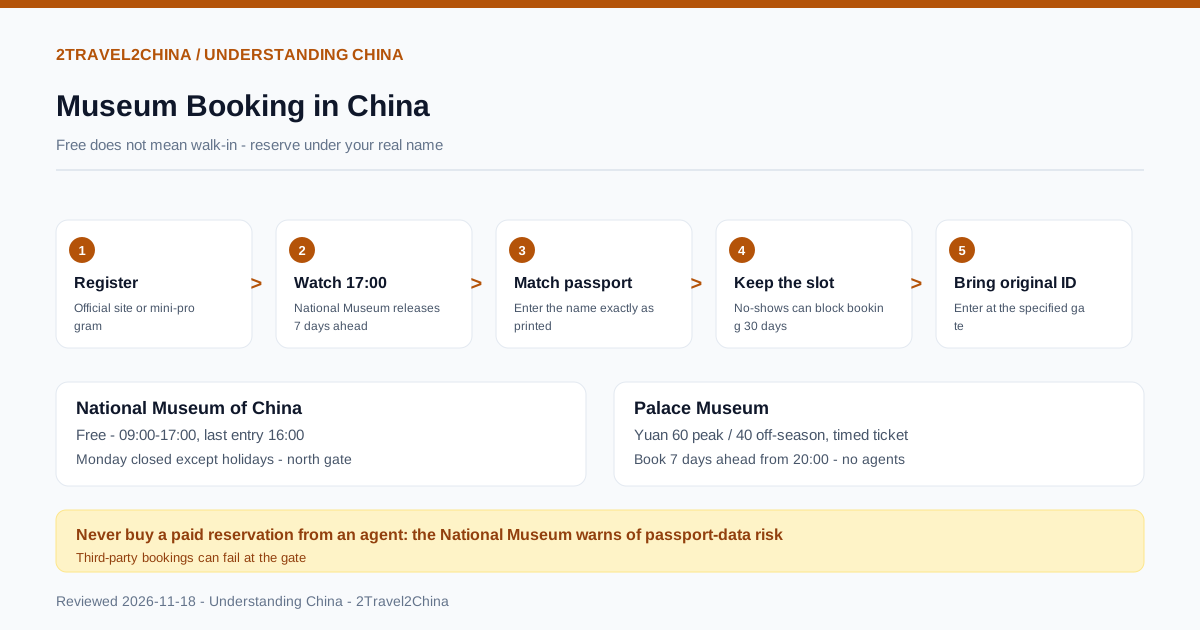
Most national and provincial museums in China charge no admission but require every visitor to reserve a free ticket under their real name before arrival. The National Museum of China states that all visitors must make a real-name reservation, that free tickets can be booked within seven days through its official channels, and that visitors must arrive in the reserved time slot with the original ID used to book. A foreign passport is a valid government-issued ID for this purpose.
The Palace Museum follows a different model: paid, timed tickets sold only through the museum's own channels. Its current visitor notice says the museum is closed on Mondays except public holidays and that bookings can be made up to seven days ahead. Because demand is extreme in peak season, the practical skill is knowing exactly when tickets are released rather than simply knowing the price.
The National Museum of China has repeatedly warned visitors against paid agents and scalpers. Book only through the museum's official website, official mini-program or official WeChat account; a third-party reservation can expose your passport data and fail at the gate.
National Museum of China: the rules in detail
The museum's published visitor rules set opening at 09:00 and closing at 17:00, with last entry at 16:00. From 1 June to 31 October the museum extends closing to 17:30 with last entry at 16:30. It closes on Mondays except statutory holidays. The main entrance for reserved visitors is the north gate, and staff check the original booking document against the reservation before allowing entry.
Reservations open daily at 17:00 for dates within the following seven days. Three entry windows are published: 09:00-11:00, 11:00-13:30 and 13:30-16:00, with the final window extended to 16:30 in the summer period. Each account may make one reservation per week for up to five people, and each ID number may be used once a day and up to four times a month. Cancelling still counts toward the weekly limit.
| Rule | Published detail | Practical effect |
|---|---|---|
| Admission | Free, real-name reservation for all visitors | No cash desk; booking is mandatory |
| Booking window | Within seven days, tickets released daily at 17:00 | Set an alarm the evening a week before your visit |
| Entry slots | 09:00-11:00, 11:00-13:30, 13:30-16:00 | Arrive inside your slot; late arrival can be refused |
| Account limit | One booking per week, up to five people | Do not experiment with multiple accounts |
| No-show penalty | Three accumulated no-shows block booking for 30 days | Cancel early if plans change |
| Opening hours | 09:00-17:00, last entry 16:00; summer to 17:30 | Mondays closed except statutory holidays |
Palace Museum: paid, timed and one-way
The Palace Museum, known in English as the Forbidden City, sells timed tickets through its own English booking site and its official WeChat mini-program. The museum's current visitor notice states that tickets can be reserved up to seven days in advance, with bookings opening at 20:00 Beijing time. Its homepage lists 08:30 as opening time, 15:30 as last entry and 16:30 as closing time in the current season, with Monday closure except on statutory holidays.
Published admission is ¥60 from 1 April to 31 October and ¥40 from 1 November to 31 March, with separate ¥10 add-ons for the Treasure Gallery and the Gallery of Clocks. Prices and season dates come from the museum's published rates; check the booking page before paying, because concession categories for foreign teenagers and students differ from those for Chinese citizens. The museum authorises no third-party ticket sellers.
Entry is through the Meridian Gate on the south side and exit is north at the Gate of Divine Prowess or east at the East Glorious Gate. The route is one-way, so plan which side galleries you want to see before you pass the gate. Bring the physical passport used at booking; the name and document number must match, and screenshots or photocopies are not accepted at the gate.
The Treasure Gallery and Gallery of Clocks should be selected when you book the main ticket. They are usually not added later at the gate, and both close shortly after the main last-entry time.
Provincial museums: what is different
Provincial and city museums set their own rules. Shanghai Museum's East Building is free and can normally be entered by scanning a passport or ID at the door, with Tuesday closure and a large collection of bronze, ceramic and calligraphy galleries. Shaanxi History Museum in Xi'an is also free but uses a timed reservation that releases tickets a few days ahead; its Qin and Han annex across the city is usually the easier same-day fallback.
The pattern to expect is straightforward. Flagship museums in Beijing, Shanghai and Xi'an use real-name booking; smaller city museums may allow walk-in entry with ID; temporary blockbuster exhibitions may carry a separate paid ticket even when the permanent collection is free. Check the museum's own English page or official mini-program the day before, especially around public holidays, when release times and closing days can shift.
- National-level museums: free real-name reservation, often seven days ahead.
- Provincial flagships: free, but timed reservation in busy seasons.
- Special exhibitions: separate paid ticket, sometimes a separate queue.
- City and site museums: often walk-in with passport, but check Monday closures.
Passport, name matching and the entry check
Almost every reservation failure at a Chinese museum comes from a mismatch between the booking name and the travel document. The National Museum of China requires the original ID used for booking and verification at the north gate; the Palace Museum requires the passport used at purchase. Book exactly as the passport reads, including middle names where the system supports them, and carry the physical document rather than a photograph.
Create the account before you travel
Register on the museum's official site or mini-program while you have stable connectivity and time to complete verification.
Enter the name exactly
Use the Latin-letter spelling printed in the passport's machine-readable zone when the form requires English characters.
Book the correct time slot
Choose a window you can keep; cancellation may still consume the weekly allowance.
Save the confirmation offline
Screenshot the QR code and booking number because mobile data inside a museum can be slow.
Bring the original passport
Present the physical document used for the booking at the specified gate and arrive within the reserved window.
Five collections worth rearranging a day for
Reservations are an inconvenience, but the collections justify the effort. If your itinerary has one free cultural day in each city, these institutions offer the highest density of objects that connect directly to the dynastic and archaeological sites described elsewhere in this section. Each has a distinct strength, so choose by interest rather than trying to visit them all.
| Museum | City | Best for | Allow |
|---|---|---|---|
| National Museum of China | Beijing | Ancient China gallery, bronzes and national collections | Half a day |
| Palace Museum | Beijing | Imperial architecture and court collections | Four to six hours |
| Shanghai Museum East | Shanghai | Bronzes, ceramics and calligraphy | Half a day |
| Shaanxi History Museum | Xi'an | Qin, Han and Tang context for the city's sites | Three hours |
| Luoyang Museum | Luoyang | Han and Tang capitals, Silk Roads context | Two hours |
Booking failures and how to recover
Tickets for the most popular museums can disappear within minutes during holidays. That is a scheduling problem, not a reason to skip the collection. The recovery options differ by museum, but the order of attempts is the same: try the official channel again at cancellation peaks, switch to a less popular time window, or use a museum's secondary branch or annex, which often holds related objects with far shorter queues.
- Recheck early morning and the evening before the visit, when cancellations cluster.
- Choose a weekday afternoon instead of a holiday morning.
- Use an annex or branch museum with the same institutional collection.
- Pair a site museum with an open-air heritage park if the flagship is full.
- Never buy a paid reservation from an agent; the National Museum warns this risks passport data and money.
Frequently asked questions
Can foreigners book National Museum of China tickets?
Yes. The museum requires a real-name reservation for every visitor and accepts valid government-issued identification, including a passport. Free tickets can be booked within seven days via its official website, mini-program or WeChat account. Enter the name exactly as it appears on your passport and bring the original document.
When are National Museum of China tickets released?
The museum's published visitor rules state that free tickets are released daily at 17:00 for dates within the next seven days. Entry windows are 09:00-11:00, 11:00-13:30 and 13:30-16:00, extended to 16:30 in the summer period. Book as soon as the window opens and arrive during your reserved slot.
How far ahead can I book the Forbidden City?
The Palace Museum's current notice says visitors can reserve up to seven days ahead, with new dates opening at 20:00 Beijing time. Ticket prices are ¥60 from April to October and ¥40 from November to March. Use only the museum's own booking site or WeChat mini-program; the museum authorises no third-party sellers.
What happens if I miss my museum time slot?
The National Museum of China states that visitors must enter during the reserved slot, and a late arrival can be refused. Repeated no-shows carry a penalty: three accumulated failures block reservations for 30 days. If your plans change, cancel through the official channel as early as possible, noting that cancellations still count toward the weekly limit.
Are all museums in China closed on Mondays?
Many are, but not all. The National Museum of China and the Palace Museum close on Mondays except statutory holidays, and Shanghai Museum East is normally closed on Tuesdays. Holiday notices can temporarily reverse these patterns, as the National Museum's 2026 International Museum Day opening demonstrated. Check the individual museum's official notice before you build the day.