Bike Sharing in China: How Hellobike, Meituan Bike and Qingju Work
Shared bikes are everywhere in Chinese cities, but the market that tourists read about in 2017 has completely consolidated. Three operators now matter: Hellobike, Meituan Bike and DiDi's Qingju, all unlocked with a QR scan through Alipay or WeChat. This guide explains which bikes you will see, how to ride one without a Chinese phone plan, what it costs, the parking fines that trip up visitors, and where bikes are actually available.
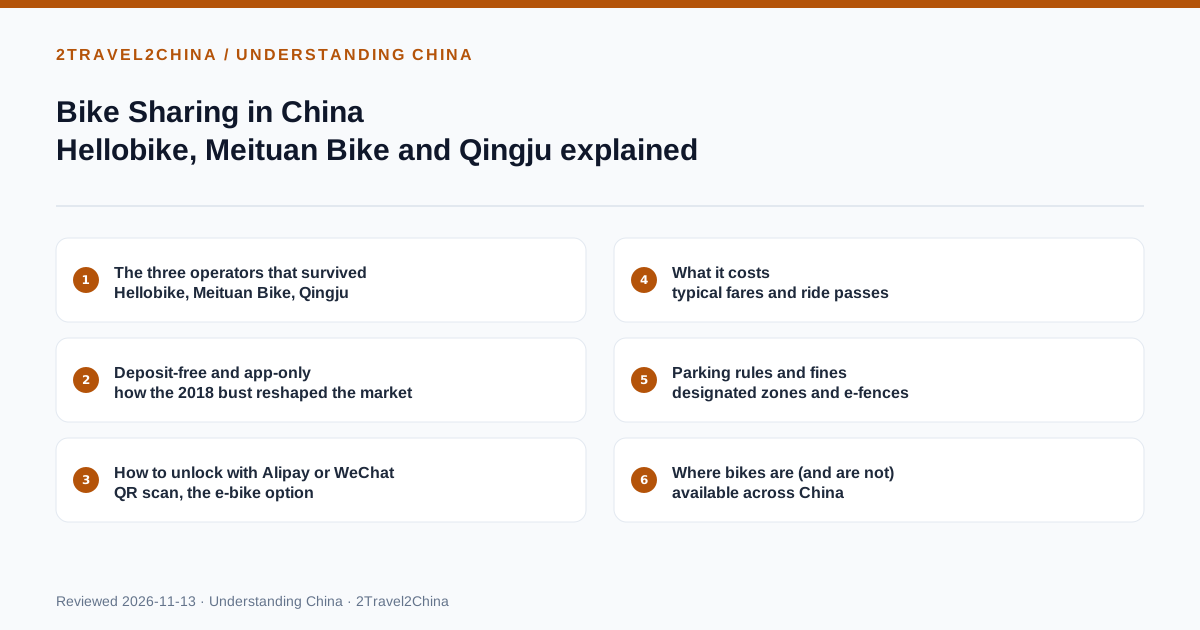
The three operators that survived
China's bike-sharing boom peaked around 2017 with dozens of brands and millions of painted bikes, then collapsed in 2018 when over-expansion and deposit scandals bankrupted most of them, including the once-dominant Ofo. Today the market is stable and concentrated. Hellobike, part of the Alibaba-Ant family, is the largest by fleet; Meituan Bike is the yellow-bike arm of the Meituan delivery ecosystem; and Qingju belongs to DiDi, the ride-hailing company.
You can tell them apart by colour and app: Hellobike is sky-blue and lives inside Alipay, Meituan Bike is yellow and links to both Meituan and WeChat, and Qingju is greenish-blue and connects to DiDi and WeChat. Because all three are reachable through Alipay or WeChat mini-programs, you do not need three separate accounts to ride whichever bike is nearest you on the street.
| Operator | Colour | Reached through |
|---|---|---|
| Hellobike | Sky blue | Alipay mini-program |
| Meituan Bike | Yellow | Meituan and WeChat |
| Qingju (DiDi) | Greenish-blue | DiDi and WeChat |
Deposit-free and app-only
The deposit model that caused the 2018 collapse is gone. None of the surviving operators require a refundable deposit; you simply link a payment method and pay per ride. This is a direct result of the market shake-out, and it removes the biggest risk visitors used to face with shared bikes. Your already-linked Alipay or WeChat card is the only thing you need to start a ride.
Bikes are unlocked entirely by QR scan. There is no physical key, and most newer bikes use a split lock you engage by tapping the app rather than snapping a mechanical lock. The trade-off is that a flat phone battery means no bike, so treat the app as part of your transport plan the same way you would a metro code or a ride-hailing booking.
How to unlock with Alipay or WeChat
Open Alipay or WeChat, find the bike operator's mini-program, and tap to scan the QR code on the bike's handlebars or rear wheel. The bike unlocks in a second or two, and the ride is charged automatically to your linked card when you end it in the app. Alipay's translate feature also renders the on-screen text in English, which helps if a prompt asks about parking zones or balance.
- Use Alipay for Hellobike, and either app for Meituan Bike or Qingju.
- Scan the bike's QR code; the app shows the unlock and the per-minute rate up front.
- Check the map for the operating area before riding out of the city centre.
- End the ride inside the app and confirm the lock before walking away.
- Prefer the electric-assist version for longer trips; it costs slightly more per minute.
What it costs
Pricing is a flat start plus a per-minute charge, and it varies a little by city and by whether the bike is pedal or electric. A typical pedal bike costs about 1.5 yuan for the first 15 minutes and around 1 yuan for each additional 15 minutes, while electric shared bikes run a bit higher. Day and month passes are cheap: a seven-day unlimited-ride pass can cost under 7 yuan and a thirty-day pass under 18 yuan.
The passes are worth buying if you expect to ride several times during a stay, because a handful of short trips add up to more than the weekly pass. Watch for two extra charges visitors miss: riding outside the operator's service area, and parking outside a designated zone, both of which trigger penalty fees on top of the ride price.
Parking rules and fines
Cities manage shared bikes with electronic fences and painted parking bays marked by white lines. You are expected to end the ride inside a designated area; parking on a sidewalk, inside a building, or outside the service zone can cost a 2 to 20 yuan penalty that the app deducts automatically. The fine is small but annoying, and repeatedly ignoring it can freeze your account.
Before you end a ride, the app shows whether you are in a valid parking zone. If it is not, ride a little further to the nearest marked bay rather than ending the trip where you stand.
Where bikes are (and are not) available
Shared bikes are dense in large and mid-sized cities but thin or absent in small towns and many rural areas, and they are rarely found inside scenic spots or on pedestrian streets where they are banned. For a visitor staying in a major city, they are a genuine last-mile option between a metro station and a hotel or restaurant, but do not count on them for cross-city travel or for reaching attractions outside the urban core.
The operating area is drawn on the map inside the mini-program, so check it before relying on a bike for a specific trip. Where a bike is not available, the metro and ride-hailing fill the gap, and the same Alipay or WeChat app you used for the bike handles both of those as well.
A short setup order before you arrive
Install Alipay and WeChat
Both reach all three operators and translate the interface you need.
Link a foreign card
Per-ride and pass charges settle against the card you already use for payment.
Try one ride near your hotel
Confirm the scan, the parking zone and the end-ride flow in a low-pressure setting.
Buy a weekly pass if staying several days
It is cheaper than paying per ride and covers all three brands through the same apps.
Frequently asked questions
Which shared bike should I use in China?
Use whichever bike is nearest, because Hellobike, Meituan Bike and Qingju are all reachable through Alipay or WeChat. Hellobike is blue and links to Alipay, Meituan Bike is yellow, and Qingju is greenish-blue and links to DiDi. All three are deposit-free and unlocked by scanning the bike's QR code.
Do I need a Chinese phone number to ride?
No. You can use the Alipay or WeChat mini-programs with the account and card you already have for payment, and Alipay translates the screen into English. A phone number helps but is not required, which is why the super-app route is easier than the standalone brand apps.
How much does shared bike rental cost?
A pedal bike is about 1.5 yuan for the first 15 minutes and around 1 yuan for each further 15 minutes. A seven-day unlimited-ride pass can cost under 7 yuan. Avoid two penalties: riding outside the service area and parking outside a marked bay, each of which adds a small fine.
Where can I park a shared bike?
End the ride inside a designated parking bay marked by white lines, shown on the app's map. Parking on a sidewalk, inside a building or outside the service zone triggers a 2 to 20 yuan penalty and can freeze your account if repeated. Always confirm the zone before ending the trip.
Are shared bikes available everywhere in China?
They are dense in large and mid-sized cities but thin or absent in small towns and most rural and scenic areas, and banned on many pedestrian streets. Treat them as a last-mile option between a metro station and your destination, not as transport between cities or to far-flung attractions.