The Digital Yuan (e-CNY) Explained: China's Central Bank Digital Currency
The digital yuan, known as e-CNY, is China's central bank digital currency, issued directly by the People's Bank of China rather than by a private company. It is legal tender in electronic form and has been running in pilots since 2020. This guide explains what e-CNY actually is, how it differs from Alipay and WeChat Pay, where the pilot operates, and the narrow circumstances in which a foreign visitor can use it.
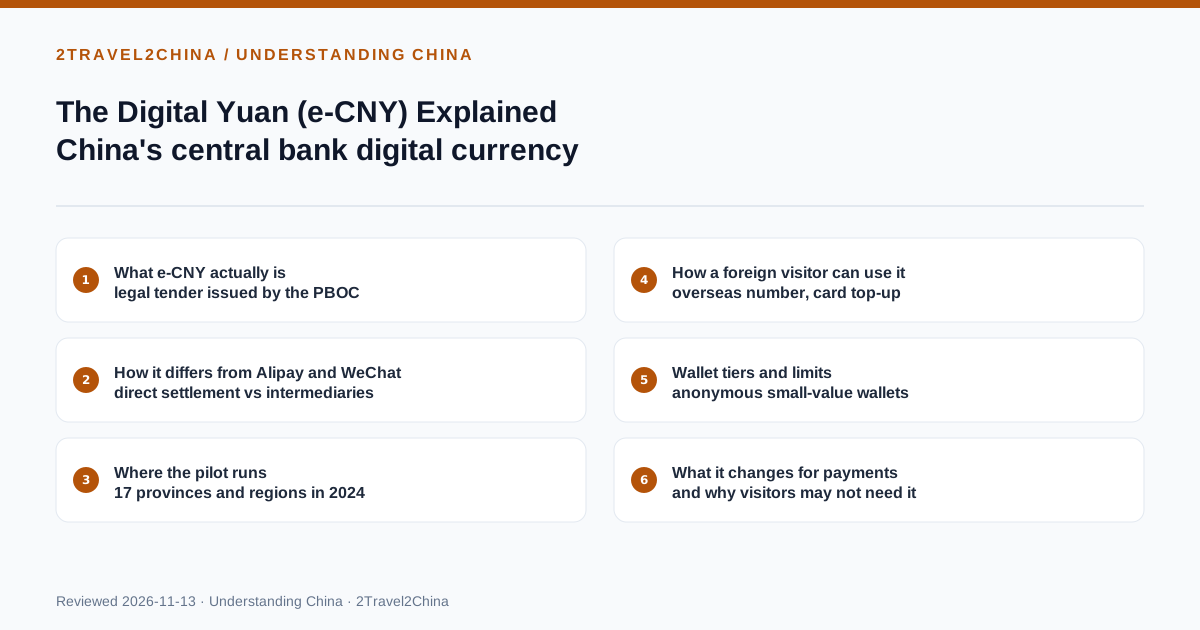
What e-CNY actually is
The e-CNY is a digital form of China's sovereign currency, issued and backed by the People's Bank of China. Unlike the balance in a payment app, it is a direct liability of the central bank, so holding it is closer to holding cash than to holding money in a wallet account. It is legal tender, which means merchants in the pilot areas are expected to accept it the same way they accept banknotes.
The currency has been in development and pilot testing since around 2019, expanding through 2020 and beyond into a widening set of cities. It is designed for retail payments, working both online and offline, and it can be stored in a purpose-built e-CNY app or inside the wallets of participating banks. The point is a state-issued alternative to the private payment rails that already dominate daily life.
| Feature | e-CNY | Cash banknote |
|---|---|---|
| Issuer | People's Bank of China | People's Bank of China |
| Form | Digital, in an app or bank wallet | Physical note or coin |
| Acceptance | Pilot areas and merchants | Everywhere in China |
How it differs from Alipay and WeChat
The key difference is the settlement layer. Alipay and WeChat Pay are payment intermediaries: when you pay, money moves between accounts through a network and the apps earn fees on the flow. The e-CNY, by contrast, is the money itself, settled directly by the central bank with no intermediary taking a cut. In practice the two can look similar on the surface, because the e-CNY app and bank wallets also show a balance and a scan-to-pay screen.
For a user the practical contrast is control and reach. The e-CNY works even when a commercial network is congested, and because it is legal tender it cannot be refused in pilot areas the way a private app's balance might be. But it is not a replacement for Alipay and WeChat in everyday life, since those apps also do bookings, rides and deliveries that a currency alone does not.
Where the pilot runs
As of 2024 the e-CNY pilot covered about 17 provincial-level regions, including Beijing, Tianjin, Hebei, Shanghai, Jiangsu, Zhejiang, Fujian, Shandong, Hunan, Guangdong, Guangxi, Hainan, Chongqing, Sichuan and Yunnan, often limited to specific cities within a province. Within those areas it is accepted across retail, public transport, culture and tourism, and at many government-service counters, so a resident can use it much like any other payment method.
- Pilot cities include Beijing, Shanghai, Guangzhou-area Guangdong, Shenzhen, Chengdu, Hangzhou, Xiamen and Xi'an.
- Within pilot areas, e-CNY works for shops, metro and bus fares, and some tourist sites.
- Outside the pilot regions it is not yet usable as a general payment method.
- Acceptance is expanding, so confirm the current list on the e-CNY app before relying on it.
How a foreign visitor can use it
Foreign visitors in pilot areas can download the e-CNY pilot-version app and register with an overseas mobile number, then open a wallet and top it up with a Visa, Mastercard or other overseas bank card. Local guides, including those from Liaoning and Xiamen, explicitly tell arriving foreigners that the balance can later be transferred back to the same overseas card, which removes the worry of leaving money stranded at the end of a trip.
This makes e-CNY one of the few ways a visitor can hold Chinese-denominated value tied to a passport rather than to a local bank account. It is useful mainly in the pilot cities and for people who want a cash-like option that does not depend on a private app, but it is not necessary: Alipay and WeChat already cover almost every payment a tourist makes.
You can only register where the e-CNY app is live, and the overseas-card top-up is offered in pilot areas such as Dalian, Shenzhen, Chengdu and Xi'an. Check the app's supported regions before you build a plan around it.
Wallet tiers and limits
The e-CNY wallet comes in tiers based on how much identity you verify. The lightest, near-anonymous tier needs minimal information and is designed for small-value, low-risk payments with correspondingly low balance and per-transaction limits, while higher tiers ask for more verification and unlock larger amounts. This tiered design is what lets a visitor open a wallet quickly without a full local bank relationship.
For a short visit the small-value anonymous wallet is usually enough, because the amounts involved in a few meals and metro rides are well within its ceiling. If you expect to spend more, the app walks you through additional verification, but most tourists will never need to, and the limits are generous relative to daily travel spending.
What it changes for payments
For most visitors, e-CNY changes very little, because Alipay and WeChat already handle nearly every payment smoothly. Its real significance is structural: it gives the central bank a direct digital channel, reduces dependence on private intermediaries, and provides a resilient option during network congestion. Understanding it prevents confusion when you see 'digital yuan' signage or a separate app in a pilot city.
The honest advice is to treat e-CNY as optional. Set up Alipay and WeChat first, since they cover transport, food, hotels and tickets; consider e-CNY only if you are in a pilot city and want a cash-like wallet tied to your passport. It is a worthwhile curiosity and a useful backup, not a required travel tool.
A short setup order before you arrive
Set up Alipay and WeChat first
They remain the primary payment layer for almost everything on a trip.
Check the e-CNY pilot list
Confirm your destinations are in the pilot before downloading the app.
Register with an overseas number
Open a small-value wallet and top up with your foreign card if you want to try it.
Transfer any balance back before leaving
The app lets you return the wallet balance to the same overseas card.
Frequently asked questions
What is the digital yuan e-CNY?
The e-CNY is a digital form of China's currency issued directly by the People's Bank of China, making it legal tender rather than a private app balance. It has been in pilot testing since around 2019 and is used for retail, transport and public services within designated pilot regions across about 17 provincial-level areas.
How is e-CNY different from Alipay and WeChat Pay?
Alipay and WeChat are payment intermediaries that move money between accounts and charge fees, while the e-CNY is the money itself, settled directly by the central bank with no intermediary cut. In daily use both scan to pay, but the e-CNY is legal tender and works as a cash-like backup rather than a full lifestyle app.
Can foreign visitors use the digital yuan?
Yes, in pilot areas. Visitors can download the e-CNY pilot app, register with an overseas mobile number, open a wallet and top up with a Visa, Mastercard or other foreign card, and later transfer the balance back to that card. It is offered in cities such as Shenzhen, Chengdu, Dalian and Xi'an.
Where can I use e-CNY in China?
It is accepted within the pilot regions for retail, public transport, tourism and some government services, including Beijing, Shanghai, Guangdong, Sichuan, Zhejiang and Fujian among others, often limited to specific cities. Outside the pilot it is not yet a general payment method, so confirm the current list on the app.
Do I need the digital yuan for a trip to China?
No. Alipay and WeChat Pay already cover nearly all travel payments, and the e-CNY is optional. It is worth considering only if you are in a pilot city and want a cash-like wallet tied to your passport, or a resilient backup if a commercial network is congested.