Opening a Bank Account and Moving Money as a Foreigner in China (2026)
A foreign card linked inside Alipay or WeChat Pay is enough for most short visits, but it is not a Chinese bank account. The People's Bank of China raised the foreign-card mobile-payment ceiling to USD 5,000 per transaction and USD 50,000 per year, while a 3 percent service fee applies to transactions above RMB 200. Salary, rent and utilities usually need a local account. This guide gives both routes, the exact branch steps and the limits that decide which one you need.
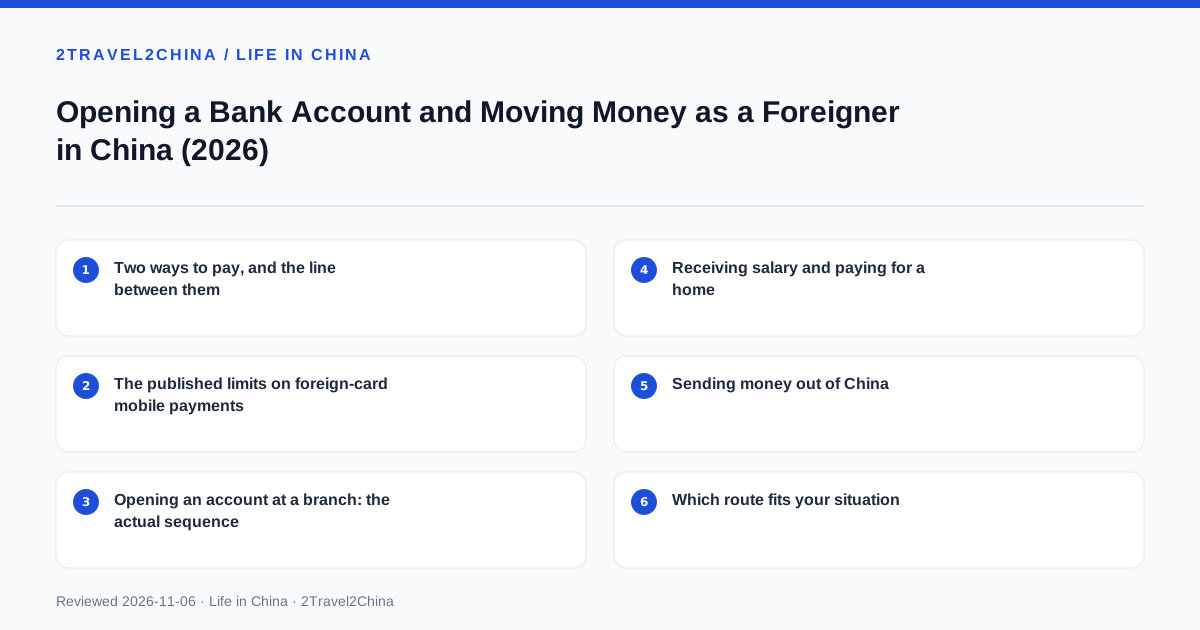
Two ways to pay, and the line between them
The National Immigration Administration guide for foreign business people describes two distinct setups. The first is mobile payment: install Alipay or WeChat, register with a domestic or foreign phone number, link an international card bearing Mastercard, Visa, JCB, Diners Club or Discover, or a domestic UnionPay card, then scan a merchant QR code or show your own payment code. The second is an ordinary bank account opened at a commercial bank branch. Linking a card takes minutes and needs no branch visit; opening an account takes documents, a mainland mobile number and a counter visit.
The practical difference is what each setup can receive. A linked foreign card is a funding source for your own spending; it is not an account that an employer can pay a salary into, that a landlord can debit rent from, or that a utility company can set up an automatic payment against. Those flows generally require a domestic account. If you are staying for a semester, a contract or a multi-year assignment, plan for the branch visit early rather than discovering the gap when payroll asks for an account number.
| Linked foreign card | Local bank account | |
|---|---|---|
| Where it is opened | Inside Alipay or WeChat Pay | At a commercial bank branch |
| What you need | Passport details, the card, a phone number | Passport or permanent residence ID, a mainland mobile number |
| Receives salary | No | Yes |
| Pays rent and utilities | Usually not accepted for standing orders | Yes |
| Time to set up | Minutes | A branch visit, then card collection or activation |
The published limits on foreign-card mobile payments
In March 2024 the State Council Information Office briefing on improving payment services set out the current ceilings. The People's Bank of China directed Alipay, Tenpay and other major payment institutions to raise the single-transaction limit for foreign visitors using mobile payments from USD 1,000 to USD 5,000, and the annual cumulative limit from USD 10,000 to USD 50,000. Those are ceiling figures for foreign-card-funded mobile payments, not a monthly allowance and not a cash withdrawal limit.
The NIA guide adds a fee rule that many visitors do not see until a larger purchase. When an international card is used for a QR-code payment, transactions of RMB 200 or less carry no additional service fee. Above RMB 200, the user pays a service fee of 3 percent of the transaction amount. For a hotel bill or a high-value electronics purchase that fee is material, and it is one of the reasons a local account becomes worthwhile for residents even when the linked card still works.
- Binding a card requires the issuing bank to authorise the connection; some issuers reject the request because their systems cannot recognise the message. Contact the issuer or use a domestic card.
- Major shopping areas, tourist attractions and hotels above a defined scale are required to support several payment methods, including mobile payment, bank cards and cash.
- Cash remains legal tender. A traveller may bring up to RMB 20,000 in cash per entry or exit, and foreign currency can be exchanged at arrival-port bank counters, licensed exchange offices, self-service machines or ATMs.
- Several overseas e-wallets, including AlipayHK, WeChat Pay HK, mPay, Kakao Pay, Touch n Go, TrueMoney, Changi Pay and Naver Pay, can be used directly for QR payments on the mainland.
Limits and fee schedules are set by regulators and payment institutions and can change. Confirm the current figures with the issuing bank and the payment app before making a large purchase; the linked official sources show where the published numbers come from.
Opening an account at a branch: the actual sequence
The NIA guide gives a short, concrete sequence for opening a bank account as a foreign national. It starts with a branch visit, not an app. Bring your passport or Foreign Permanent Resident ID Card and a mainland mobile number, because the number is used for verification, transaction alerts and the bank mobile app. Requirements vary between commercial banks, so the guide explicitly advises confirming details with the branch customer manager rather than assuming one policy applies everywhere.
Visit a commercial bank branch
Bring your passport or Foreign Permanent Resident ID Card and an active mainland mobile number. Ask the customer manager which account type is available to a non-resident or resident foreign customer.
Complete the account application form
Use the same romanised name and passport number as your visa, residence permit and accommodation registration. Inconsistent spelling is a common cause of a returned application.
Verify the card at an ATM
The NIA guide advises testing or changing the PIN at an ATM as soon as you receive the card, so you know the card works before you need it.
Install the bank mobile app
Set up online banking while you are still at the branch. Staff can resolve a registration failure on the spot, which is much harder to do by phone later.
Protect the card and register loss reporting
Keep the card separate from your passport, and know how to report a loss immediately. The guide specifically warns against theft or misuse by third parties.
Expect the bank to ask about the purpose of the account and your residence status. A tourist on a short stay may be offered a narrower account than a resident with a work-category residence permit. Neither the law nor the NIA guide promises a particular account type, so treat the branch answer as the operative one.
Receiving salary and paying for a home
Once a domestic account exists, the routine of living in China becomes much simpler. Employers pay into it, landlords accept a transfer from it, and utility, telecom and property-management bills can be linked to it. This is also where the address registration from the residence guide connects: banks perform identity checks against your passport and residence documents, and a mismatched address or an expired visa can trigger a request to update your information.
For rent, ask the landlord or agent which payment method they will accept before signing. Some will accept a transfer from a domestic account only; others accept Alipay or WeChat transfers, which are convenient but leave you with a transaction record that is harder to reconcile against a lease. Keep the lease, the payment schedule and each receipt together, and make sure the name on the receipt matches the name on the contract.
- Notify the bank when you replace your passport, so the identity record stays consistent with immigration records.
- Keep the accommodation registration receipt available when asked for proof of address.
- Ask whether the account supports the payment methods your landlord, employer and utility providers actually use.
- Do not share the account or card with a third party, including an agent offering to handle paperwork on your behalf.
Sending money out of China
Outward remittance is a separate banking process, not a consequence of having an account. Banks handle it under foreign-exchange administration rules and will ask for the source of the funds and the supporting documents, which for an employee typically means employment, tax and salary records. The required set varies by bank and by the nature of the payment, so ask your own branch for its document list before you need to send money, and build in time for review.
A linked foreign card does not solve this either: it is a way to spend into China, not a channel for moving a local salary balance abroad. If your assignment involves regular cross-border transfers, treat the bank choice as part of the relocation decision and ask about outbound remittance, multi-language statements and international card support before opening the account.
This guide describes the published branch process and the published payment limits. It does not replace the terms your own bank gives you in writing, and cross-border transfer documentation should always be confirmed with the handling branch.
Which route fits your situation
Use one question to decide: will anybody need to pay money into an account in your name? If the answer is no, and you are here for a short visit, a linked foreign card plus a small amount of cash is usually enough. If the answer is yes, because of salary, rent deposits, scholarships or a long lease, open a domestic account in the first week and use the linked card only as a backup.
| Situation | Recommended setup | Why |
|---|---|---|
| 10-day transit or short holiday | Linked foreign card plus RMB cash | No incoming payments; setup takes minutes |
| One-semester student | Local account, keep the linked card | Allowance or scholarship payments, dormitory and phone bills |
| Employed resident | Local account as the primary | Salary, tax records, rent and utilities |
| Family with a lease | Local account plus a written rent record | Deposit, monthly transfer and a clear paper trail |
Whatever you choose, keep two independent ways to pay. A card issuer can decline an authorisation, a phone can be lost, and an app can ask for re-verification at an inconvenient moment. The official guidance itself recommends carrying a little cash as a fallback, and the larger sites are required to keep cash as an accepted option.
Frequently asked questions
What are the current limits for a foreign card in Alipay or WeChat Pay?
The People's Bank of China directed payment institutions to raise the single-transaction ceiling from USD 1,000 to USD 5,000 and the annual cumulative ceiling from USD 10,000 to USD 50,000. These are ceilings for foreign-card-funded mobile payments, confirmed in the 2024 State Council briefing and the NIA guide.
Is there a fee for paying with a linked foreign card?
Yes, above a threshold. Under the NIA guide, QR-code payments of RMB 200 or less carry no additional service fee; above RMB 200 the user pays 3 percent of the transaction amount. For large bills, a local account avoids that charge.
What do I need to open a Chinese bank account?
Bring your passport or Foreign Permanent Resident ID Card and a mainland mobile number to a commercial bank branch, complete the application form, then verify or change the PIN at an ATM after receiving the card. Install the bank app while still at the branch. Requirements differ by bank.
Can my employer pay salary into my linked foreign card?
No. A linked foreign card is a funding source for your own spending, not a domestic account that can receive payroll, rent standing orders or utility debits. Open a local account if anyone needs to pay money into an account in your name.
How much cash can I bring into or out of China?
The NIA guide states a limit of RMB 20,000 in cash per person per entry or exit. Foreign currency can be exchanged at arrival-port bank branches, licensed exchange offices, self-service exchange machines, or withdrawn from ATMs with an international card.