Currency Exchange and Cash in China: What Still Works (2026)
China is close to cashless for everyday purchases, but cash still has a small, real role: a dead phone, a rural stall, a deposit, or a vendor whose terminal only supports domestic wallets. Exchanging and carrying a modest amount of RMB is straightforward once you know where it is done, what identification is required and which denominations are actually useful. This guide covers the mechanics and a cash plan sized for a normal trip.
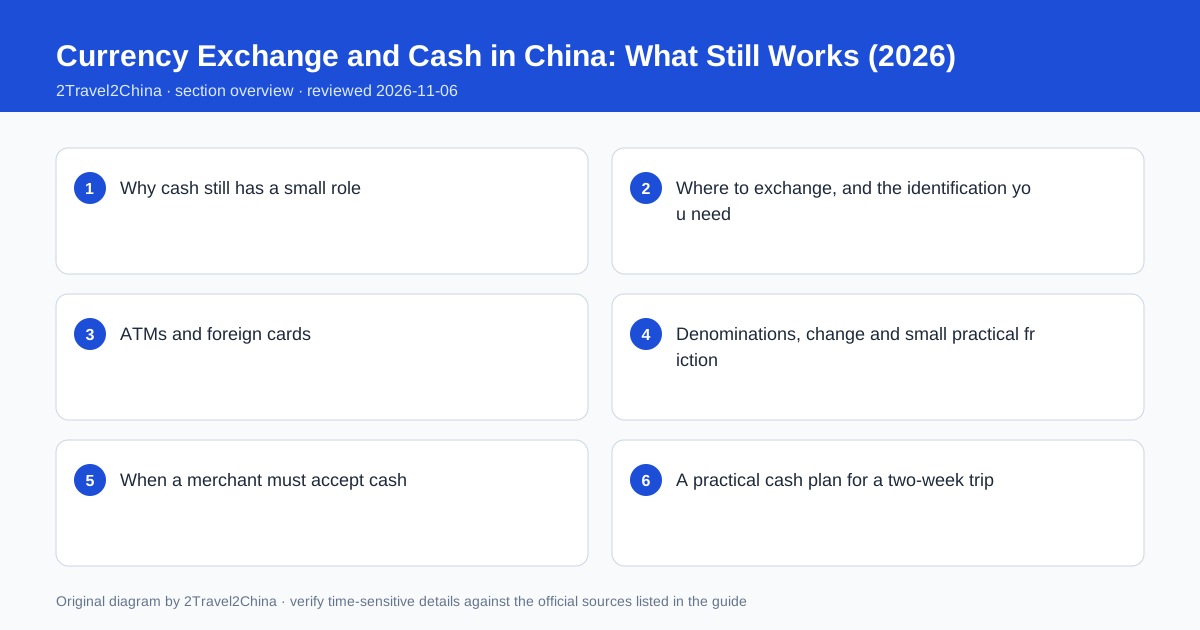
Why cash still has a small role
A visitor can complete a two-week trip using Alipay or WeChat Pay for almost everything: metro gates, convenience stores, restaurants, taxis, attraction tickets and high-speed rail. The argument for cash is therefore about exceptions rather than routine spending. A phone battery that dies at the end of a long day, a mountain stall with no reliable data, a small deposit that a wallet cannot process, or a terminal that only accepts a domestic wallet — each is uncommon, but each is much easier to solve with a couple of small notes than with a troubleshooting session.
| Situation | Why a wallet may fail | What cash solves |
|---|---|---|
| Dead phone battery | No way to generate or scan a code | A taxi or a meal while you find a charger |
| No data signal | Payment request cannot complete | A small purchase at a rural or mountain stall |
| Domestic-only terminal | Foreign-card wallet not supported | A simple note-and-change transaction |
| Small deposit or locker | Amount or account type unsupported | A refundable cash deposit |
| Emergency backup | Bank verification codes unavailable | One day of normal spending |
The useful amount is modest. Carrying the equivalent of a few hundred RMB in small notes covers most of these cases without creating a security problem or leaving you with a large amount of unused currency at the end. Cash is a backup layer, not a payment strategy. Setting up the wallets properly before departure remains the main task; this guide deals with the margin around them.
Where to exchange, and the identification you need
Currency exchange is available at international airports, branches of major banks and licensed exchange counters in city centres. Airport counters are convenient but usually quote a wider spread than a bank branch. Bank branches are reliable and transparent but have opening hours, may require a queue and a form, and sometimes handle foreign exchange only at designated counters. In all cases, exchanging cash requires identification: for a visitor, that means the passport, and the name on the transaction record should match the passport exactly.
| Venue | Advantages | Trade-offs |
|---|---|---|
| Airport exchange counter | Open for arriving flights, immediate | Wider spread, often a fixed fee |
| Major bank branch | Transparent rate, reliable receipts | Opening hours, possible queue and form |
| Licensed city exchange counter | Central, sometimes better rate | Check it is licensed; rates vary |
| Hotel front desk | Convenient late at night | Usually the least favourable rate |
| ATM withdrawal | No counter, widely available | Issuing-bank fees and daily limits |
Keep the exchange receipt. Some banks will reconvert unused RMB into foreign currency at departure if you can show the original purchase record, and the receipt is also useful if a question arises about the source of funds. Avoid informal street exchangers: the rate advantage is rarely worth the counterfeit and personal-security risk, and a licensed counter or bank branch removes both. Where a branch asks for a purpose or a form, it is routine administrative detail rather than a problem.
ATMs and foreign cards
ATMs are widespread in cities, at airports, in shopping centres and near major stations, and many display an English-language option. Cards on international networks are accepted at the larger bank machines, though not at every standalone cash point. The withdrawal is usually processed in RMB, with your bank converting the amount and applying its own foreign-transaction fee, a possible cash-advance fee for credit cards, and a daily withdrawal limit. Using a debit card issued for travel is generally cheaper than a credit-card cash advance.
- Use ATMs attached to a bank branch rather than unbranded standalone machines
- Choose to be charged in RMB, letting your own bank do the conversion
- Check your daily cash withdrawal limit before departure
- Tell the issuing bank you will be travelling so the card is not blocked
- Keep the machine receipt and check it against the bank statement
The prompt offering to charge you in your home currency is dynamic currency conversion, and it usually produces a worse rate than letting your bank convert. Choose RMB. If a machine retains the card, note the branch, the machine number and the time, and contact the bank branch first — attached machines can often be opened during staffed hours. Keep a second card in a separate bag, because a retained card at the start of a trip is the one scenario where a small cash reserve genuinely earns its place.
Denominations, change and small practical friction
RMB notes run from 1 to 100 yuan, and the 100-yuan note is large relative to the price of a snack, a bottle of water or a short local bus ride. Small vendors may struggle to change it, especially early in the day, and some will simply ask for a smaller note. When exchanging, ask for a mix of 10-, 20- and 50-yuan notes rather than a stack of hundreds. Coins and 1-yuan notes are useful for lockers, trolleys and small stalls.
| Note | Typical use | Why it matters |
|---|---|---|
| 100 yuan | Hotel deposits, larger meals | Hard to change at small stalls |
| 50 yuan | Taxi fares and casual restaurants | Usually changeable |
| 20 yuan | Snacks, convenience stores, short rides | The most useful everyday note |
| 10 yuan and below | Water, lockers, local buses, small tips of change | Avoids a request for change |
| Coins | Trolleys, vending machines | Light but easy to accumulate |
Two habits reduce friction. Break a 100-yuan note deliberately at a convenience store or a supermarket early in the day, where change is available, rather than at the smallest stall. And keep small notes in a separate pocket or pouch so you are not unfolding a large note in front of a queue. None of this is complicated, but it is the difference between cash feeling useful and cash feeling awkward.
When a merchant must accept cash
Chinese rules on cash acceptance are aimed at ensuring that domestic cash remains usable in an increasingly digital economy. In practice, essential services, larger retailers, transport counters and banks will handle RMB cash, while a small vendor with no till float may still struggle with a large note. The rule is a useful backstop for a genuine refusal, but it is not a practical tool for winning an argument at a market stall, and visitors rarely need to invoke it.
- Ask for a smaller note or a fresh QR code before assuming a refusal
- Try a staffed counter rather than an unattended kiosk
- Keep the request short and factual; a language gap is usually the real issue
- Use a translation app showing the amount in Chinese numerals
- Escalate only for an essential service, not a discretionary purchase
The everyday reality is that a wallet payment is faster for both sides, and merchants are not trying to make life difficult. If a small stall cannot change a 100-yuan note, buying something small with a 10- or 20-yuan note solves it. Where an essential service genuinely refuses cash without an alternative, ask for the manager or the service counter. Document the time and place if you need to follow it up later, but expect the issue to be resolved on the spot.
A practical cash plan for a two-week trip
A sensible plan is small, deliberate and set up before you need it. Exchange or withdraw a modest amount on arrival, ask for small denominations, keep most of it separate from your daily spending wallet, and top up once mid-trip if you have actually used some. At the end, spend the remainder on meals and transport rather than paying a second exchange spread to convert it back. The point is resilience, not a cash-based trip.
Set up both wallets before departure
Alipay and WeChat Pay, each verified with a passport and a linked foreign card.
Exchange or withdraw on arrival
Enough for one or two days of ordinary spending, in small notes.
Keep a separate reserve
Store the bulk of the cash apart from the notes you use daily.
Use cash for the exceptions
A dead phone, a rural stall, a deposit, a verification-code problem.
Spend down before departure
Use the remainder on meals and local transport rather than reconverting it.
Revisit the plan if the trip shape changes. A week in Shanghai with an international hotel needs very little cash. A route that includes Huangshan, a rural homestay or a long train day justifies a little more. And a traveller whose bank cannot deliver verification codes abroad should carry a larger buffer, because the failure mode in that case is not a single payment but a day or two of unreliable wallet access.
Exchange rates, ATM fees, cash-advance terms and provider rules change, and the availability of English-language ATM menus varies by machine. Check your card issuer’s overseas cash terms before departure and confirm current exchange arrangements at a licensed bank or counter.
Frequently asked questions
Do I need cash in China in 2026?
Not for routine spending — Alipay and WeChat Pay cover almost everything. Carry a modest amount of RMB in small notes as a backup for a dead phone, no signal, a rural stall or a small deposit.
Where is the best place to exchange currency?
A major bank branch usually offers the most transparent rate, while airport counters are convenient but wider. Licensed city exchange counters vary. Bring your passport, keep the receipt and avoid informal street exchangers.
Can I use a foreign card at an ATM in China?
Yes, at many bank-attached machines displaying an English option. Choose to be charged in RMB rather than your home currency, and check your bank’s overseas withdrawal fee and daily limit before travelling.
Why do small shops struggle with a 100-yuan note?
The note is large relative to a snack or a short ride and small vendors may not hold enough change. Ask for 10- and 20-yuan notes when exchanging, and break large notes at a supermarket early in the day.
Must Chinese merchants accept cash?
Chinese rules protect the acceptance of domestic cash, and essential services, banks and larger retailers will handle it. In practice, asking for a smaller note or a fresh QR code resolves almost every everyday difficulty.