Mobile Payment Problems in China: Common Failures and Fixes (2026)
A failed mobile payment in China is usually one of five problems: an incomplete identity verification, a card the issuing bank blocks, a transaction ceiling or service fee, an expired passport record, or a network and QR issue. Working out which one you have takes less than a minute if you read the error message carefully. This guide gives a diagnostic order, the fix for each case and a fallback that keeps the day moving.
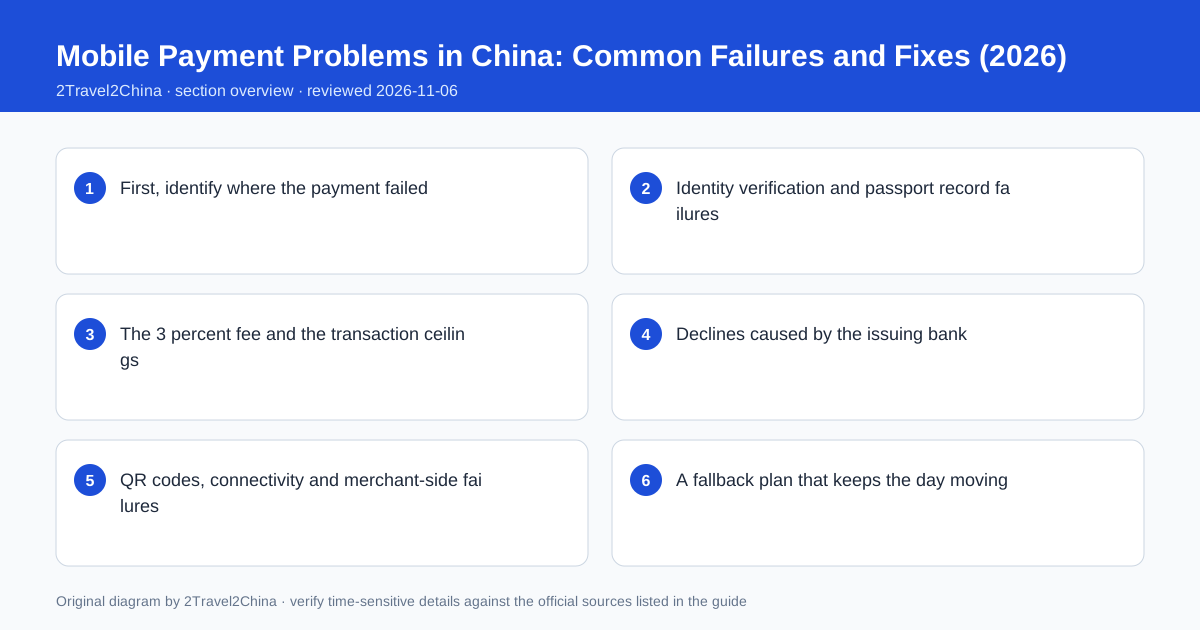
First, identify where the payment failed
The error message tells you which layer broke. A message about identity verification or a passport is a wallet-account problem. A message about the card, an authentication challenge or a bank decline comes from the card issuer. A message about an amount limit or a service fee is the foreign-card rule. And a spinning QR code with no message at all is usually connectivity or a merchant-side terminal issue. Do not retry the same payment repeatedly: several rapid attempts can trigger the issuing bank’s fraud controls and turn a one-minute fix into a phone call home.
| Symptom | Likely layer | First action |
|---|---|---|
| Identity or passport error | Wallet account verification | Re-check the passport name and expiry in the wallet |
| Card declined or authentication failed | Issuing bank or card network | Check whether the bank blocked an overseas wallet token |
| Amount or fee message | Foreign-card ceiling or 3 percent fee | Split or reduce the amount, or use another card |
| QR scans but nothing happens | Network or merchant terminal | Switch network, ask the merchant to generate a fresh code |
| Wallet balance visible but payment blocked | Account risk control | Complete the in-app verification prompt |
Keep both Alipay and WeChat Pay installed and verified before you travel. They use different rails and different risk systems, so one can work when the other does not. Link two different cards if you have them, ideally from different issuers. This is not redundancy for its own sake: it is the cheapest way to make a single failure a non-event rather than a trip-disrupting problem.
Identity verification and passport record failures
Foreign cards work inside Alipay and WeChat Pay after the wallet has verified the holder’s identity with a passport. The verification step asks for the exact name, passport number, nationality and document expiry. Any mismatch with the cardholder record or an expired passport entry can disable payments even when the card itself is fine. A renewed passport is the classic cause: the wallet still holds the old document number, and the account stops passing verification checks.
Open the wallet identity page
Find the passport or identity section in settings and read what is stored there.
Compare with the physical passport
Check name order, hyphens, spaces, number and expiry date character by character.
Update expired document details
Upload the new passport page if prompted and allow time for review.
Re-run a small payment
Use a low-value transaction to confirm the account is active again.
Keep the old passport to hand
If the account still references it, the physical copy helps resolve a mismatch.
Verification reviews are not always instant. If a document update is pending, use the other wallet or cash for a day rather than repeatedly submitting the same change. Where a wallet asks for a mainland mobile number, note that some functions are available without one but certain features are not; the in-app prompt will say which. Setting this up at home, where a bank can answer a verification challenge and a phone has reliable data, is far easier than doing it in a queue.
The 3 percent fee and the transaction ceilings
The payment-access measures announced by the People’s Bank of China raised the single-transaction ceiling for foreign-card mobile payments from USD 1,000 to USD 5,000 and the annual ceiling from USD 10,000 to USD 50,000. Transactions above RMB 200 attract a 3 percent service fee, while smaller ones do not. The fee is a cost of the foreign-card route, not a penalty or a mistake by the merchant. It appears before you confirm the payment, so read the confirmation screen rather than assuming the amount shown is the amount charged.
| Amount | Service fee | Practical note |
|---|---|---|
| Up to RMB 200 | No 3 percent fee | Everyday snacks, metro rides and small purchases |
| Above RMB 200 | 3 percent service fee | Hotel bills, fine dining, larger retail purchases |
| Up to USD 5,000 per transaction | Ceiling on a single payment | Splitting does not remove the fee ceiling |
| Up to USD 50,000 per year | Annual cumulative ceiling | Relevant mainly to long stays, not a two-week trip |
Splitting a large bill into sub-RMB-200 payments is not a reliable workaround: many merchant terminals do not allow it, some flag it as unusual activity, and the fee rule is applied to the transaction rather than to the traveller’s intention. For a large hotel bill, ask whether the property can accept the foreign card directly at the front desk; many international and mid-range hotels can. Otherwise treat the 3 percent as a known cost and keep it in the trip budget rather than fighting it at the till.
Declines caused by the issuing bank
If the wallet says the card was declined or an authentication challenge never arrives, the decision was made by the bank that issued the card, not by Alipay or WeChat Pay. Banks apply their own controls to overseas wallet tokenisation and to cross-border transactions, and some require a one-time approval through their app or a short-message code. A card that works fine for a hotel booking at home can still be blocked when a wallet tries to tokenise it abroad.
- Check the banking app for a pending authorisation or an approval request
- Confirm that overseas and mobile-wallet transactions are enabled for that card
- Ensure the phone can receive the bank’s SMS or app verification code while abroad
- Ask the bank to allow the merchant country and the wallet tokenisation request
- Try the second linked card, ideally from a different issuer
The SMS point is often the real blocker. If your home SIM is not roaming or a travel eSIM replaced it, the verification code may never arrive. Enable roaming for the home number, use an app-based approval instead of SMS where the bank offers one, or authorise the card before departure while you can still receive the code. Keep a card from a second issuer precisely for this scenario. Calling a bank from another time zone is possible but slow, and it is worth avoiding on day one of a trip.
QR codes, connectivity and merchant-side failures
Not every failed payment is a payment failure. A static printed QR code can be damaged, outdated or replaced by a merchant account that is no longer active. A dynamic code generated on a terminal expires quickly. A weak data connection inside a basement restaurant or a crowded station can leave the wallet waiting for a response with no error message at all. Switching between Wi-Fi and mobile data, or asking the merchant to generate a fresh code, resolves most of these cases.
- Ask for a fresh dynamic QR code rather than rescanning the same printed one
- Switch between mobile data and Wi-Fi, then retry once
- Confirm whether you are meant to scan the merchant code or show your payment code
- Check that the amount on the confirmation screen matches the price agreed
- At small stalls, ask whether a cash payment is simpler for both sides
The two directions of a QR payment are worth knowing. In one, you scan the merchant’s code and enter an amount. In the other, the merchant scans a payment code generated by your wallet. Visitors often try the wrong one after being handed a scanner. If the terminal beeps but no confirmation appears on your phone, do not pay a second time — ask the merchant to check whether the first transaction settled, and keep the receipt. Duplicate payments are rare but are much easier to reverse at the counter.
A fallback plan that keeps the day moving
The aim is to make a payment failure boring. Before leaving home, verify both wallets, link two cards, enable app-based bank approvals, and carry a small amount of RMB for contingencies. On the trip, keep the passport record current in both apps, keep the home SIM able to receive SMS, and save offline copies of your hotel address and first-night booking. That combination resolves almost all of the common cases without a phone call.
Try the other wallet first
A different risk system often clears immediately.
Try the second linked card
An issuing-bank block is usually card-specific.
Use a hotel front desk or a staffed counter
Direct foreign-card acceptance is more common there.
Fall back to a small amount of RMB cash
Enough for a meal, a taxi and a phone charge.
Resolve the root cause in the evening
Do not spend a sightseeing day on hold to a bank.
Keep the fee and ceiling figures in perspective: they affect a large bill, not a metro ride or a bowl of noodles. Most daily purchases are small, fee-free and settle in a second. The situations that genuinely need a backup are a dead phone, a bank verification code that cannot arrive, and a merchant whose terminal only supports domestic wallets. A little cash and a second card cover all three.
Fee thresholds, transaction ceilings, verification flows and supported card networks are set by payment providers and regulators and do change. Check the current terms inside the app and on the People’s Bank of China and payment-provider pages before relying on a particular figure. This guide explains the diagnosis, not a permanent rule.
Frequently asked questions
Why did my Alipay payment suddenly stop working?
The most common causes are an expired or mismatched passport record in the wallet, a card the issuing bank has blocked for overseas wallet transactions, a verification code that never arrived, or an account risk check. Read the exact error message before retrying.
What is the RMB 200 rule and the 3 percent fee?
Foreign-card mobile payments above RMB 200 incur a 3 percent service fee; smaller transactions do not. It is a cost of the foreign-card route, shown on the confirmation screen before you approve the payment.
Can I split a large bill to avoid the fee?
Not reliably. Many terminals do not allow split payments and some flag repeated small transactions. For a large hotel bill, ask whether the property can take the foreign card directly instead.
My bank verification code never arrives in China. What can I do?
Enable roaming on your home SIM, switch to app-based approval if your bank offers it, and authorise the card before departure. A travel eSIM that replaces the home number can prevent SMS codes from arriving.
Should I set up both Alipay and WeChat Pay?
Yes. They use different rails and risk systems, so one often works when the other does not. Verify both before departure and link two cards from different issuers if you have them.