Food Delivery Apps in China: How Meituan, Ele.me and the Super-Apps Work
Food delivery is a default part of daily life in Chinese cities, and it is also one of the clearest windows into how China's app economy works. Two platforms, Meituan and Ele.me, handle almost the entire market, and both are reached through the same super-apps you use for payment. This guide explains which app to use, how a visitor without fluent Chinese can still order, what it costs, and why the apps look different from Uber Eats or Deliveroo you may know.
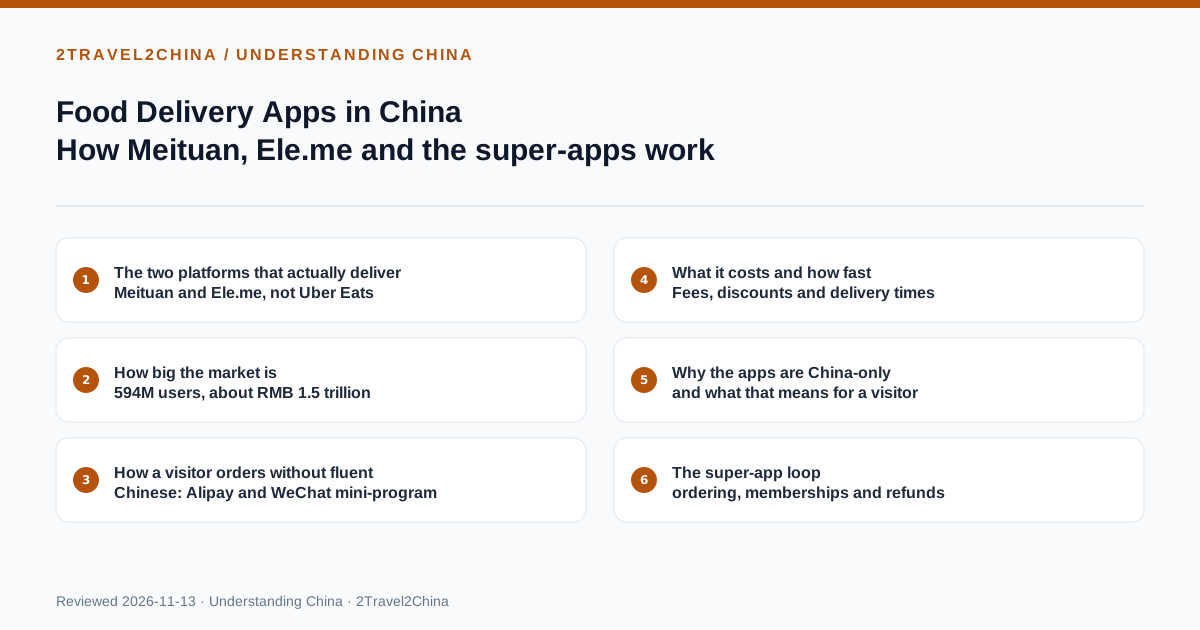
The two platforms that actually deliver
China's food delivery market is effectively a duopoly. Meituan is the larger operator, estimated at roughly 65 percent of the meal-delivery market in 2024, while Ele.me, owned by Alibaba, holds about a third. A handful of smaller regional players share the remainder. There is no Uber Eats, Deliveroo or DoorDash in mainland China, so knowing these two names covers essentially every order you are likely to place.
Meituan began as a group-buying and local-services app and grew into the country's delivery backbone, while Ele.me was an early pure-play food-delivery start-up later absorbed into Alibaba's ecosystem. Both now sit inside the same super-apps you already need for payment: Meituan is reachable through WeChat and its own app, and Ele.me is reachable through Alipay and its own app. Choosing between them usually comes down to which has more restaurants near you, not to a large price difference.
| Platform | Estimated 2024 share | How a visitor reaches it |
|---|---|---|
| Meituan | About 65 percent of meal delivery | WeChat and the Meituan app |
| Ele.me | About 33 percent of meal delivery | Alipay and the Ele.me app |
| Other regional apps | About 2 percent combined | Standalone apps, limited coverage |
How big the market is
The scale is hard to overstate. China's online food delivery user base reached about 592 million people in the second half of 2024, and the meal-delivery market was worth roughly 1.5 trillion yuan for the year, equal to about a quarter of all spending on eating out. On a single peak day in mid-2025, Meituan alone processed more than 150 million instant-retail orders, a figure that shows how routine on-demand delivery has become.
This size matters for a visitor because it means coverage is excellent in cities and the logistics are fast. Restaurants from global chains to small noodle shops list on these platforms, and a dense fleet of riders keeps delivery times short. The trade-off is that the systems are built for Chinese-language users first, which is why the ordering method below is more useful than simply downloading the brand apps.
How a visitor orders without fluent Chinese
The most reliable route for a visitor is to order inside Alipay or WeChat rather than through the standalone Meituan or Ele.me apps. Both super-apps run Chinese-to-English translation on their pages, and their mini-programs for Meituan and Ele.me let you browse menus, choose a restaurant and pay with the card you already linked. This avoids installing a second app and sidesteps much of the Chinese-only interface of the delivery brands.
- Open Alipay or WeChat and search for the Meituan or Ele.me mini-program in English or Chinese.
- Allow location access so the app shows restaurants that deliver to your hotel or address.
- Use the in-app translate feature to read menu items, or show the restaurant name to staff.
- Pay with your already-linked foreign card; the order confirmation appears in the same app.
- Track the rider on the map and use the app's chat to send your gate or building in English plus Chinese characters.
Delivery addresses are entered in Chinese characters. Save your hotel's name and address in characters from your booking, and paste it into the address field rather than typing a translation by hand.
What it costs and how fast
A typical meal delivery in a major city costs the menu price plus a delivery fee around 5 to 8 yuan, with many orders falling below that during promotional periods. Restaurants frequently run discounts, and the platforms use membership passes that cut fees after a few orders. Compared with eating in, delivery is only marginally more expensive and far cheaper than a hotel minibar or room service.
Speed is the headline feature. Average delivery times are about 30 minutes in cities, and the network is dense enough that a rider is usually minutes away. During bad weather or meal peaks the wait stretches, but it rarely becomes unusable. Tipping is not part of the system, and there is no expectation to tip the rider, which is one of the clearer differences from food delivery in North America or Europe.
Why the apps are China-only and what that means
Meituan, Ele.me and the mini-programs operate only with mainland Chinese accounts, Chinese-language menus and domestic logistics, so the experience is local by design. The standalone brand apps also assume a Chinese app store and phone number. This is why ordering through Alipay or WeChat, where your foreign card already works, is the lower-friction path for a short visit rather than fighting the standalone apps directly.
It also explains why international delivery apps never gained a foothold here: the domestic networks are faster, cheaper and more complete than anything a foreign entrant could build. For a visitor, the practical takeaway is to treat delivery as an Alipay or WeChat feature, not as a separate service to install and learn from scratch.
The super-app loop
Food delivery is one tile in a much larger loop. The same Meituan or Ele.me mini-program also handles groceries, pharmacy items, daily necessities and even flower delivery, and the discount memberships span all of those categories. Once your address and payment are set, the app becomes a general errand runner, which is why many residents stop distinguishing between 'food delivery' and 'shopping' entirely.
Refunds and customer service run inside the app through chat, and disputes are usually resolved quickly because the platforms compete on service. Keep your order number handy, and use the in-app translation to explain a missing item. For a visitor this loop is convenient but optional: a few orders during a trip are enough to see how the system works without depending on it daily.
A short setup order before you arrive
Install Alipay and WeChat
Do this at home on a network you trust, because app-store access can be unreliable on a mainland connection.
Link a foreign card and verify
A funded payment method is what makes every mini-program, including delivery, usable.
Save your hotel address in Chinese
Copy it from your booking confirmation and keep it in the app's saved-address list.
Try one low-stakes order
A coffee or a simple meal near your first hotel confirms the flow before you rely on it.
Frequently asked questions
Which food delivery app should I use in China?
Use Meituan or Ele.me, which together cover about 98 percent of the meal-delivery market. The easiest path for a visitor is to order through their Alipay or WeChat mini-programs rather than installing the standalone brand apps, because the super-apps translate pages and reuse the card you already linked.
Can I use Uber Eats or Deliveroo in China?
No. Neither operates on the mainland, and no international food-delivery app has meaningful coverage there. China's market is served entirely by domestic platforms, so planning around Meituan and Ele.me is the only practical option for delivery during a visit.
How do I order food without reading Chinese?
Order inside Alipay or WeChat, which offer in-app translation, and use the Meituan or Ele.me mini-program. Save your hotel's name and address in Chinese characters from your booking, paste it into the address field, and use the map and chat to track the rider and send your location.
How much does food delivery cost in China?
Expect the menu price plus a delivery fee around 5 to 8 yuan, often reduced by restaurant or platform discounts. Delivery is usually about 30 minutes in cities. Tipping is not expected and there is no rider tip, which differs from food delivery in many Western countries.
Is food delivery safe and reliable for visitors?
Yes. The networks are large, fast and used daily by hundreds of millions of people, and in-app customer service resolves missing-item disputes quickly. The main friction is the Chinese-language interface, which Alipay and WeChat translation handle well enough for a straightforward order.