Schools and Study Options for Foreign Families in China (2026)
Schooling in China is decided by residency status before it is decided by school quality. Schools for children of foreign nationals are regulated to enrol the children of foreign nationals legally residing in China, while public-school international divisions and bilingual schools apply different eligibility rules. Holders of a Foreign Permanent Resident ID Card have a separate route into the public system. This guide lays out the three paths, the documents, and the questions to put to a school before you apply.
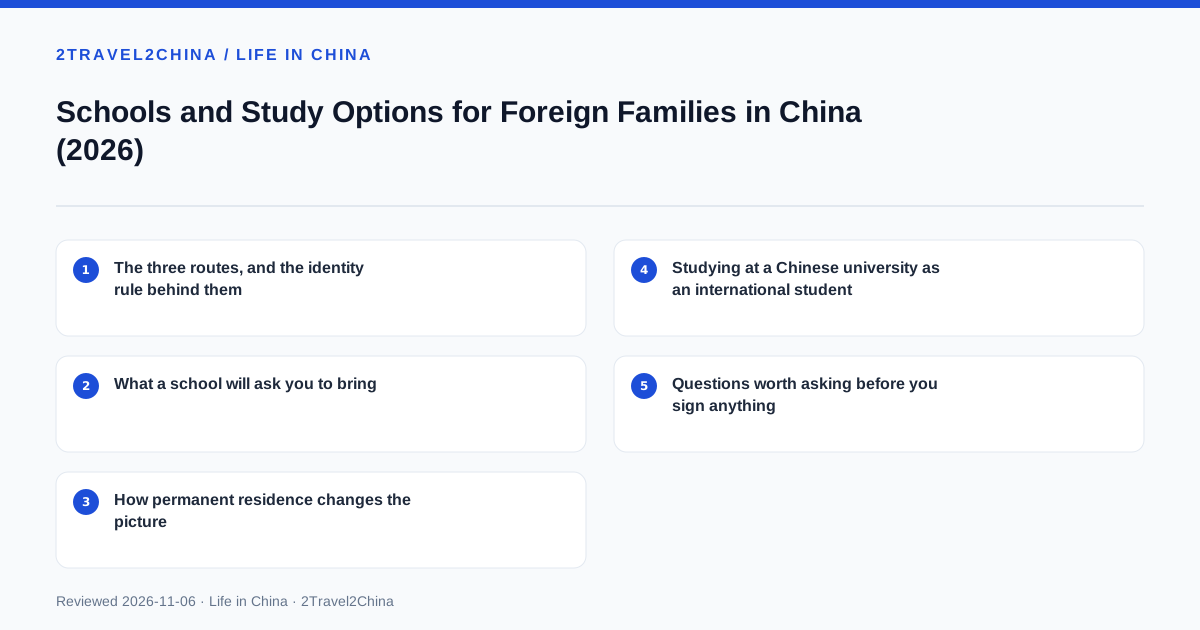
The three routes, and the identity rule behind them
Families generally encounter three options: a school for children of foreign nationals, an international division or bilingual school attached to a Chinese school, and an ordinary public school. The first is a distinct category created by Ministry of Education rules. The interim measures issued in 1995 define its enrolment as the children of foreign nationals holding residence documents in China, and a 2015 Ministry of Education opinion restates that its main intake is the accompanying children of foreign nationals legally residing in the province, and that it must not enrol children of Chinese citizens resident in China.
That single sentence explains most of the confusion in English-language guides. Eligibility is about the legal status of the child and the parents, not about language ability or where the family used to live. Schools in this category are approved by provincial education authorities and may teach a foreign or international curriculum such as IB or AP rather than the Chinese national curriculum. They generally do not confer a Chinese school registration record, so the route leads to overseas university study rather than the Chinese secondary-school examination track.
| Route | Typical eligibility | Curriculum | Exam track |
|---|---|---|---|
| School for children of foreign nationals | Child of a foreign national legally residing in China | Foreign or international curriculum | Overseas university path |
| Public-school international division | Foreign, Hong Kong, Macao and Taiwan students, plus locally defined categories | Mixed Chinese and international | Usually overseas path |
| Bilingual private school | Often open to both foreign and Chinese students | Varies by school | Some can register for domestic exams |
| Ordinary public school | Locally defined; permanent residence changes the position | Chinese national curriculum | Domestic examination path |
What a school will ask you to bring
Application files vary by city and by school, but the recurring documents are consistent because they all evidence the same thing: that the child and at least one parent have a lawful basis to be in China. Expect to produce the child passport, a valid visa or residence permit, the accommodation registration record, proof of the parent-child relationship, the parent work or residence documents, previous school records and immunisation records.
- Child passport, valid visa or residence permit, and the temporary accommodation registration record.
- Birth certificate and proof of parent-child relationship, with a certified translation where the original is not in Chinese.
- Work permit, residence permit, employment letter and tax record for the sponsoring parent, where the school requires them.
- Previous transcripts, a transfer letter and vaccination records, translated if necessary.
- Any additional documentation required by the provincial education authority for a specific eligibility category.
Two details cause avoidable delays. First, names must match across the passport, birth certificate, residence permit and registration record, including transliteration. Second, the accommodation registration receipt is often requested as proof of address, which is why the 24-hour filing described in the residence guide should be done before the application window opens. Application seasons commonly run from autumn into the following spring with rolling intake, so start the document set months ahead.
Eligibility is assessed by the school and the local education authority, and cities apply additional conditions. Confirm the current requirements directly with the admissions office and the provincial education department; a published school ranking is not an eligibility answer.
How permanent residence changes the picture
A Foreign Permanent Resident ID Card opens a different route. The 2012 measures on treatment of foreign nationals with permanent residence in China, issued jointly by 25 departments, provide that the accompanying children of permanent residents may, at the compulsory-education stage and where conditions are met, be handled by the education authority at the place of residence under the nearby-enrolment principle for admission and transfer, without charges beyond those prescribed by the state. In other words, the child is not limited to the foreign-national school track.
Some cities have additional talent-residence schemes that grant similar treatment to holders of local overseas-talent residence certificates. Because these are local instruments, their names, validity and the documents they require differ. Ask the district education bureau which scheme applies to your certificate rather than assuming a national rule. For families without permanent residence, the bilingual and international-division routes are usually more flexible than a school for children of foreign nationals.
- Check whether your residence document counts as permanent residence or as a time-limited work or study residence permit.
- Ask the district education bureau about nearby-enrolment procedures before choosing a flat, since the address can matter.
- Confirm whether a domestic school registration record will be created, and what it means for later university applications.
- Keep the accommodation registration receipt current if you change address during the school year.
Studying at a Chinese university as an international student
University study is a separate system from school-age enrolment. International students apply to a university programme, and the visa or residence document follows admission rather than the other way round. The China Scholarship Council publishes information on scholarship programmes and university pathways, while individual universities set their own language requirements, application deadlines and document lists. Many programmes are taught in Chinese, and an increasing number are offered in English.
For a family, the practical link is that a parent on a work-category residence permit and a child on a dependent residence document are different statuses with different documents. A short-term language course, a semester exchange and a full degree also have different residence arrangements. Confirm the category with the university international office and with the local exit-entry administration before paying tuition or booking a long flight.
- Confirm the programme language of instruction and whether a Chinese proficiency certificate is required.
- Ask the university international office which visa or residence category the programme supports.
- Check whether the campus provides accommodation registration support for international students.
- Budget for health insurance or a medical examination if the programme requires one.
- Keep digital copies of admission letters and passport pages for the visa application.
Questions worth asking before you sign anything
School marketing material rarely states the eligibility rule plainly, and fee information published by commercial directories is not a regulatory source. Ask the admissions office to put its eligibility decision and its fee schedule in writing. Ask specifically whether a Chinese school registration record will be created, because that determines whether a domestic examination path remains open later.
| Question | Why it matters |
|---|---|
| Which eligibility category does my child fall under? | Determines whether this school type can legally enrol them |
| Which documents must be certified or translated? | Certification can take weeks and delays an application |
| Will a domestic school registration record be created? | Determines whether the Chinese exam route stays open |
| What is included in the fee, and what is extra? | Tuition, buses, meals and materials are often billed separately |
| What happens if our residence status changes mid-year? | A change of category can affect continued enrolment |
| Is the accommodation registration receipt required at enrolment? | Connects the school application to the 24-hour address filing |
Finally, note that a school for children of foreign nationals is not automatically better than a bilingual school, and an international division is not the same institution as a stand-alone foreign-national school. The right choice depends on the child age, how long the family will stay, which curriculum the next school will accept, and what the family residence document actually permits.
Frequently asked questions
Can a Chinese citizen child attend a school for children of foreign nationals?
Generally no. Ministry of Education rules define the intake as children of foreign nationals legally residing in China and state that these schools must not enrol children of Chinese citizens resident in China. Cities apply additional conditions for exceptional family situations, so confirm with the provincial education authority.
What documents do international schools usually require?
The child passport and valid visa or residence permit, the accommodation registration record, birth certificate and proof of parent-child relationship with certified translation if needed, parent work or residence documents, previous transcripts and vaccination records. Requirements vary by school and city.
Does a Foreign Permanent Resident ID Card allow public school enrolment?
The 2012 multi-department measures provide that accompanying children of permanent residents may, at compulsory-education stage and where conditions are met, be admitted or transferred by the local education authority under the nearby-enrolment principle, without charges beyond state prescriptions. Confirm the local procedure with the district bureau.
When should we apply?
International school application seasons commonly open in autumn and run into the following spring, with rolling admission at some schools. Start the document set months earlier, since certified translations and relationship documents are the slowest items.
How does university study in China work for international students?
Apply to a university programme first; the visa or residence document follows admission. The China Scholarship Council publishes scholarship information, and universities set their own language requirements and deadlines. Ask the international office which residence category the programme supports.