Double 11 in China 2026: A Shopping Guide for Foreign Visitors
Double 11, also called Singles' Day, is China's biggest shopping festival and falls on 11 November 2026. For foreign visitors it is more than a local sale: it is the cheapest time of year to buy Chinese brands and electronics, and thanks to China's 2025 tax-refund upgrade, tourists can now claim an 11% departure refund on purchases from as little as ¥200. This guide explains the dates, the scale, and exactly how a visitor shops and gets money back.

What is Double 11 and when does it take place in 2026?
Double 11, known in Chinese as Shuangshiyi, is China's largest annual shopping festival and is held on 11 November every year. In 2026 it lands on Wednesday 11 November, but the sales run for weeks: presales typically open in mid-October and platforms stack their deepest discounts toward the 11 November climax. What began as an anti-Valentine's singles' day on university campuses is now a national retail event larger than Black Friday and Cyber Monday combined.
The name comes from the date written as four ones (11.11), which visually resembles bare sticks — a playful symbol of being single. Alibaba turned it into a shopping event in 2009, and it has grown into a weeks-long cycle of pre-sales, deposits, coupons and a final midnight peak. For a visitor, the practical window is roughly mid-October through 11 November, with the best prices in the final days.
- 2026 festival day: Wednesday 11 November 2026.
- Presales: usually open from mid-October, with a second 'peak' around 11 November.
- Main platforms: Taobao and Tmall (Alibaba), JD.com, Douyin, Pinduoduo and Kuaishou.
- Best deals for visitors: the final week, not the first announcement.
How big was the 2025 Double 11 — the model for 2026?
The most recent completed festival, Double 11 2025, generated about ¥1.695 trillion (roughly US$235 billion) in total online retail sales across China, up 14.2% year on year, according to monitoring firm Syntun. Tmall ranked first, JD.com second and Douyin third. Because Alibaba and JD stopped publishing their own GMV figures four years ago, independent trackers like Syntun are now the only public yardstick for the festival's true size.
Within that total, comprehensive e-commerce platforms accounted for ¥1.619 trillion (up 12.3%) and instant retail — on-demand delivery from Meituan, Taobao Instant and JD Now — reached ¥67 billion, up 138.4%. The 2025 cycle also ran longer than ever, with Kuaishou opening on 7 October, Douyin and JD on 9 October, Tmall on 15 October and Pinduoduo on 16 October, so expect a similar stretched timeline for 2026.
Platforms no longer shout a single headline number, so ignore social-media claims of a specific 'GMV record'. The reliable figure is Syntun's nationwide estimate of about ¥1.695 trillion for 2025, and 2026 is expected to be similar in shape if not slightly larger.
Why should a foreign visitor care about Double 11?
Shopping is already a top reason many international visitors come to China, and Double 11 is when local brands, electronics and tea hit their lowest prices of the year. The 'China Haul' trend is real: overseas visitors spent ¥263.6 billion (about US$36.6 billion) shopping in China in 2025, up 27.8% year on year. Time your trip around early-to-mid November and you shop the same deals as locals — plus a tax refund on top.
The visitor advantage is twofold. First, Chinese-made goods are cheapest at the source, so drones, phones, tea and silk cost far less than at home. Second, the tax refund described below returns up to 11% of the price at departure, a benefit locals never get. Stacked together, a well-planned Double 11 shopping day can beat any airport duty-free run.
- Lowest annual prices on Chinese brands and electronics.
- An 11% departure tax refund that only foreign visitors can claim.
- A 'China Haul' shopping culture that welcomes overseas buyers.
- Easy parcel shipping home if you overbuy.
Can foreigners actually shop on Taobao and Tmall?
Yes, but not by typing a foreign card straight into Taobao. The practical route is to set up Alipay's tourist mode before you arrive and link an international card such as Visa, Mastercard or JCB, then pay through Alipay at checkout on Taobao, Tmall and most Chinese stores. WeChat Pay offers the same path through its own tourist wallet. Without one of these two apps, buying on Chinese platforms is very difficult for a short-term visitor.
Both Alipay and WeChat Pay let you register with a passport and a foreign card, and both work inside the Taobao and Tmall checkout flow. Set them up and run a small test payment before you fly, because a failed verification on arrival wastes a shopping day. Our dedicated guides walk through Alipay setup and WeChat Pay setup step by step.
Do not rely on a plain foreign credit card at Chinese online checkout — most Taobao and Tmall stores do not accept one directly. Alipay or WeChat Pay with a linked international card is the working method, and it must be verified before you travel.
The tax refund: how tourists get 11% back (the real win)
China's departure tax refund for foreign visitors was upgraded in 2025, and it is the single biggest reason to shop during your trip. The minimum purchase dropped from ¥500 to ¥200 per same-day, same-store receipt, the refund rates are 11% on 13%-VAT goods and 8% on 9%-VAT goods, and the cash refund limit rose from ¥10,000 to ¥20,000. Best of all, the instant-refund service rolled out nationwide in 2025, so you can collect cash at the store.
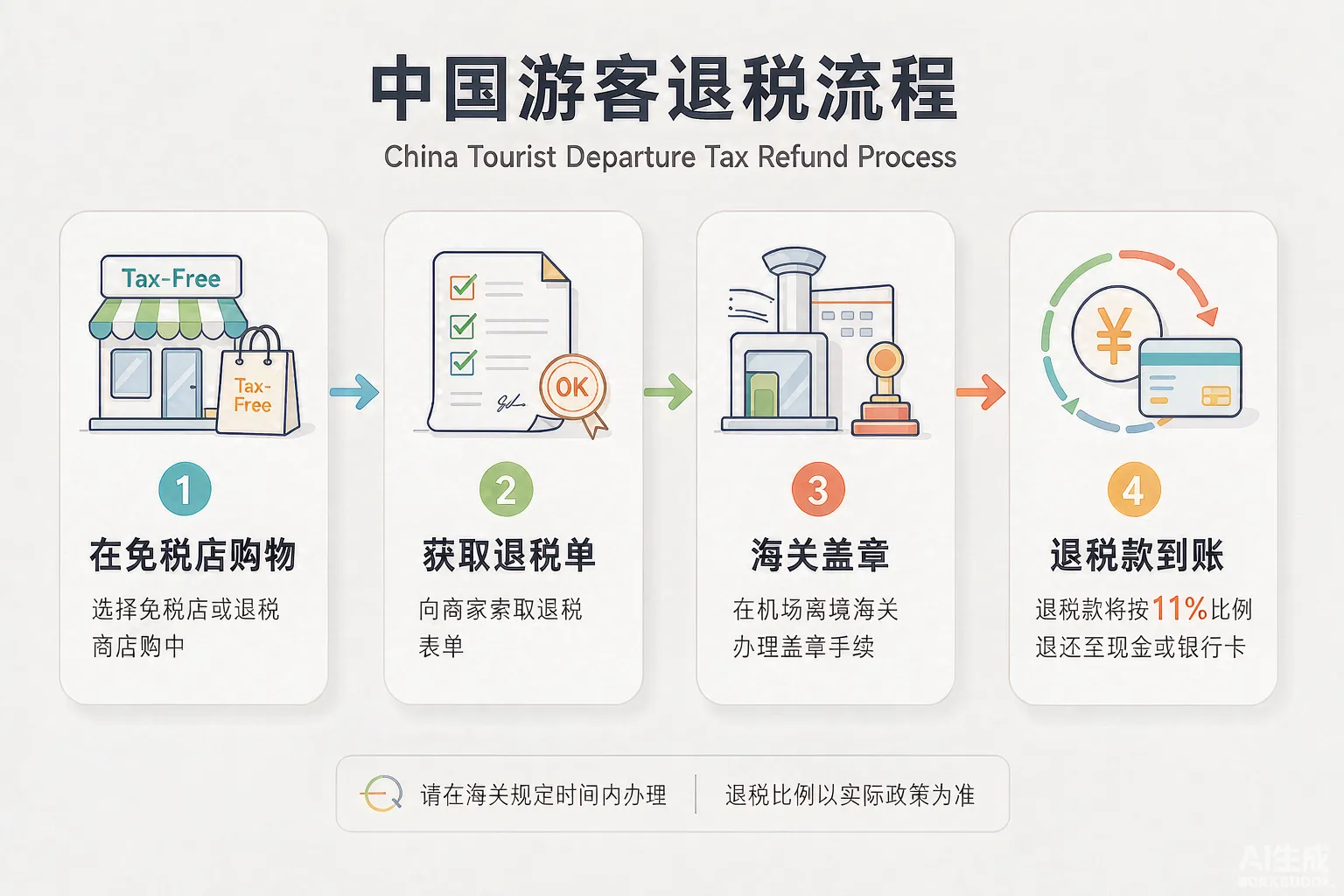
Shop at a tax-free store
Look for the 退税 (tax refund) sign or ask the staff. Spend at least ¥200 in a single day at a single store to qualify for the refund.
Get the refund form
At a participating store ask for the tax-refund form (境外旅客购物离境退税申请单) with your passport. Keep it with the receipt and the unused goods.
Customs check on departure
At the airport show the goods, receipt and form to customs for a stamp, within 90 days of purchase and before you fly home.
Collect the refund
Use the instant-refund counter at the store, or claim at the port refund point in cash, to a UnionPay or international card, or via mobile payment.
By May 2026 China had about 14,000 tax-refund stores, roughly four times the end-2024 count, covering malls, pedestrian streets, scenic areas and airports. Five cities — Shanghai, Beijing, Guangzhou, Tianjin and Chongqing — accounted for about two-thirds of 2025 refund sales. UnionPay's refund system can pay the money back to UnionPay, Visa, Mastercard, JCB or Diners cards as well as mobile wallets.
Rules to remember: you must be in China fewer than 183 days, the goods must be unused, you must depart within 90 days of purchase, and you must carry the items out yourself. Only purchases from registered tax-refund stores count, so always confirm the 退税 sign before paying.
What is worth buying during Double 11 as a visitor?
The best Double 11 buys for visitors are Chinese-made goods that are cheaper at source than abroad: consumer drones and electronics such as DJI, smartphones and wearables, plus tea, silk and cashmere, and guochao (national-trend) fashion and cosmetics. These also sit on the tax-refund list. Compare the festival price against what you would pay at home before filling the suitcase — not every discount is a bargain once shipping and refund logistics are counted.
- Electronics and drones: DJI and Chinese phone brands are often cheapest here, and refund-eligible.
- Tea, silk and cashmere: classic gifts with strong quality-to-price value.
- Guochao fashion and cosmetics: national-trend brands discount hard during the festival.
- Household and kitchen gadgets: good for shippable, non-warranty-sensitive buys.
Be realistic about Western luxury brands: many do not discount deeply during Double 11, and grey-market parallel imports may lack an international warranty. The strongest visitor savings are on genuinely Chinese products, which combine the festival cut with the departure refund.
How to avoid Double 11 traps
Double 11 is famous for fake discounts and confusing coupons, and the traps hit visitors harder because the interfaces are in Chinese. Common ones are presale deposits that lock you in, full-reduction coupons (满减) that only pay off above a high threshold, and inflated 'original prices' that make a small cut look huge. Stick to official brand flagship stores, screenshot prices weeks ahead, and ignore anything that needs a Chinese bank account you do not have.
- Presale deposits: you pay first and commit, often non-refundable if you change your mind.
- Fake originals: the 'before' price is sometimes lifted just to show a bigger drop.
- Coupon mazes: a ¥50 saving may require spending ¥1,000 first.
- Grey imports: cheap electronics without a valid warranty or local support.
If a deal looks too good on a non-flagship store, it often is. Buy from the brand's official flagship store on Tmall or JD, keep screenshots of the price, and never share your Alipay or WeChat Pay login to 'help' with an order.
Practical tips: pay, ship and keep receipts
Before you fly, install Alipay and WeChat Pay, complete the passport verification, and link an international card so checkout works on arrival. Ask every shop whether it is a tax-refund store and keep the refund form and receipt together. If you overbuy, use a consolidated shipping forwarder or your airline's extra-baggage option, and remember the ¥20,000 cash-refund ceiling if you plan a large purchase.
Set up payment before departure
Install Alipay and WeChat Pay, verify your passport and link a foreign card; test a small payment at home.
Confirm tax-refund status in every shop
Ask for the refund form at the register and keep goods, receipt and form in one place.
Plan shipping and refunds
Use a parcel forwarder for overflow, watch the ¥20,000 cash-refund limit, and allow extra airport time for the customs stamp.
Frequently asked questions
When is Double 11 in China in 2026?
Double 11 2026 falls on Wednesday 11 November 2026. The sales are not a single day: presales usually open in mid-October and the deepest discounts land in the final week toward 11 November. Visitors should plan shopping for early-to-mid November to catch the best prices rather than the first announcements.
Can foreigners shop on Taobao and Tmall?
Yes. The working method is to set up Alipay's tourist mode or WeChat Pay with a linked international card (Visa, Mastercard or JCB) before you travel, then pay through that app at Taobao, Tmall and most Chinese store checkouts. A plain foreign credit card does not work directly on most platforms, so the wallet app is essential.
How much tax refund can tourists get in China?
China's departure tax refund gives 11% back on 13%-VAT goods and 8% on 9%-VAT goods, with the minimum purchase lowered to ¥200 per same-day, same-store receipt in 2025 and the cash limit raised to ¥20,000. You must buy from a registered tax-refund store, keep the form, and get a customs stamp within 90 days of purchase.
What is instant refund (即买即退) in China?
Instant refund lets foreign visitors collect the tax refund in cash at the store at the moment of purchase, instead of waiting for the airport. China rolled the service out nationwide in 2025, and by May 2026 there were about 14,000 tax-refund stores, with Shanghai, Beijing and Guangzhou among the easiest cities to use it.
What should I buy on Double 11 in China?
The best visitor buys are Chinese-made goods that are cheaper at source: consumer drones and electronics such as DJI, smartphones and wearables, plus tea, silk, cashmere and national-trend fashion and cosmetics. These are also refund-eligible. Compare against home prices, because not every discount beats shipping and refund logistics.
How do I claim the tax refund at the airport?
Show your unused goods, receipt and refund form to customs at departure for a stamp, then collect the refund at the port counter in cash, to a UnionPay or international card, or via mobile payment. You must depart within 90 days of purchase, carry the items out yourself, and have spent at least ¥200 at one tax-refund store that day.