China Winter Flight Season 2026: New Routes for Snow and Sun
China's 2026/2027 winter flight season runs from 25 October 2026 to 27 March 2027 and adds 288 new domestic routes plus major capacity to both snow and sun destinations. This guide explains the schedule, the specific cities seeing more flights, the inbound routes that now reach China more easily, and when to book for the lowest winter fares.

What is China's 2026 winter flight season and why should travellers care?
China's winter flight season is the twice-yearly schedule that airlines fly from 25 October 2026 to 27 March 2027, and it directly shapes where you can fly, how often, and what you pay. The 2026/2027 schedule adds 288 new domestic routes and boosts both snow-sport and warm-weather destinations, so winter trips planned now get more non-stop options and, on many routes, lower fares than the summer schedule offered.
For a first-time visitor this matters more than it sounds. China is continental in scale: a single winter trip might pair Harbin's ice festival with a Sanya beach escape, and the route network decides whether that means one connection or three. The new schedule is the first concrete signal of where capacity — and therefore cheaper seats — will sit this winter.
Treat the season start (25 October) as your booking trigger, not a deadline. Carriers discount to fill new capacity right after the switch, and the worst-price window is the February 2027 Spring Festival surge, not the opening month.
When does the 2026/2027 winter-spring flight season run?
The 2026/2027 winter-spring flight season runs from 25 October 2026 to 27 March 2027, a 154-day window that replaces the summer schedule and aligns with winter time changes in many countries. Airlines publish the schedule in advance, so flights booked from late October through the whole winter — including China's Spring Festival peak in February 2027 — fall inside this season, not the old one.
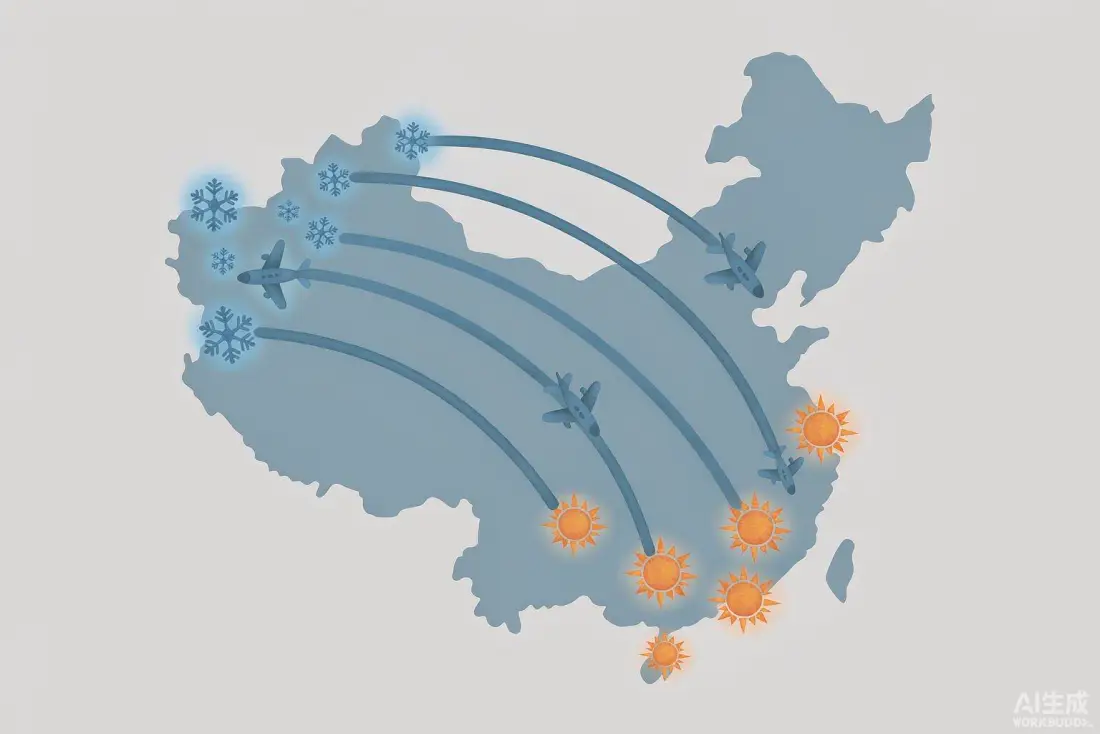
China switches its flight schedule twice a year, in late October and late March, the same rhythm as Europe and North America. The winter plan is explicitly built around two travel pulls: 'go north for snow' and 'go south for sun', plus the holiday surge around Spring Festival. Knowing the dates lets you time bookings to the cheaper opening weeks.
How many flights and new routes does the season actually add?
The new season puts 216 airlines into the air with about 116,000 weekly flights, including 91,454 domestic passenger flights and 16,654 international passenger flights per week across 84 countries. Within that, 34 Chinese carriers open 288 brand-new domestic routes, and international passenger service now reaches 84 countries on 191 carriers — a concrete expansion travellers can plan trips around.
| Metric | 2026/2027 winter season |
|---|---|
| Schedule period | 25 Oct 2026 – 27 Mar 2027 (154 days) |
| Airlines operating | 216 (domestic + international) |
| Weekly flights | about 116,000 (11.6万班) |
| Domestic passenger flights / week | 91,454 |
| New domestic routes added | 288 (by 34 carriers) |
| International passenger flights / week | 16,654 across 84 countries |
| Inbound tourism routes growth | 16 routes up 45.9% year on year |
The headline '116,000 weekly flights' means roughly 16,500 flights a day across the country. For a visitor, the useful part is the 288 new domestic routes and the specific snow and sun cities called out below — that is where new non-stop options appear.
New snow routes: fly straight to winter sports and ice festivals
The winter schedule deliberately adds capacity to snow destinations. Carriers such as China Eastern open 21 new routes focused on Northeast China's Heilongjiang and Xinjiang's Altay, the two main ski and ice-festival hubs, while Beijing Daxing adds Hulunbuir and boosts Chengdu Shuangliu, Xi'an and Shanghai Hongqiao. Booking data shows Shenyang and Dalian up about 20% year on year, with Yanji and Altay among the hottest searches.
| Destination | Region | Why visit in winter | Booking signal |
|---|---|---|---|
| Harbin / Heilongjiang | Northeast | Ice and Snow Festival, skiing | New-route focus (China Eastern +21) |
| Altay (Xinjiang) | Northwest | Premier backcountry skiing | Among hottest searches; capacity added |
| Yanji | Jilin | Korean-food trips, snow scenery | Hot ticket search |
| Shenyang / Dalian | Liaoning | City ice events, coastal snow | Bookings ~+20% YoY |
| Hulunbuir | Inner Mongolia | Frozen grassland, dog sledding | New route at Beijing Daxing |
New sun routes: warm escapes across southern China
The south gets the same boost. Kunming, Sanya and Haikou all sit in the top ten domestic destinations for the new season's first month, and carriers add capacity to Guangdong, Hainan and Yunnan. Booking data shows tickets to Huizhou and Jieyang up about 30% year on year, Guangzhou, Zhuhai and Dali up about 20%, and Xiamen and Xishuangbanna up over 10%.
| Destination | Region | Why visit in winter | Booking signal |
|---|---|---|---|
| Sanya | Hainan | Beaches, ~26–28°C warmth | Top-10 destination, new routes |
| Haikou | Hainan | Warm, fewer crowds than Sanya | Top-10 destination |
| Kunming | Yunnan | Spring-like 15–20°C all winter | Top-10 destination |
| Dali / Xishuangbanna | Yunnan | Mild, low-season calm | Tickets +20% / +10% YoY |
| Huizhou / Jieyang | Guangdong | Coastal escapes near Guangzhou | Tickets ~+30% YoY |
Warm-weather China is not only Hainan. Kunming and Xishuangbanna in Yunnan stay mild all winter with far fewer tourists than Sanya, and they sit inside regions open to the 240-hour transit waiver — useful if you are entering China without a visa.
Inbound routes to China jump 45.9%
International visitors benefit too: 16 inbound tourism routes grew 45.9% year on year under the new schedule, including Moscow–Haikou, Ulaanbaatar–Beijing and Busan–Zhangjiajie. Combined with China's expanded visa-free entry for 50 countries through 31 December 2026, more direct flights make a winter trip easier to arrange for travellers who previously needed two connections to reach smaller cities like Zhangjiajie.
The standout for independent travellers is Busan–Zhangjiajie: it links a major Korean gateway straight to the Avatar-mountains destination that was hard to reach on a single ticket before. Moscow–Haikou opens a direct warm-weather option for Russian visitors, who were already among the fastest-growing inbound groups during the 2026 National Day holiday.
If you are flying in from Europe or North America, the wider international lift matters more than any single route: flights to Kazakhstan, India, Canada and Belgium each rise over 40% versus last winter, widening connection choices through those hubs.
First China–Iceland flight and other international openings
Air China launches the first ever direct flight between China and Iceland this season, part of a wider international push that also adds capacity to Kazakhstan, India, Canada and Belgium, where flight volumes rise over 40% versus the previous winter. New Beijing Daxing links include Bangkok and two Caucasus routes via Urumqi to Tbilisi and Yerevan, widening Europe–Asia transfer options.
Beijing is the clear hub to watch. Beijing Capital Airport runs about 1,300 flights a day in the new season, while Beijing Daxing serves 129 domestic points and 44 international or regional points, adding Baise, Aksu, Bijie and Hotan domestically and Bangkok plus the two Caucasus corridors internationally. For most visitors, a Beijing or Guangzhou entry point gives the most onward choices.
When to book and what it costs
Book in the opening window: the season's first month, 25 October to 30 November 2026, already shows about 12.62 million domestic tickets booked, up 3% year on year, and about 3.2 million outbound tickets, up 10%. Fares dip on many routes at the season switch as carriers discount to fill new capacity, so locking flights in November often beats waiting until the February Spring Festival surge.
Book in the opening window (late Oct–Nov)
Carriers discount to fill new winter capacity right after 25 October; fares on many snow and sun routes are lowest here and climb into the February Spring Festival peak.
Compare the new non-stop against one-stop
The 288 added domestic routes mean cities that needed a connection last winter may now have a direct flight — check both the legacy hub route and the new arc.
Watch the Spring Festival dates
The 2027 Spring Festival surge is the most expensive week of the season; if your trip must land then, book the moment the 60-day window opens.
Pair flights with high-speed rail
For legs under about four hours, China's high-speed rail is often cheaper and runs city-centre to city-centre; compare before paying for a short domestic flight.
How foreigners book flights inside China
Foreign travellers book Chinese domestic flights through the carriers' own apps, Trip.com, or at airport counters, using Alipay or WeChat Pay for foreign cards or an international card on major platforms. For city pairs under about four hours, China's high-speed rail is often cheaper and central-city to central-city; compare both before booking, because the new schedule's 'bus-ified' trunk routes compete directly with trains.
- Book on carrier apps, Trip.com, or at the airport counter; link Alipay or WeChat Pay to a foreign card before you depart.
- For sub-four-hour hops, check 12306 high-speed rail — it is often cheaper and avoids airport transfers.
- New routes may show as 'no direct flight' on older apps; re-search after 25 October when the schedule loads.
- Keep your passport details exact: the name on the ticket must match the machine-readable zone or you will be denied boarding.
A name mismatch between your ticket and passport is the most common cause of denied boarding in China. Enter the passport exactly as printed, and double-check the pinyin spelling on carrier apps that auto-fill.
Snow or sun: choosing your winter China route
Pick snow if you want Harbin's Ice Festival, Altay skiing or Yanji food trips, and fly via Beijing or direct new routes; pick sun for Sanya beaches, Kunming spring weather or Xishuangbanna warmth, reached through Guangzhou or Chengdu hubs. Both sit inside regions open to the 240-hour transit waiver, so transit-visa-free travellers can build a winter China stopover around either theme.
The two themes are not mutually exclusive. A common first-timer winter route flies into Beijing for the Wall and a Harbin side trip, then hops south to Sanya or Kunming to end in warmth before flying home — and the 2026/2027 schedule adds capacity on exactly those north–south arcs. Pair the flights with high-speed rail for the middle legs to keep the trip flexible.
Frequently asked questions
When does China's 2026 winter flight season start and end?
The 2026/2027 winter-spring flight season runs from 25 October 2026 to 27 March 2027, a 154-day window that replaces the summer schedule. All winter travel, including the February 2027 Spring Festival peak, falls inside this season. China switches its flight plan twice a year, in late October and late March, matching the rhythm used in Europe and North America.
Which new flight routes help winter travellers in China?
The season adds 288 new domestic routes and boosts snow and sun destinations. China Eastern opens 21 routes to Heilongjiang and Xinjiang's Altay for skiing and ice festivals, while capacity rises to Sanya, Haikou, Kunming, Dali and Xishuangbanna for warm weather. Sixteen inbound routes to China, including Busan–Zhangjiajie, grow 45.9% year on year.
Are flights cheaper during China's winter season?
Often, yes, in the opening weeks. Carriers discount to fill new winter capacity right after the 25 October switch, and the season's first month shows about 12.62 million domestic tickets booked, up 3% year on year. The clear exception is the February 2027 Spring Festival surge, the most expensive week, when fares climb sharply across all routes.
Can foreign tourists use the new inbound routes to reach China?
Yes. Sixteen inbound tourism routes grew 45.9% year on year, including Moscow–Haikou, Ulaanbaatar–Beijing and Busan–Zhangjiajie, and Air China launches the first direct China–Iceland flight this season. These sit alongside China's expanded visa-free entry for 50 countries through 31 December 2026, making winter arrivals easier for many passport holders.
Do I need a visa to visit China in winter 2026?
It depends on your passport. Ordinary passport holders from 50 countries, including the UK, Canada, Australia, Japan and South Korea, can enter visa-free for up to 30 days through 31 December 2026, and 57 nationalities can use the 240-hour transit waiver. US citizens need a tourist (L) visa. Always verify your passport on the National Immigration Administration list before booking.
Should I fly or take the train between Chinese cities in winter?
For legs under about four hours, China's high-speed rail is usually cheaper and runs city-centre to city-centre, avoiding airport transfers and winter weather delays. For longer hauls or remote snow destinations like Altay, flying the new direct routes saves time. Compare both on 12306 for rail and carrier apps for flights before you commit.